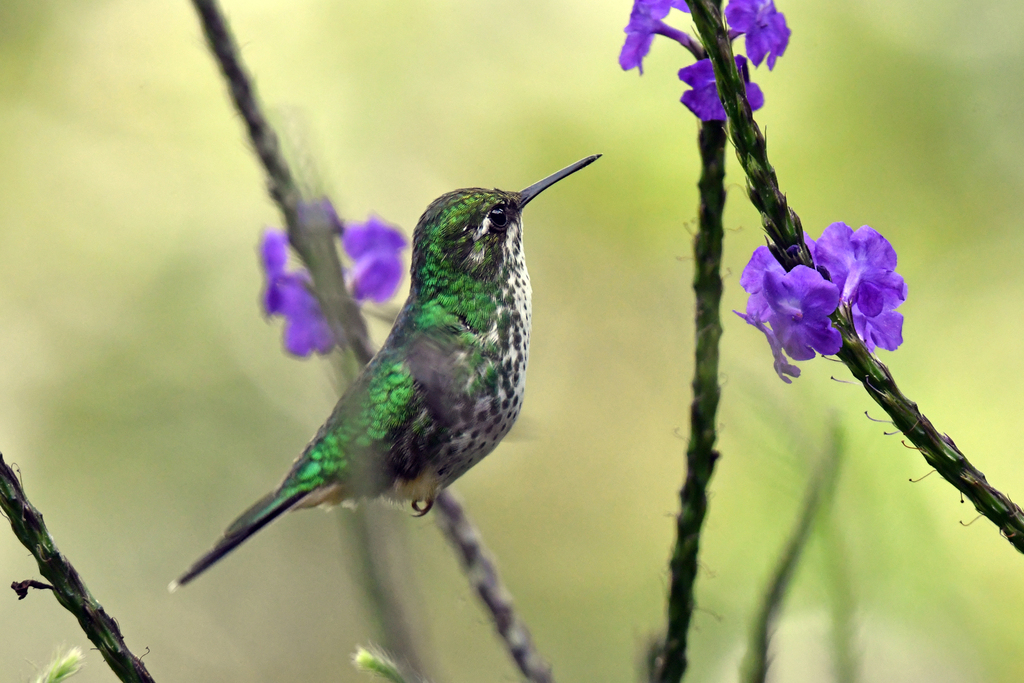
White-booted Racket-tail
Photo © Tom Kennedy
Photo © Tom Kennedy — CC BY 4.0 — Source: iNaturalist photo #350902676Identification
The white-booted racket-tail is a striking member of the "brilliants" group of hummingbirds, immediately recognizable by the distinctive elongated tail feathers unique to males. These outer rectrices feature bare shafts with long terminal oval flags that are straight and do not cross, with flags that slightly overlap. Both sexes display greenish upperparts without a glittering forehead, and both possess distinctive white leg puffs. Males are noticeably larger at 11 to 15 cm long (including 7 to 8 cm tail feathers) and weigh 2.5 to 2.7 grams, while females are more modest at 7.6 to 9 cm and 2.6 to 3.2 grams. Males sport a greenish-gray throat and solid green belly, whereas females feature green spotting patterns on their white throat and belly that vary by subspecies—from heavily spotted to virtually unspotted.
Range & Habitat
This species is found exclusively in three Andean countries: Colombia, Ecuador, and Venezuela, with five recognized subspecies distributed across their mountainous regions. The white-booted racket-tail inhabits temperate and subtropical Andean forest, showing a preference for humid to wet forest edges while also occurring in forest interiors and secondary growth. Elevation is key to finding this bird: it is most numerous between 1,600 and 2,200 meters but ranges from as low as 600 meters to as high as 4,000 meters. The subspecies occupy distinct geographic ranges, from the Venezuelan Coastal Range in the north to Colombia's Pacific slope in the south.
Behaviour & Diet
White-booted racket-tails are highly specialized nectarivores that typically forage between 6 and 18 meters above the ground, visiting a variety of flowering plants including Palicourea, Clusia, Inga, and Cavendishia. They are notably social, with several birds often feeding in close proximity to one another. Beyond nectar, they supplement their diet by hawking small insects from perches. Both sexes produce diagnostic vocalizations: a descending, thin sweet trill rendered as "ti-tlee-ee-ee" along with single "tsit" and "trrt" notes. Breeding occurs at least between January and April in Colombia, with females constructing tiny cup nests of plant fiber and lichen on horizontal twigs 6 to 8 meters high. After a 16 to 17-day incubation period, chicks fledge 19 to 22 days after hatching. The species makes seasonal elevational movements following breeding.
Best Time & Places to See It
The white-booted racket-tail is a very common species throughout its range, making it an excellent target for visiting birdwatchers. It occurs in several protected areas, and the best viewing locations will be humid mountain forests between 1,600 and 2,200 meters elevation in the Andes of Colombia, Ecuador, and Venezuela. While breeding activity peaks between January and April in Colombia, the species may breed year-round, offering opportunities across seasons. Its preference for forest edges and secondary growth means it can be found in slightly more open habitat than many forest birds, increasing viewing chances.
Photography Tips
The dramatic tail of males makes them particularly photogenic, though patience and a high shutter speed will be essential to capture the male's distinctive racket-tail in sharp detail. Look for birds foraging between 6 and 18 meters up in flowering trees and shrubs—Palicourea and other mid-story plants are excellent focal points. The white leg puffs provide a useful identifying feature and can add visual interest to photographs. Since birds often feed close together, you may have opportunities to capture multiple individuals in a single frame. Early morning light in the cloud forest habitat will show off the subtle green iridescence of both sexes. The bird's preference for forest edges and secondary growth means it is more accessible than strictly interior-forest species.
Natural Munchique National Park
El Tambo, Colombia
+194 birds
Where the Western Cordillera rises steeply from the Pacific plains of southwestern Colombia, Natural Munchique National Park sprawls across 1,078 square kilometers of montane forest that…
VIEW NATIONAL PARKNatural Serranía de los Yariguíes National Park
El Carmen de Chucurí, Colombia
+320 birds+3 mammals
Where the northern cordilleras of Colombia rise toward cloud forest, the Serranía de los Yariguíes unfolds across nearly 1,820 square kilometers of some of the most…
VIEW NATIONAL PARKNatural Farallones de Cali National Park
Buenaventura, Colombia
+733 birds+27 mammals
Where the Pacific coastal plain meets the western slopes of the Andes, Farallones de Cali National Park sprawls across nearly 3,500 square kilometers of dramatic topography…
VIEW NATIONAL PARKNatural Chingaza National Park
Junín, Colombia
+285 birds+6 mammals
Where the Andes rise above three thousand metres in the Cundinamarca region, high-altitude grasslands and cloud forests converge in a landscape shaped by both geology and…
VIEW NATIONAL PARKPuracé National Natural Park
Puracé, Colombia
+327 birds+2 mammals
Where the Andes thrust upward across southwestern Colombia, Puracé National Natural Park spans nearly 2,631 square kilometers of some of South America's most dramatic montane terrain.…
VIEW NATIONAL PARKGuácharos Cave National Natural Park
Acevedo, Colombia
+359 birds
High in the Andean foothills of southern Huila, where mist-laden slopes rise above 1,600 metres, lies a landscape carved by underground rivers and crowned by karst…
VIEW NATIONAL PARKNatural Sumapaz National Park
Cubarral, Colombia
+368 birds+1 mammals
Where the Andes descend toward the Amazon basin, the high páramo grasslands of Sumapaz National Park sprawl across more than five thousand square kilometers of Meta…
VIEW NATIONAL PARKEl Tamá National Park
Toledo, Colombia
+435 birds
Where the Andes descend toward the Caribbean coastal lowlands of northern Colombia, El Tamá National Park sprawls across nearly 3,800 square kilometres of montane forest, cloud…
VIEW NATIONAL PARKNo community photos yet. Log in to add the first one.
No community observations of this species yet.