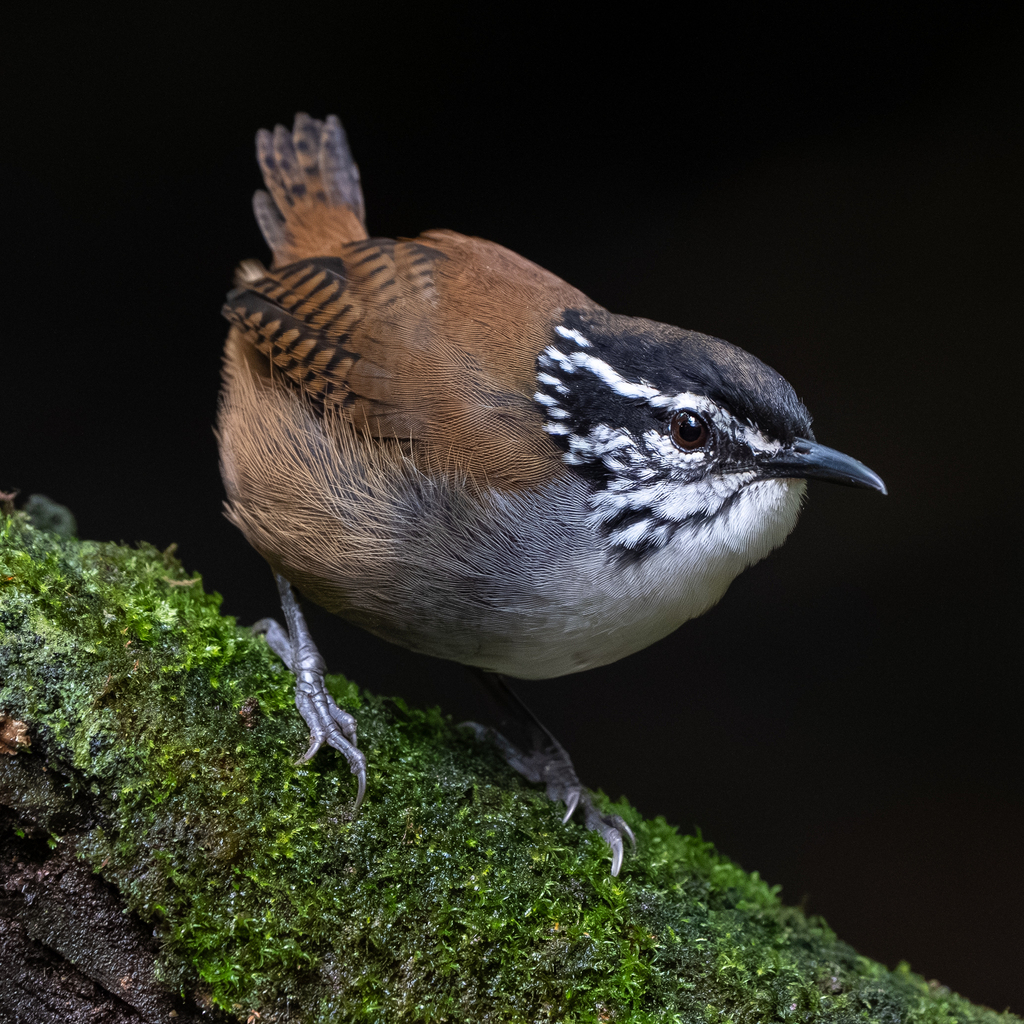
White-breasted Wood Wren
Photo © Anthony Batista
Photo © Anthony Batista — CC BY 4.0 — Source: iNaturalist #317457029Identification
The white-breasted wood wren is a diminutive songbird, measuring just 10 centimetres in length and weighing a mere 16 grams. Despite its small size, it is readily identifiable by its distinctive plumage: chestnut-brown upperparts contrasting with a darker crown, pale supercilia (eyebrows), and striking black-and-white streaking on the sides of the head and neck. The underparts are predominantly white, becoming buff on the lower belly, while the short wings and very short tail are prominently barred with black. Juvenile birds appear duller overall, with greyer underparts than adults.
Range & Habitat
This resident breeding species inhabits a wide range from central Mexico through Central America and into northwestern South America, extending to northeastern Peru and Suriname. It favours tropical wet forests in lowlands and foothills, typically found at elevations up to 1,850 metres, including adjacent areas of tall second-growth forest. The species constructs its characteristic neat, roofed nest on the ground or occasionally very low in undergrowth, always well concealed by dense vegetation. Remarkably, pairs also build communal "dormitory nests" higher in vegetation—up to 3 metres above ground—likely used for roosting by individuals or family groups outside the breeding season.
Behaviour & Diet
White-breasted wood wrens are highly vocal birds, producing a sharp "cheek" or explosive "tuck" call. Their song is a distinctive series of notes—"cheer oweet oweet cheery weather"—which the renowned bioacoustics expert Luis Baptista compared to the opening bars of Beethoven's Fifth Symphony. True to their wren family heritage, pairs frequently engage in duet singing together. These active foragers typically work in pairs or family groups, gleaning insects and other invertebrates from low vegetation and the forest floor. Breeding females incubate eggs for approximately two weeks, with young fledging after a similar period.
Best Time & Places to See It
To encounter this charming wren, focus your search in tropical wet forests from Mexico southward through Central America and into Amazonian Peru and Suriname. Listen carefully for their distinctive calls and duetting songs, which often betray their presence before you glimpse these cryptic birds. Patient observation of low undergrowth and ground-level vegetation during daylight hours offers the best chances of sighting. Early morning, when birds are most vocal, is an ideal time for locating them.
Photography Tips
The white-breasted wood wren's diminutive size and preference for dense, low vegetation present genuine challenges for photographers. Use a telephoto lens to maintain distance and avoid flushing birds from their preferred foraging zones. Focus on capturing the distinctive head and neck markings, which are key identifying features. The bird's habit of foraging in pairs or family groups offers opportunities for compelling multi-subject compositions. Overcast days in dense forest will challenge your camera's metering, so be prepared to adjust exposure to render the white underparts accurately while preserving detail in the darker crown and back.
Amacayacu National Park
Antisana National Park
Arenal Volcano National Park
Barbilla National Park
Barra del Colorado National Wildlife Refuge
Baru Volcano National Park
Braulio Carrillo National Park
Cahuita National Park
Caño Negro National Wildlife Refuge
Nothing matches these filters.
No community photos yet. Log in to add the first one.
No community observations of this species yet.