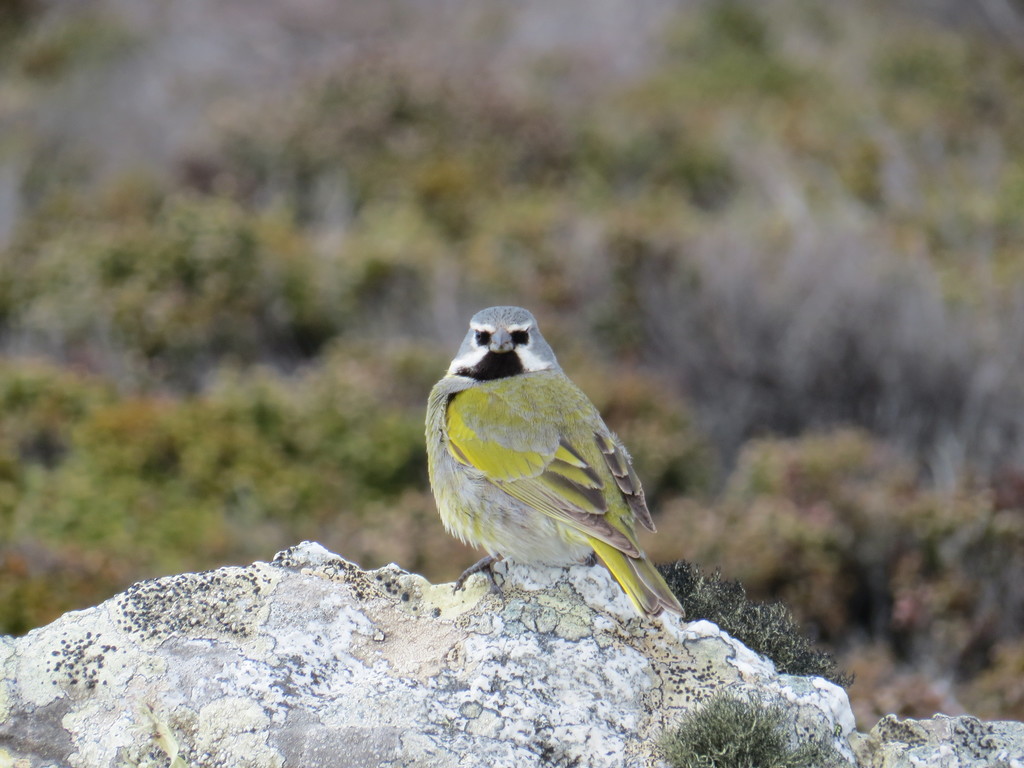
White-bridled Finch
Photo © Norma Malinowski
Photo © Norma Malinowski — CC BY 4.0 — Source: iNaturalist photo #55246494Identification
The white-bridled finch is a small passerine measuring 14–15 cm in length, easily identified by its distinctive facial markings. Males are striking birds with a grey-green back and bright yellow underparts, featuring a grey head and upper breast. The species' namesake white bridles border a bold black throat and mask, creating a dramatic face pattern. Large yellow patches adorn the wings and tail, making the male unmistakable in flight. Females are subtler in appearance, displaying brown plumage with dark streaks throughout, though they retain the yellow outer tail feathers and yellow fringes on wing feathers characteristic of the species. Birds from the South American mainland are noticeably smaller than their Falkland Island counterparts, with smaller bills and proportionally more yellow in the wings and tail.
Range & Habitat
The white-bridled finch is endemic to the southernmost regions of South America, with two distinct subspecies. Melanodera melanodera inhabits the Falkland Islands where it is common throughout the archipelago, typically occurring up to about 150 metres above sea level with highest concentrations in coastal areas. The mainland subspecies, M. m. princetoniana, is thinly distributed across Magallanes Region in Chile and Santa Cruz Province in Argentina, ranging from approximately 47°S southward to northern Tierra del Fuego, with elevations reaching up to 580 metres. The species favours flat terrain including grassland, heathland, farmland, and dunes. While the Falkland population remains stable at approximately 7,000–14,000 pairs and is not considered threatened, mainland populations are believed to be declining due to the impacts of overgrazing.
Behaviour & Diet
White-bridled finches are ground foragers with a diet consisting predominantly of grass seeds. They are vocal birds, producing a short, high-pitched call and singing a distinctive song composed of repeated series of two or three whistles. Males typically sing from low perches such as rocks or grass tussocks, making them relatively easy to locate by ear. During breeding season, pairs construct grass nests lined with hair or feathers, positioning them low in grass clumps or between stones. Clutches typically consist of three or four eggs, which are blue-grey or grey-green in colour with purple-brown markings concentrated towards the larger end.
Best Time & Places to See It
The Falkland Islands offer the most reliable opportunity to observe white-bridled finches, where they are common throughout the archipelago in suitable grassland habitat. Coastal areas and low-lying grasslands are particularly productive. On the South American mainland, the species is more elusive and thinly distributed across the windswept steppes of southern Chile and Argentina, making sightings less predictable. The singing season, when males are most vocal and visible on exposed perches, provides the best opportunity for detection in both locations.
Photography Tips
Photographing males is rewarding due to their bold coloration and contrasting facial pattern—focus on capturing the distinctive white-bridled face markings and yellow wing patches. Their habit of singing from low perches like rocks and grass tussocks provides excellent opportunities for approach and composition. Early morning activity tends to be most productive. In the Falklands, the common nature of the species allows for patient stalking; on the mainland, locating birds by their distinctive whistled song and then positioning yourself carefully will increase success rates. The open grassland habitats they favour offer minimal cover, requiring a slow, deliberate approach.
Sea Lion Island
Sealion Island Settlement, Falkland Islands
+74 birds+3 mammals
Windswept tussock grasslands roll across volcanic terrain where Southern Ocean swells crash against rocky shores, creating one of the Falkland Islands' most dramatic wildlife theatres. This…
VIEW ISLAND & ARCHIPELAGOKidney Island
Stanley, Falkland Islands
+47 birds
Wind-scoured tussock grassland sweeps across this remote South Atlantic outcrop, where peaty soils and exposed rock formations create a landscape as austere as it is vital.…
VIEW ISLAND & ARCHIPELAGOPort Stephens
Port Stephens, Falkland Islands
+29 birds
Windswept moorlands sweep down to pristine beaches where kelp forests fringe the turquoise shallows, their giant fronds swaying in the southern current. Port Stephens, cradled on…
VIEW NATURE RESERVEMurrell Farm
falskland islands, Falkland Islands
+54 birds
Rolling grasslands sweep across windswept plateaux where the South Atlantic exerts its relentless influence on the vegetation, sculpting tussock grassland into a tapestry of browns and…
VIEW NATURE RESERVECape Dolphin
falskland islands, Falkland Islands
+54 birds+1 mammals
Where windswept grasslands meet dramatic coastal cliffs, the Falkland Islands' northern reaches reveal one of the Southern Hemisphere's most compelling seabird sanctuaries. The terrain here is…
VIEW NATURE RESERVEVolunteer Point
Stanley, Falkland Islands
+70 birds+3 mammals
Windswept grasslands meet volcanic black sand beaches where three penguin species converge in the South Atlantic's most theatrical wildlife theatre. This remote peninsula on East Falkland…
VIEW NATURE RESERVEWest Point Island
West Point, Falkland Islands
+67 birds+3 mammals
Windswept cliffs plunge dramatically into the South Atlantic, their rust-coloured rock faces sculpted by millennia of gales and spray. This northwestern outpost of the Falkland Islands…
VIEW ISLAND & ARCHIPELAGONo community photos yet. Log in to add the first one.
No community observations of this species yet.