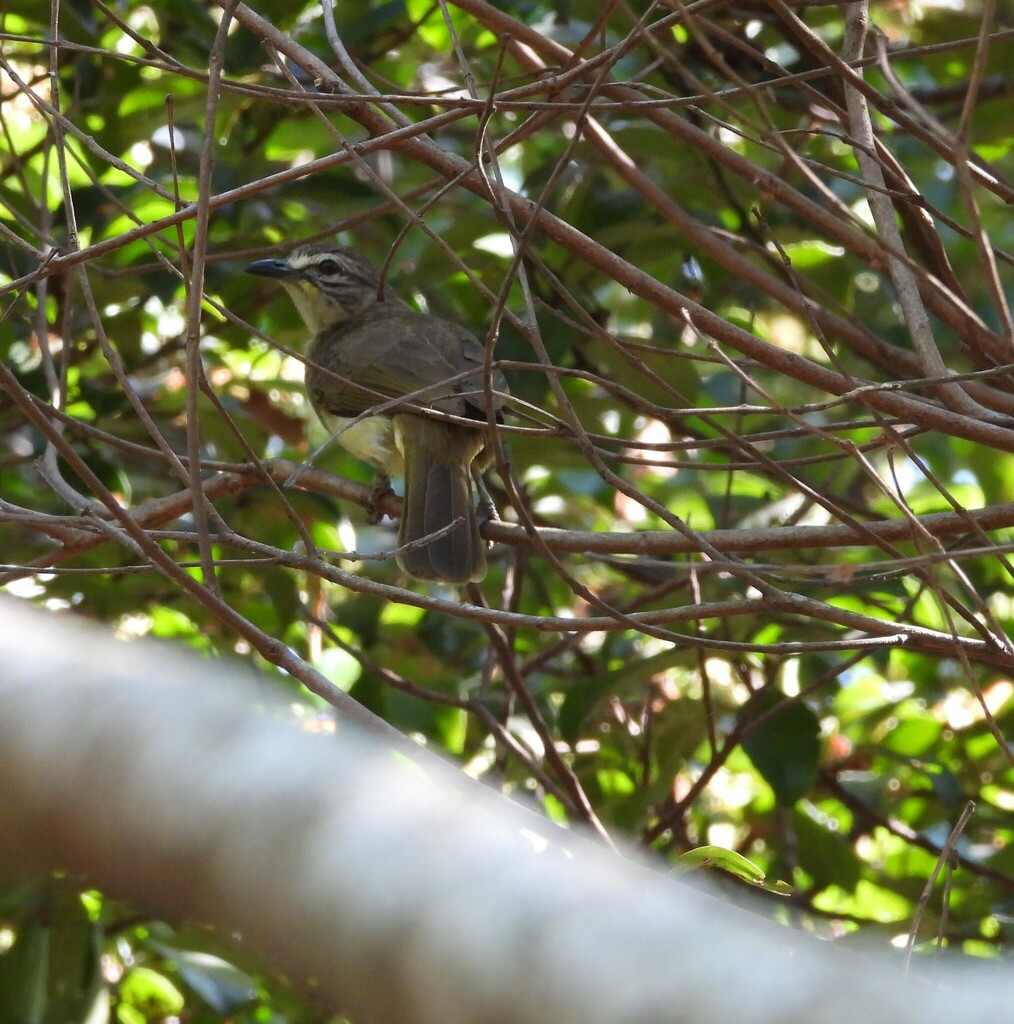
White-browed Bulbul
Photo © Mark Clarke
Photo © Mark Clarke — CC BY 4.0 — Source: iNaturalist #264077183Identification
The white-browed bulbul is a compact passerine measuring about 20 cm in length with a moderately long tail of 8 centimetres. Its most distinctive features are the crisp white supercilium (eyebrow) and white crescent below the eye, which contrast sharply with a dark eyestripe and moustachial stripe. The plumage is largely olive-grey above with whitish underparts, and a characteristic yellowish vent. Look for touches of yellow on the chin and moustache as well. The throat remains largely whitish, a key distinction from the similar-sounding yellow-throated bulbul, which inhabits rockier terrain. Males and females are identical in plumage, and both may display three or four fine hair-like filoplumes on the nape.
Range & Habitat
The white-browed bulbul is endemic to southern India and Sri Lanka, with two recognized subspecies: the nominate race found across central and southern India, and the slightly darker insulae subspecies restricted to Sri Lanka. The northern range boundary extends across Gujarat, Madhya Pradesh, and western West Bengal near Midnapur. This species favours dry open scrub country, primarily on plains, though it also frequents gardens and woodlands with dense shrubbery where it can remain well concealed.
Behaviour & Diet
White-browed bulbuls typically forage singly or in pairs, skulking within dense vegetation where they search for fruit, nectar, and insects. Although they can be difficult to spot, their presence is often betrayed by a distinctive loud, rich spluttering warble—a burst of song usually delivered from the top of a bush before the bird dives back into cover. They are consequently more often heard than seen. Breeding is an extended affair, spanning March through September with possible double brooding. Peak breeding activity occurs in February and again in September, while the dry season from May to July appears to be largely avoided for nesting in some regions. They construct loosely woven cup nests from twigs, cobwebs, and hair, placing them low within thick bushes, typically on the periphery. A clutch of two eggs is standard. Individuals can live for more than 11 years in the wild.
Best Time & Places to See It
Look for white-browed bulbuls in their preferred dry scrub habitats across peninsular India and Sri Lanka, particularly in areas with dense shrubbery and open scrubland. They are resident year-round, making them accessible to travellers at any season, though breeding season activity (March to September) may provide opportunities to locate birds through their distinctive vocalizations. March and February may offer particularly good viewing prospects.
Photography Tips
Patience is essential when photographing this species, as it spends much time concealed within dense vegetation. Position yourself near scrubby areas and listen for the distinctive loud, spluttering warble—this is your cue to watch the tops of bushes, where the bird often sings before retreating into cover. Early morning hours are typically productive. Use a telephoto lens to capture details of the white supercilium and facial markings from a distance, and be prepared for rapid movement as the bird dives into vegetation. The contrasting facial pattern and whitish underparts provide good subject definition even in dappled scrub habitat light.
Lunugamvehera National Park
Sri Lanka
+204 birds+14 mammals
Dry scrubland and shallow wetlands converge in Sri Lanka's southeastern lowlands, where Lunugamvehera National Park anchors one of the island's most ecologically vital landscapes. The park's…
VIEW NATIONAL PARKMinneriya National Park
Sri Lanka
+158 birds+9 mammals
Across the dry zone of Sri Lanka's North Central Province spreads a landscape of shallow tanks, grassland margins, and scattered dry forest—a mosaic of water and…
VIEW NATIONAL PARKWasgamuwa National Park
Sri Lanka
+156 birds+8 mammals
Dry deciduous forest and open grassland sweep across the North Central lowlands where Wasgamuwa National Park protects one of Sri Lanka's largest remaining tracts of this…
VIEW NATIONAL PARKMaduru Oya National Park
Sri Lanka
+74 birds+1 mammals
Granite ridges rise abruptly from the humid lowlands of Sri Lanka's Uva Province, their weathered slopes clothed in dry monsoon forest and scattered woodland where deciduous…
VIEW NATIONAL PARKEravikulam National Park
Devikulam, India
+192 birds+7 mammals
High in the Western Ghats of Kerala, where monsoon mists cling to slopes that rise above 2,000 metres, Eravikulam National Park preserves one of South India's…
VIEW NATIONAL PARKKanha Tiger Reserve
Kanha Kisli F.V., India
+321 birds+23 mammals
Where sal forests give way to emerald meadows and crystalline streams carve through ancient valleys, one of India's finest wilderness reserves unfolds across the Maikal Range.…
VIEW NATIONAL PARKTadoba National Park
Palasgaon Singru, India
+270 birds+20 mammals
Where sal forests meet open grasslands and rocky outcrops rise from red laterite soil, central India's landscape unfolds in raw, untamed beauty. Ancient teak woodlands and…
VIEW NATIONAL PARKBandhavgarh National Park
Garhpuri, India
+285 birds+17 mammals
Where granite ridges rise dramatically above sal and bamboo forests, one of India's most pristine tiger reserves unfolds across the Vindhyan plateau. Ancient rock formations tower…
VIEW NATIONAL PARKPeriyar National Park
Mlappara, India
+232 birds+4 mammals
Dawn breaks over mist-shrouded ridges where the Western Ghats tumble toward Kerala's spice-scented lowlands. Here, ancient tropical forests envelope a glittering artificial lake, creating a mosaic…
VIEW NATIONAL PARKPampadum Shola National Park
Vattavada, India
+258 birds+14 mammals
Where misty shola forests cling to the high plateaus of the Nilgiri Mountains, ancient evergreen remnants create a world apart. This 2,316-hectare reserve protects one of…
VIEW NATIONAL PARKNagarahole Tiger Reserve
Nalkeri Forest, India
+323 birds+23 mammals
Where granite escarpments rise above dense deciduous forests and the Kabini River carves through pristine wilderness, one of India's most biodiverse landscapes unfolds across the Western…
VIEW NATIONAL PARKNo community photos yet. Log in to add the first one.
No community observations of this species yet.