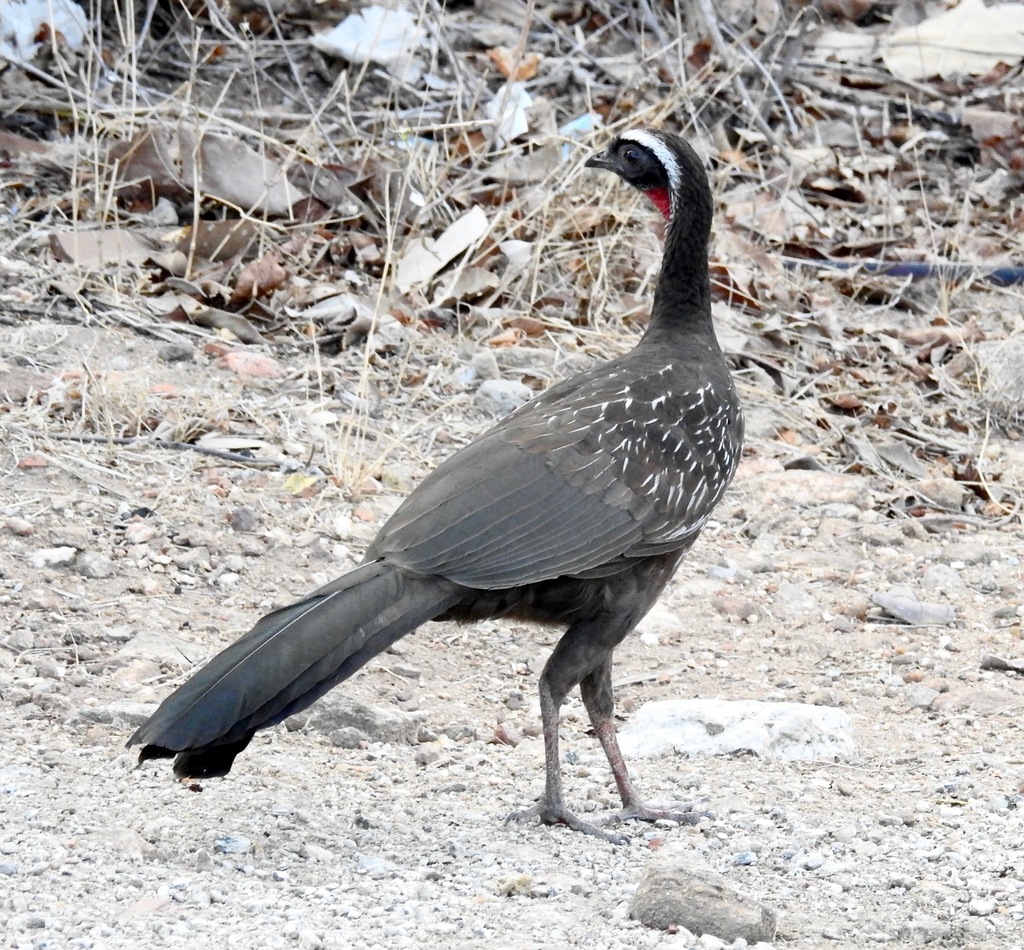
White-browed Guan
Photo © Laura Gaudette
Photo © Laura Gaudette — CC BY 4.0 — Source: iNaturalist #195238169Identification
The white-browed guan is a medium-sized bird measuring 65 to 70 cm in length, named for its most distinctive feature: a prominent white stripe running above each eye, sharply separated from the bare grayish skin around the eye by a black line. Adults display overall blackish-brown plumage enlivened by prominent white streaks on the upper wings, and like other members of the guan family, they possess a characteristic red dewlap on the throat. Juveniles lack the red dewlap entirely, instead showing yellowish facial skin, and their white wing streaks are noticeably fainter than those of adults, making them appear duller overall.
Range & Habitat
This species is endemic to northeastern Brazil, with its range roughly bounded by southern Maranhão, northeastern Minas Gerais, and the Atlantic coast. The white-browed guan inhabits several dry forest types, including open angical, caatinga scrubland, restinga coastal forests, and sometimes campo rupestre grassland. These adaptable birds range from sea level up to 1,000 metres in elevation and appear to tolerate some degree of habitat degradation, though they are not found continuously throughout their range and have been extirpated from some areas.
Behaviour & Diet
White-browed guans are typically ground feeders, often seen in small groups of up to seven birds moving together through their habitat. While their exact movement patterns have not been studied, they are presumed to be largely sedentary, undertaking only short-range travels to locate food and water. Their diet consists of fruits, seeds, and insects, though detailed dietary studies remain lacking. These birds visit water sources regularly to drink.
During breeding season, which appears to include at least part of the rainy season, pairs build stick nests lined with dry leaves in trees or palms, typically laying clutches of two or three eggs. White-browed guans communicate through various calls described as "honking" sounds, with a few being more raucous or grating. They also perform a wing-whirring display similar to that of other Penelope guans.
Best Time & Places to See It
The white-browed guan occurs in several protected areas within its northeastern Brazilian range, though finding them requires patience and knowledge of local hotspots. Early mornings are typically most productive for observation, when these ground-feeding birds are most active. The breeding season, which incorporates at least part of the rainy season, may offer the best opportunities to locate birds as they become more vocal and active around nesting sites.
Photography Tips
Photographing white-browed guans presents both challenges and rewards. Their ground-feeding habit and relatively small flock sizes mean they can be approachable, but their preference for dense scrub and dry forest habitats may limit visibility. Focus on capturing the distinctive white supercilium and black eye-line that give this species its name. The red dewlap of adults is a striking feature worth highlighting. Early morning light is ideal for revealing the plumage details, particularly the white streaking on the wings that contrasts with the blackish-brown body.
No community photos yet. Log in to add the first one.
No community observations of this species yet.