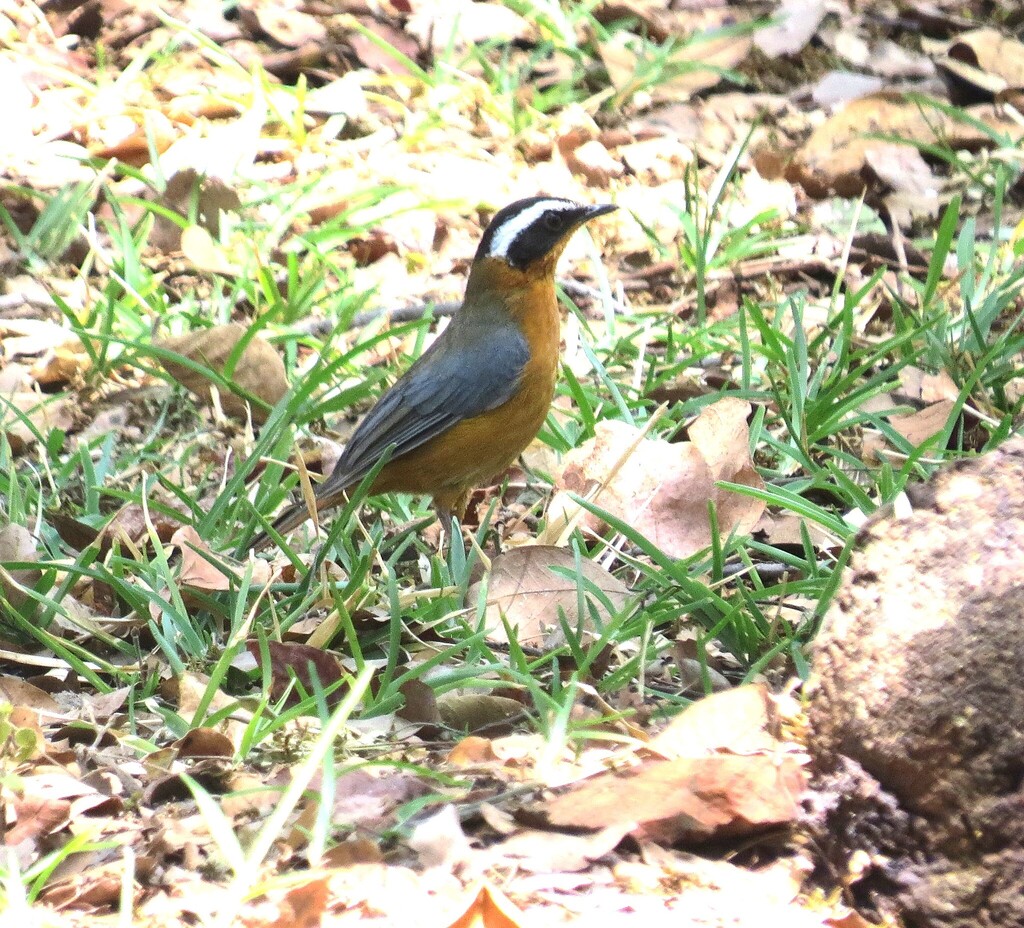
White-browed Robin-Chat
Photo © Gerry van Tonder
Photo © Gerry van Tonder — CC BY 4.0 — Source: iNaturalist #319531178Identification
The white-browed robin-chat is a compact bird measuring 19–20 cm in length and weighing 29–51 g. Its most distinctive feature is the striking white eyebrow stripe contrasting sharply against a black crown and face. The back is olive grey-brown, while the rump is rufous. The two central tail feathers are olive-brown, but the remaining tail feathers are a vibrant orange-rufous that catches the eye in flight. The underparts are bright orange-rufous, creating a warm overall impression. The flight feathers and wing coverts are grey-brown, with rufous underwing coverts visible in flight. The beak is black, and the legs range from pinkish-brown to dark brown. Females are slightly smaller than males, and juveniles show a brown head with rufous-brown markings on the back, pale throat, and pale orange-buff breast.
Range & Habitat
This species is found across east, central, and southern Africa, with three recognized subspecies distributed from Gabon and Sudan south to South Africa. The bird favours riverine forests, thickets, and woodland edges, and readily adapts to human-modified landscapes including gardens and cultivated areas. In East Africa, it occurs up to 2,200 m elevation, but south of the Limpopo River it typically remains below 1,000 m. The species has shown range expansion in parts of southern Africa, though this has been subject to local environmental changes.
Behaviour & Diet
The white-browed robin-chat is an active forager with a varied diet comprising ants, termites, beetles, other insects and arthropods, frogs, and fruits. The species is highly vocal, with contact calls that include repeated pit-porlee, chiiritter-porlii, and da-da-tee phrases. Its alarm call is a distinctive takata-kata-kata. The melodious song, typically delivered at dawn and dusk, begins quietly and builds to louder volume, featuring pip-pip-uree, don't-you-do-it, or tirrootirree phrases repeated many times. When singing intensely, the bird opens its beak wide, inflates its breast, and moves its tail with each note. Pairs often sing in duet. The species is monogamous and territorial, defending its territory vigorously with alarm calls and physical attacks on intruders.
Best Time & Places to See It
Breeding patterns vary across the species' range. Around the Equator, it breeds year-round; in East Africa, breeding occurs during the two wet seasons; in southern Africa, breeding has been recorded from July to May. The species typically produces two broods per year, sometimes three. Look for this robin-chat in riverine forests, dense thickets, and wooded gardens throughout its African range. It nests in tree holes, stumps, saplings, roots, riverbanks, or on the ground, and has adapted to nesting on human buildings with climbing vegetation, making it relatively accessible for observation in some areas.
Photography Tips
The white-browed robin-chat's bright orange-rufous underparts and striking white eyebrow make it photogenic, particularly when perched in good light. Early morning and late afternoon sessions during the dawn and dusk singing periods offer excellent opportunities to capture the bird in full voice, with its distinctive posture—breast inflated, beak wide open, and tail moving rhythmically. Patience near riverine areas and thicketed habitats will reward photographers; the bird's relatively bold behaviour, especially near human settlements, makes close approach possible. The contrast between its dark upper parts and bright underparts requires careful exposure metering to preserve detail in both areas.
Bwindi Impenetrable National Park
Lake Mburo National Park
Mabamba Swamp
Queen Elizabeth National Park
Aberdare National Park
Amboseli National Park
Arabuko Sokoke Forest Reserve
Arusha National Park
Awash National Park
Nothing matches these filters.
No community photos yet. Log in to add the first one.
No community observations of this species yet.