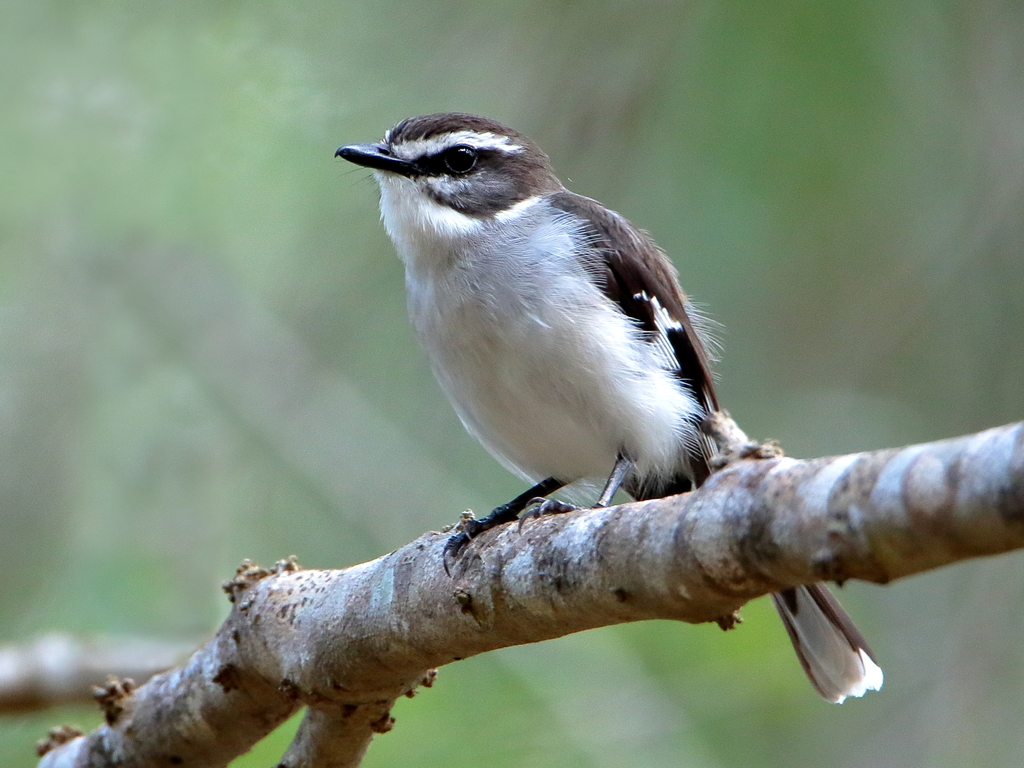
White-browed Robin
Photo © Graham Winterflood
Photo © Graham Winterflood — CC BY-SA 4.0 — Source: iNaturalist photo #57981786Identification
The white-browed robin is unmistakable in the field, distinguished by its prominent white eyebrow-stripe that gives the species its common name. Its upperparts are olive-brown, contrasting with pale underparts featuring a pale grey breast and white belly. A white patch adorns the wings, while the bill is black and the eyes dark brown. This compact robin is an elegant and easily identified member of Australia's native bird community.
Range & Habitat
This species is endemic to north-eastern Australia, with its range extending from Cape York Peninsula south to the Burdekin River in Queensland. The white-browed robin favours forest, woodland and scrub habitats, typically in areas near water where moisture supports dense vegetation and abundant invertebrate prey.
Behaviour & Diet
Like other members of the Australasian robin family Petroicidae, the white-browed robin is primarily insectivorous, foraging among vegetation for small invertebrates. Breeding occurs from August or September through to February or March, with pairs raising one or two broods each season. The species constructs a distinctive neat cup-shaped nest woven from bark and grass, bound together with spider webs, feathers and fur, and cleverly camouflaged on the outside with lichen or pieces of bark. Nests are typically positioned in tree-forks or hanging vines several metres above the ground. Each clutch consists of two eggs, which are cream to buff in colour, marked with brown splotches and spots concentrated towards the larger end.
Best Time & Places to See It
The breeding season from August to March offers the best opportunity to locate white-browed robins, as they are more vocal and active during this period. Visitors should focus on suitable habitat in north-eastern Queensland, particularly in forested and wooded areas near water sources. Patient observation in early morning hours often yields sightings of these charismatic robins.
Photography Tips
The white-browed robin's prominent facial markings and contrasting plumage make it a rewarding photographic subject. The distinctive white eyebrow-stripe should be the focus of portrait shots. Early morning light in forest or woodland edges provides ideal conditions. Since these robins favour areas near water, positioning yourself near streams or waterholes within suitable habitat increases encounter probability and allows for patient waiting as the bird's natural behaviour unfolds.
Daintree National Park
Dedin, Australia
+362 birds+37 mammals
Daintree National Park is one of the world’s oldest and most biologically diverse tropical rainforests, protecting an extraordinary landscape where ancient forests meet the Great Barrier…
VIEW NATIONAL PARKEndeavour River National Park
Philadelphia, Australia
+203 birds+1 mammals
Where the Endeavour River winds through northeastern Queensland's tropical lowlands, a compact mosaic of rainforest, open woodland, and riverine corridor creates one of Australia's most ecologically…
VIEW NATIONAL PARKRinyirru National Park
Lakefield, Australia
+258 birds+7 mammals
Where the savanna grasslands of far north Queensland meet seasonal wetlands and eucalypt woodlands, Rinyirru National Park sprawls across more than 12,500 square kilometres of rugged,…
VIEW NATIONAL PARKGirringun National Park
Australia
+231 birds+10 mammals
Where granite gorges cleave through subtropical woodland in North Queensland, Girringun National Park unfolds across rugged terrain shaped by millions of years of weathering and erosion.…
VIEW NATIONAL PARKWooroonooran National Park
Australia
+240 birds+28 mammals
Where the Great Dividing Range rises sharply inland from Queensland's tropical coast, Wooroonooran National Park encompasses a landscape of steep, forested gorges and cascading waterways carved…
VIEW NATIONAL PARKNo community photos yet. Log in to add the first one.
No community observations of this species yet.