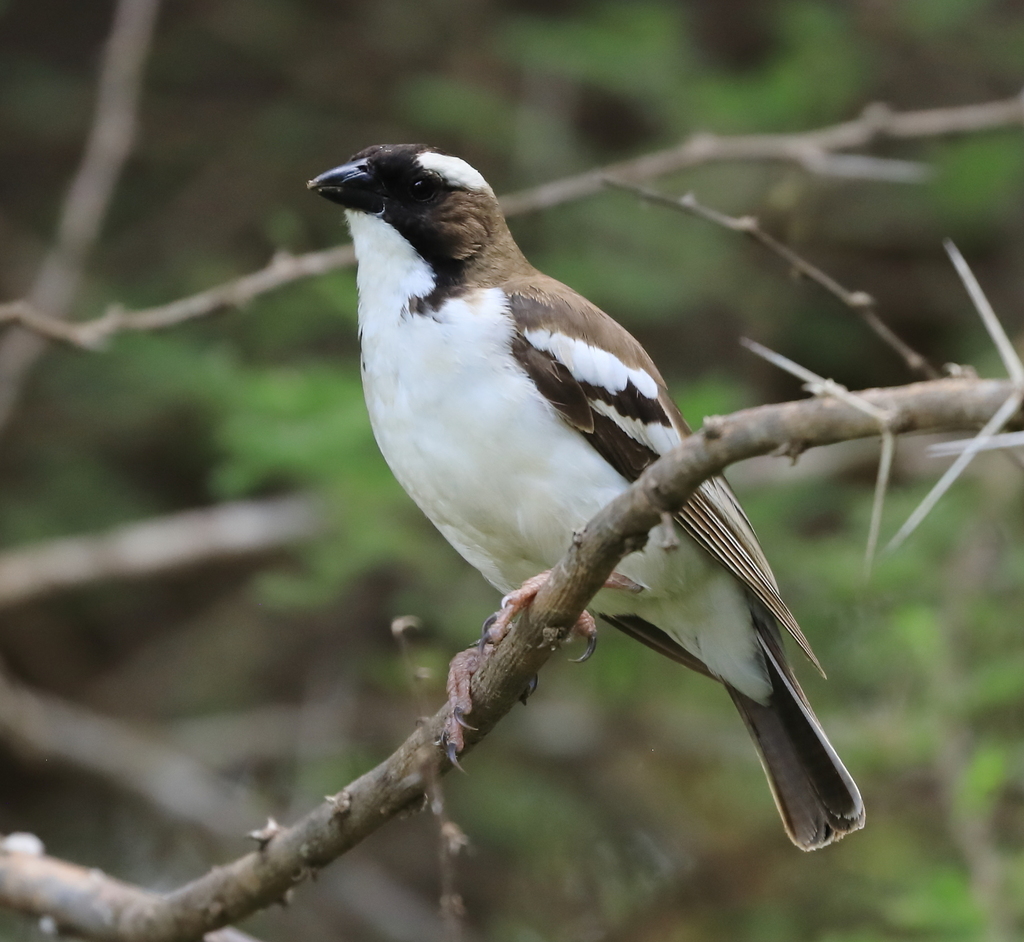
White-browed Sparrow-Weaver
Photo © Darren Obbard
Photo © Darren Obbard — CC BY 4.0 — Source: iNaturalist photo #354973226Identification
The white-browed sparrow-weaver is a small, predominantly brown bird measuring 17 to 19 cm in length. Its most distinctive features are a broad white eyebrow stripe and a white rump that becomes visible in flight. Males display a striking black bill, while females have a horn-colored (light gray) bill, and juveniles show pinkish-brown bills. In Zimbabwe, birds of this species exhibit faint brown spotting across their white breast. The species is larger than the similar yellow-throated petronia, which has a pinkish-brown bill and buff eyebrow stripe.
The white-browed sparrow-weaver's vocalizations are equally distinctive. Birds emit either brief chik-chick calls or loud, fluid cheoop-preeoo-chop whistles, which often betray their presence before they are seen.
Range & Habitat
This species is found throughout central and north-central southern Africa, with populations as far north as Ethiopia. It is most abundant in dry regions with woodland or wooded grassland across northern South Africa, Botswana, northern and central Namibia, and western Zimbabwe. The birds are particularly common in South Luangwa National Park, Zambia, and southern Malawi. Populations are sedentary, and the species is becoming more abundant, expanding its range on southern, northern, and eastern fronts.
White-browed sparrow-weavers nest in colonies along thornveld and scrubby, dry riverbanks, preferring the shelter of tree limbs for their distinctive nests.
Behaviour & Diet
These highly social birds live in groups of two to eleven individuals, typically comprising one breeding pair and non-reproductive helpers. Year-round activity includes nest-building and maintenance. Breeding occurs throughout the year but peaks during warmer months. Groups construct between ten and sixty inverted-U-shaped nests of dry grass in tree limbs, though only some are used for actual breeding or roosting. Breeding nests have a single entrance, while roosting nests feature entrances at both ends. Interestingly, nests are positioned on the leeward side of trees—a behavior that varies regionally, suggesting cultural transmission among populations. Other bird species, including red-headed finches and ashy tits, sometimes occupy these nests.
White-browed sparrow-weavers display remarkable thermoregulatory flexibility. Desert populations maintain higher body temperatures and allow greater daily temperature fluctuations than their semi-desert counterparts, reducing their need for water-costly evaporative cooling. During extreme heat, they spend less time foraging in direct sunlight, seeking shade to conserve water.
Best Time & Places to See It
South Luangwa National Park in Zambia and southern Malawi offer excellent opportunities to observe this species. The birds are active year-round, but watching during the warmer breeding months provides the greatest activity and the best chance to observe their complex social behavior and nest-building activities. Look for colonies of distinctive grass nests in thornveld and along dry riverbanks.
Photography Tips
The white rump is most visible when birds are in flight, so be prepared to capture birds in action for this key identification feature. The bold white eyebrow stripe contrasts well against the brown plumage and should be a focus for head portraits. Position yourself near known nest sites in early morning or late afternoon light to photograph the birds against shaded tree limbs. Patience is rewarded—their gregarious nature and year-round activity mean multiple individuals will eventually present photo opportunities. The distinctive inverted-U-shaped grass nests are photogenic subjects in their own right and provide valuable context for behavioral images.
Lake Mburo National Park
Mabamba Swamp
Murchison Falls National Park
Queen Elizabeth National Park
Aberdare National Park
Abijata-Shalla Lakes National Park
Amboseli National Park
Arabuko Sokoke Forest Reserve
Arusha National Park
Nothing matches these filters.
No community photos yet. Log in to add the first one.
No community observations of this species yet.