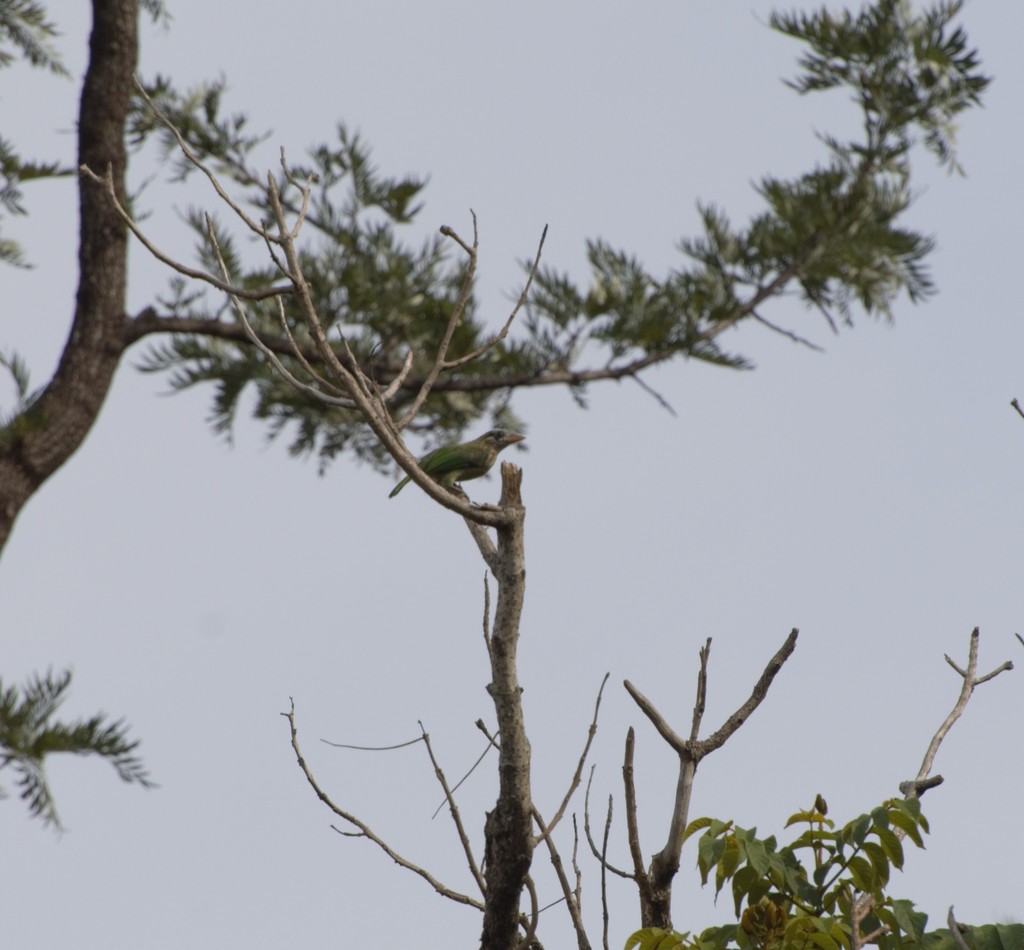
White-cheeked Barbet
Photo © C L Dheeraj
Photo © C L Dheeraj — CC BY 4.0 — Source: iNaturalist #26760238Identification
The white-cheeked barbet is a small green barbet measuring 16.5–18.5 cm in length, found exclusively in southern India. Its most distinctive features are a broad white cheek stripe below the eye and a prominent supercilium, which readily separate it from the similar brown-headed barbet. The bird has a brownish head streaked with white, sometimes giving it a capped appearance, with a pale pink bill. Like all Asian barbets, it is predominantly green in plumage and sits upright on perches, habits that make it surprisingly difficult to spot despite its relatively vivid markings.
Range & Habitat
The white-cheeked barbet is endemic to southern India, with its main range along the Western Ghats extending southward from the Surat Dangs and into associated hills of southern India. It also occurs in parts of the southern Eastern Ghats, particularly in the Shevaroy and Chitteri Hills. The species inhabits forest areas, and in some drier forests to the east of the Western Ghats, it occurs alongside the brown-headed barbet. Evidence suggests that in certain areas, the white-cheeked barbet may have displaced the brown-headed barbet, which was formerly the dominant barbet species in those regions.
Behaviour & Diet
White-cheeked barbets are primarily frugivorous, feeding in trees and rarely descending to the ground. They obtain most of their water requirements from their fruit diet, though they will drink and bathe in tree holes when water is available. They show a strong preference for figs, particularly Ficus benjamina and Ficus mysorensis, but also consume fruits of introduced species such as Muntingia calabura. They opportunistically take winged termites and other insects, and occasionally visit flowers of Bombax for nectar, potentially aiding in pollination. When foraging, they are notably aggressive, attempting to chase other barbets, Asian koels, and competing frugivores. These birds play an important ecological role as seed dispersal agents in forest ecosystems.
Best Time & Places to See It
During the breeding season beginning in December and continuing through May, white-cheeked barbets become much more conspicuous as their loud, constant calling intensifies, particularly in the early mornings. This makes the breeding season the best time for locating them. The Periyar Tiger Reserve is a known location where breeding birds can be observed. The monotonous "Kot-roo...Kotroo..." call, which begins with an explosive "trrr," is the best way to locate these otherwise cryptic birds. During hot afternoons they may also utter a single note "wut" resembling calls of other barbet species.
Photography Tips
Patience is essential when photographing white-cheeked barbets, as their green plumage and upright, still-sitting behaviour make them difficult to locate visually despite their loud calls during breeding season. Use the bird's vocalizations as your primary guide—position yourself where calling birds are heard and wait for them to reveal themselves. Early morning during the breeding season offers the most intense calling activity and the best opportunities for photography. Since they feed primarily in trees and rarely visit the ground, focus your efforts on canopy and mid-story levels of forest habitats, particularly around fruiting fig trees where they may congregate with other frugivores.
Eravikulam National Park
Devikulam, India
+192 birds+7 mammals
High in the Western Ghats of Kerala, where monsoon mists cling to slopes that rise above 2,000 metres, Eravikulam National Park preserves one of South India's…
VIEW NATIONAL PARKPeriyar National Park
Mlappara, India
+232 birds+4 mammals
Dawn breaks over mist-shrouded ridges where the Western Ghats tumble toward Kerala's spice-scented lowlands. Here, ancient tropical forests envelope a glittering artificial lake, creating a mosaic…
VIEW NATIONAL PARKPampadum Shola National Park
Vattavada, India
+258 birds+14 mammals
Where misty shola forests cling to the high plateaus of the Nilgiri Mountains, ancient evergreen remnants create a world apart. This 2,316-hectare reserve protects one of…
VIEW NATIONAL PARKBandipur National Park
Hirehalli, India
+302 birds+19 mammals
Where the Western Ghats descend into the Deccan plateau, ancient deciduous forests blanket a landscape carved by the Nugu River. Bandipur unfolds across 880 square kilometres…
VIEW NATIONAL PARKNagarahole Tiger Reserve
Nalkeri Forest, India
+323 birds+23 mammals
Where granite escarpments rise above dense deciduous forests and the Kabini River carves through pristine wilderness, one of India's most biodiverse landscapes unfolds across the Western…
VIEW NATIONAL PARKNo community photos yet. Log in to add the first one.
No community observations of this species yet.