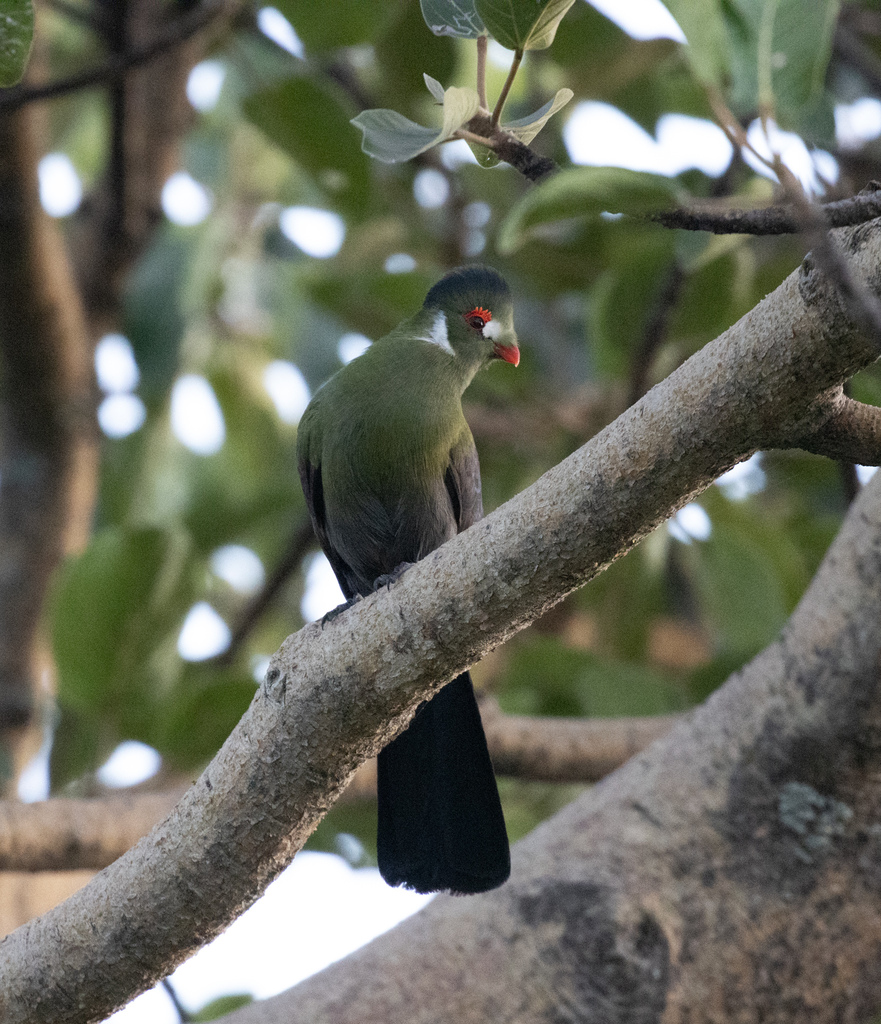
White-cheeked Turaco
CC BY 4.0
CC BY 4.0 — Source: iNaturalist photo #607997188The white-cheeked turaco (Menelikornis leucotis) is a species of bird in the family Musophagidae. It is found in Eritrea, Ethiopia, and South Sudan. A mid-sized species, it measures about 43 cm (17 in) in length, including a tail of 19 cm (7.5 in), and weighs about 200–315 g (7.1–11.1 oz). This species is the most commonly raised turaco in captive conditions. == Distribution and habitat == The white-cheeked turaco is native to Sudan, South Sudan, Ethiopia and Eritrea, where it is found in Podocarpus and juniper forests in the highland regions. == Subspecies == There are two subspecies, the nominate subspecies M. l. leucotis found in the Podocarpus forests of Eritrea, Ethiopia and southeastern South Sudan and M. l. donaldsoni found in south-central Ethiopia south of the Rift Valley and in the extreme west of Somalia. The latter is quite distinct in plumage colour—the eastern population is separated from the larger population by the escarpment. The white-crested turaco has been shown to hybridise with the sympatric Ruspoli's turaco (Menelikornis ruspolii) that contributed more to concerns about Ruspoli's turaco that is considered endangered. == In captivity == In captivity a 'cinnamon' colour sport (a recessive colour mutation) first occurred spontaneously in…
No community photos yet. Log in to add the first one.
No community observations of this species yet.