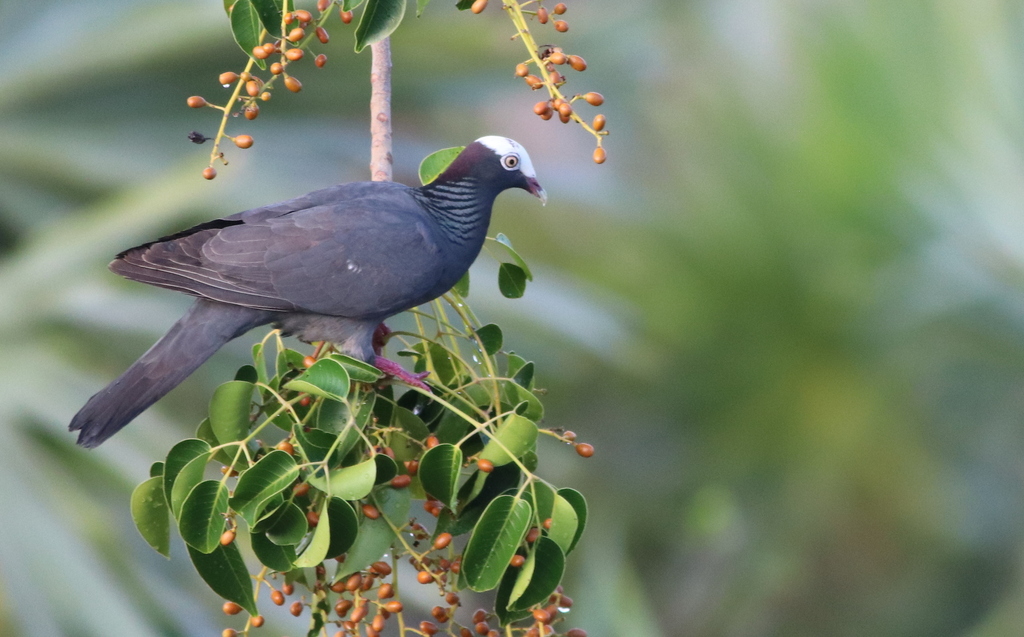
White-crowned Pigeon
Photo © Gary T. Leavens
Photo © Gary T. Leavens — CC BY-SA 4.0 — Source: iNaturalist photo #370397583Identification
The white-crowned pigeon is a medium-sized pigeon measuring 29–35 cm in length with a wingspan of 48–59 cm, weighing between 150–301 g. It is roughly the same size as the common rock pigeon but generally less chunky, with a relatively longer and more square tail. Adults display slate-gray to almost-black plumage, with a distinctive bright white crown patch in males that becomes more gray-white in females. The bird's most striking feature is its iridescent collar-patch, which shines with a barred white pattern tinged with green—though this is only visible in good lighting conditions. Both adults and juveniles have a white iris and a pale-tipped red bill. Juveniles are noticeably lighter in shade, lacking the nape pattern and white iris, and showing only a few pale feathers on the crown. The bird's loud, distinctive call is a deep coo-cura-coo or coo-croo, characteristic of the Patagioenas genus.
Range & Habitat
The white-crowned pigeon is primarily a Caribbean resident, breeding mainly in the Bahamas, Cuba, Jamaica, and Antigua, with smaller breeding populations in Hispaniola, Puerto Rico, the Virgin Islands, the Cayman Islands, Anguilla, and other Caribbean islands. It also breeds along the Caribbean coast of Central America and in the United States is found only in the Florida Keys, Everglades, and the southern tip of mainland Florida. The species has been spotted as far south as Fuerte Island, off the northern coast of Colombia, and often spends winters in the Caribbean islands.
The white-crowned pigeon requires two distinct habitats: coastal mangrove forests for breeding and inland areas for feeding. It traditionally nests in low-lying, coastal red mangrove forests on isolated offshore mangrove islets with limited disturbance. These tidally inundated mangrove islands provide essential protection from predators such as raccoons. However, recent observations have documented nesting in unexpected urban areas, including downtown Key West and Miami, a shift possibly driven by habitat loss from hurricanes and increased predation pressure.
Behaviour & Diet
The white-crowned pigeon is a fruit and seed-eating species that travels inland from its coastal breeding colonies to forage on the fruits and seeds of a wide variety of plants. In Florida, it frequently feeds on the fruit of poisonwood, a native plant. The species is notably skittish and will readily abandon its nest if disturbed or encroached upon. It breeds in nest colonies or individually in mangrove forests, with specific breeding requirements tied to isolated mangrove habitat.
Best Time & Places to See It
The white-crowned pigeon is a resident breeder throughout the Caribbean, making it available year-round, though birds often winter in the Caribbean islands after breeding. The Bahamas, Cuba, Jamaica, and Antigua offer the most reliable viewing opportunities as primary breeding strongholds. In the United States, the Florida Keys and Everglades provide the only chance to observe this species, particularly in remote wildlife refuges where traditional mangrove nesting sites persist. Recent urban sightings in Key West and Miami indicate the species may be expanding to new areas, offering additional viewing possibilities.
Photography Tips
Photographing white-crowned pigeons presents distinct challenges and opportunities. To capture the bird's most distinctive feature—the iridescent collar-patch with its barred white and green sheen—good lighting is essential; position yourself to take advantage of direct sunlight striking the neck area. The white crown patch is more pronounced in males and provides excellent contrast against the dark slate-gray plumage. The bird's skittish nature demands patience and careful approach; maintain distance and avoid sudden movements that might cause abandonment of nesting sites. Early morning light in coastal mangrove habitats is ideal for photography. Focus on the bird's striking white iris and pale-tipped red bill as secondary focal points, and try to capture the characteristic posture of birds perched in low mangrove vegetation.
Tortuguero National Park
Roxana, Costa Rica
+420 birds+23 mammals
Canals and lagoons thread through a labyrinth of lowland rainforest where the Caribbean coast of Costa Rica meets the wetland frontier. This is terrain shaped by…
VIEW NATIONAL PARKEverglades National Park
Monroe County, United States
+345 birds+22 mammals
Where freshwater marsh meets subtropical sky, the Everglades sprawls across southwestern Florida as one of North America's most expansive wetland ecosystems. Spanning over 13,000 square kilometers,…
VIEW NATIONAL PARKArrecifes de Cozumel National Park
San Miguel de Cozumel, Mexico
+112 birds+4 mammals
Beneath the turquoise shallows of the western Caribbean, Arrecifes de Cozumel National Park protects a sprawling marine realm across 484 square kilometres off the Quintana Roo…
VIEW NATIONAL PARKSian Ka’an
Chunyaxché, Mexico
+350 birds+16 mammals
Where the Yucatán Peninsula dissolves into wetland and mangrove, a vast mosaic of forest, lagoon, and coastal margin creates one of Mexico's most biodiverse strongholds. Across…
VIEW BIOSPHERE RESERVEBiscayne National Park
Miami-Dade County, United States
+263 birds+7 mammals
Coral reefs and mangrove shallows dominate this marine sanctuary where the Florida Keys meet the Atlantic, creating a mosaic of shallow seagrass meadows, patch reefs, and…
VIEW NATIONAL PARKDry Tortugas National Park
Monroe County, United States
+211 birds+1 mammals
Seventy miles west of Key West, where the Gulf of Mexico surrenders to the Atlantic, lies a constellation of low coral keys that rise barely above…
VIEW NATIONAL PARKVirgin Islands National Park
Cruz Bay, United States
+119 birds+3 mammals
Coral reef and mangrove ecosystems define the tropical maritime landscape of this national park, where St. John's mountainous spine rises sharply from turquoise bays fringed with…
VIEW NATIONAL PARKJ.N. “Ding” Darling National Wildlife Refuge
Sanibel, United States
+277 birds+6 mammals
Mangrove channels and coastal marshlands dominate this 6,400-acre sanctuary on Florida's Gulf coast, where brackish waterways weave between dense stands of red, black, and white mangrove…
VIEW WILDLIFE SANCTUARYMerritt Island National Wildlife Refuge
Brevard County, United States
+341 birds+19 mammals
Brackish marshes and palmetto scrub define this wildlife sanctuary spanning the coastal lowlands of central Florida, where the Atlantic tide meets freshwater systems in a dynamic…
VIEW WILDLIFE SANCTUARYGreat White Heron National Wildlife Refuge
Monroe County, United States
+118 birds+3 mammals
Shallow mangrove bays and salt-marsh flats sprawl across Monroe County's coastal sanctuary, where brackish water meets the Florida Keys' distinctive transition zone between temperate and subtropical…
VIEW WILDLIFE SANCTUARYBarra del Colorado National Wildlife Refuge
Tortuguero, Costa Rica
+462 birds+36 mammals
Where the Caribbean's restless waters meet the Limón Province coastline, Barra del Colorado National Wildlife Sanctuary unfolds across a landscape of extraordinary ecological complexity. This equatorial…
VIEW WILDLIFE SANCTUARYNo community photos yet. Log in to add the first one.
No community observations of this species yet.