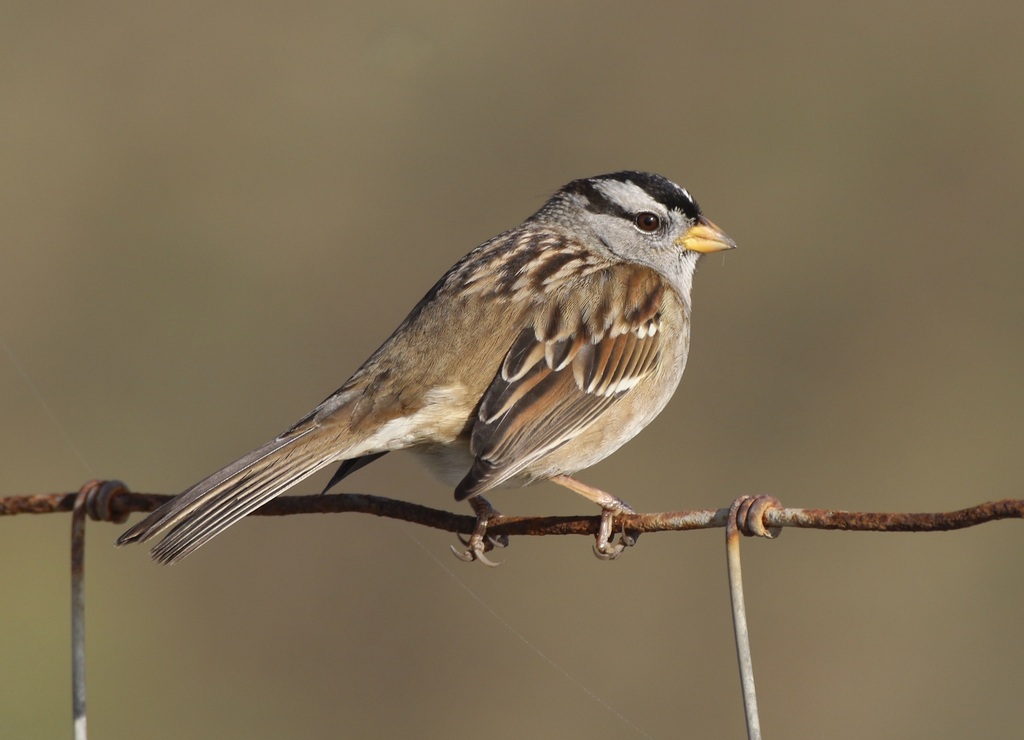
White-crowned Sparrow
Photo © Cricket Raspet
Photo © Cricket Raspet — CC BY 4.0 — Source: iNaturalist photo #450493331Identification
The white-crowned sparrow is a medium-sized passerine with striking head markings: bold black and white stripes adorning the crown, a grey face, and a distinctive appearance that sets it apart in the field. Adults display brown streaked upper parts, a long tail, and grey underparts. The wings are brown with barring, and the bill is pink or yellow. This species measures 5.9–6.3 inches in length with a wingspan of 8.3–9.4 inches and weighs 0.9–1.0 ounces.
The white-crowned sparrow resembles the white-throated sparrow but lacks the white throat markings and yellow lores characteristic of that species, making careful observation of these features essential for accurate field identification.
Range & Habitat
Native to North America, the white-crowned sparrow breeds in brushy areas across the taiga and tundra of northern Canada, the western United States, the Rocky Mountains, and the Pacific coast. Five recognized subspecies vary in breeding distribution and migratory route. The nuttalli subspecies is a permanent resident in California, while gambelli birds migrate as far as the Arctic Circle during breeding season. Northern populations migrate through most of North America, wintering in the southern United States and northern Mexico.
While primarily a North American species, white-crowned sparrows are very rare vagrants to western Europe, with occasional sightings recorded in England, Scotland, Ireland, and Norway.
Behaviour & Diet
These ground foragers often feed in low vegetation, occasionally making short flights to catch flying insects. Their diet consists mainly of seeds, other plant parts, and insects. During winter months, they frequently forage in flocks, creating excellent opportunities for observation.
White-crowned sparrows nest low in bushes or on the ground beneath shrubs, laying three to five grey or greenish-blue eggs marked with brown. The species possesses a remarkable adaptation called unihemispheric slow-wave sleep, allowing it to remain half-awake for up to two weeks during migration—a phenomenon researchers have studied for potential applications in human alertness during shift work and truck driving. Recent ornithological studies have revealed that white-crowned sparrow songs are affected by human activity and noise pollution.
Best Time & Places to See It
Migratory populations can be encountered throughout most of North America during passage and winter months. Spring and fall migrations offer prime viewing opportunities across the continent. Brush-dominated habitats, particularly in western regions, provide reliable sightings year-round for resident populations. Winter flocking behavior makes these birds easier to locate during the colder months in southern wintering grounds.
Photography Tips
The white-crowned sparrow's bold head pattern provides excellent photographic subjects in good light. Position yourself to capture the striking black and white crown stripes and grey facial markings with clear detail. Early morning light enhances the subtle brown barring on the wings and the pink or yellow bill coloration. Winter flocking offers opportunities for capturing multiple birds in natural behavior, such as ground foraging and low vegetation feeding.
Tombstone Territorial Park
Acadia National Park
Alaska Maritime National Wildlife Refuge
Alligator River National Wildlife Refuge
Arches National Park
Arctic National Wildlife Refuge
Badlands National Park
Banff National Park
Becharof National Wildlife Refuge
Nothing matches these filters.
No community photos yet. Log in to add the first one.
No community observations of this species yet.