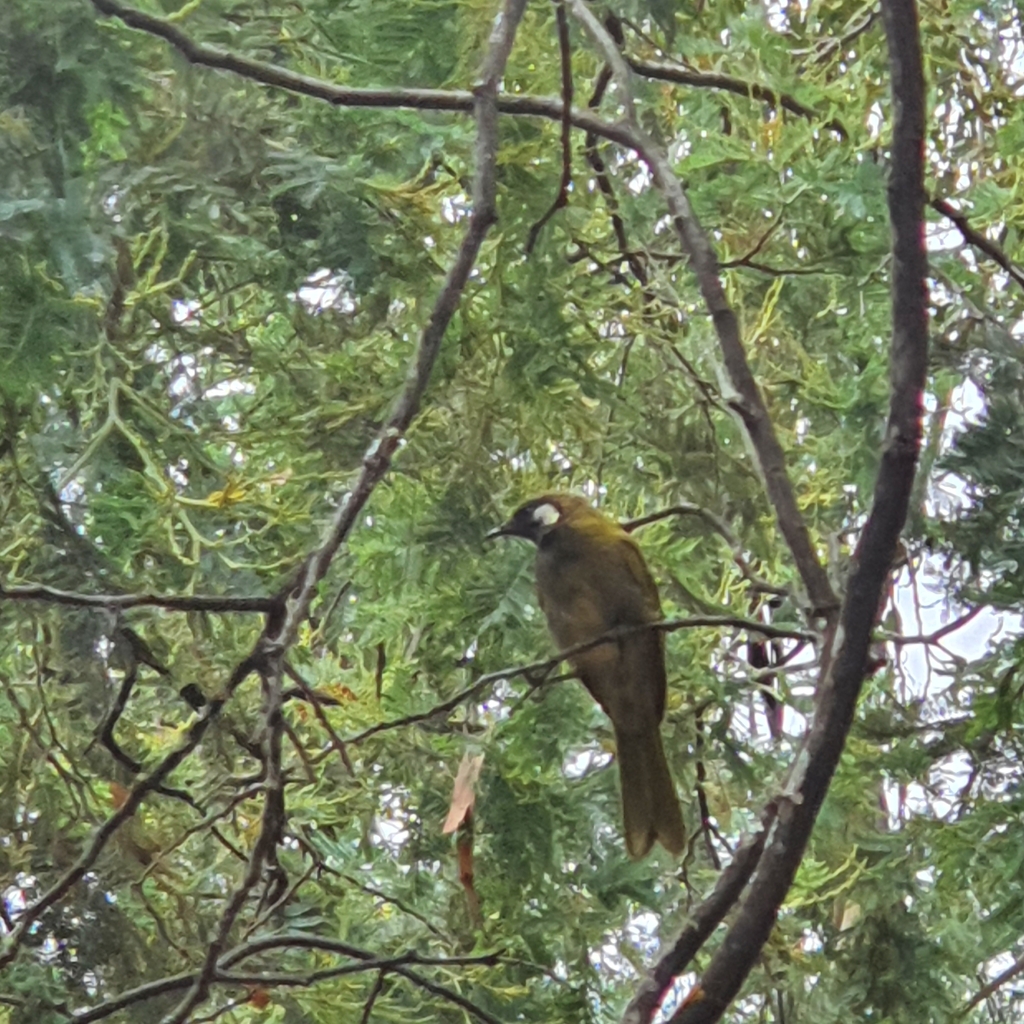
White-eared Honeyeater
Photo © Claudia Schipp
Photo © Claudia Schipp — CC0 1.0 — Source: iNaturalist #68718651Identification
The white-eared honeyeater is a medium-sized honeyeater measuring 19–22 centimetres in length and weighing approximately 20 grams. It is easily identifiable by its distinctive plumage: an olive-green body, dark grey crown with black streaks, black cheeks and throat, and most notably, striking white ear-coverts that give the species its name. The wings and tail display a mix of brown, yellow and olive tones. The bird has a black bill, dark grey legs, and a red or brown iris. There is no sexual dimorphism, so males and females appear identical.
Range & Habitat
The white-eared honeyeater is found across eastern and southern Australia, with two main subspecies: the nominate race ranges from central Queensland through New South Wales and Victoria to southeastern South Australia, while the smaller western race occurs in southwestern Western Australia and the Eyre Peninsula. Additional races are found on Kangaroo Island and in mallee regions. The species favours forests, woodlands, heathlands, mallee and dry inland scrublands with eucalyptus canopy, rough bark, and a dense shrub layer. Mature vegetation with good understory is preferred, though they can tolerate small woodland patches and are relatively unselective regarding forest type, avoiding only heavily degraded, recently burnt, or sparse habitats.
Behaviour & Diet
White-eared honeyeaters are typically solitary or found in small family groups, with movement patterns ranging from sedentary to nomadic or locally migratory. They breed from July to March, building cup-shaped nests low in shrubs, bracken or grass from 0.5 to 5 metres high, constructed from dry grass, fine stems and bark bound with cobwebs. Clutches typically consist of 2–3 white eggs with brown speckles. Parents are obligate cooperative breeders. The species feeds primarily on nectar and insects, with a deep, mellow but slightly metallic call: chwok, chwok, chwok-whit and kwitchu, kwitchu, interspersed with sharp metallic chwik!
Best Time & Places to See It
Spring is an excellent season when eucalyptus canopies provide abundant nectar. Look for white-eared honeyeaters in their preferred habitats of mature eucalyptus forests and woodlands with healthy shrub layers across eastern Australia, from Queensland south to South Australia, and in southwestern Western Australia. They can be found in both edge and interior forest habitats, and even in small woodland patches, making them relatively accessible to patient observers in suitable vegetation.
Photography Tips
The white ear-patch and black head provide strong contrasting features for photography. Look for birds feeding on flowering eucalypts in spring, when they are most active and visible. Their preference for mature trees with dense understory means shooting in dappled light; use a faster shutter speed to freeze movement as they forage for nectar and insects among bark and foliage. Early morning and late afternoon light will best showcase the olive-green plumage and highlight the distinctive white ear-coverts.
Alpine National Park
Bald Rock National Park
Barrington Tops National Park
Ben Boyd National Park
Blue Mountains National Park
Bouddi National Park
Budawang National Park
Budj Bim National Park
Cania Gorge National Park
Nothing matches these filters.
No community photos yet. Log in to add the first one.
No community observations of this species yet.