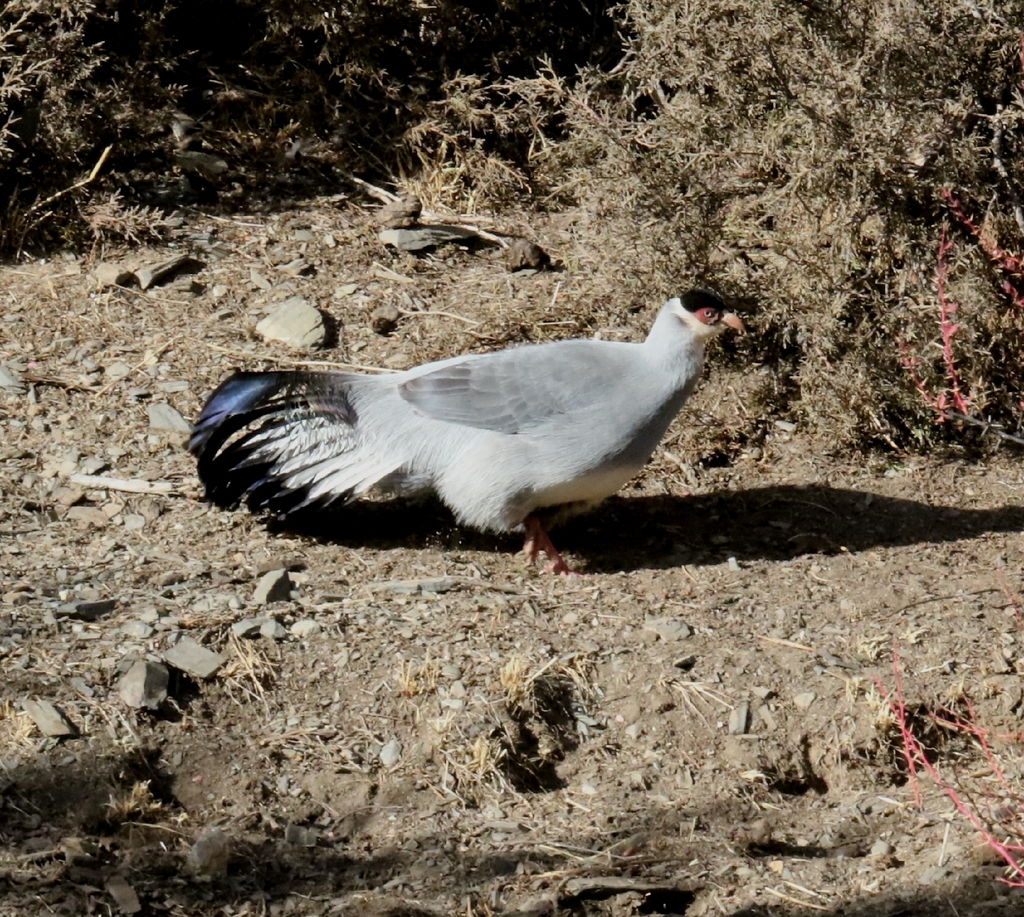
White Eared Pheasant
Photo © Agnes Trekker
Photo © Agnes Trekker — CC0 1.0 — Source: iNaturalist #339643417Identification
The white eared pheasant is a large galliform bird distinguished by its predominantly white plumage and prominent white ear tufts that give the genus its common name. Males are considerably larger than females, reaching 86–96 cm in length and weighing 2,350–2,750 g, while females weigh 1,400–2,050 g. The species displays black tail feathers and wingtips, with a distinctive black patch at the crown. Primary feathers range from dark grey to brown, and the bare facial skin is bright red. While closely related to the Tibetan and Yunnan white eared pheasants, the Szechuan subspecies (the most widespread form) is less extensively white on the body than these relatives, and its wings are characteristically dark grey or violet.
Range & Habitat
The white eared pheasant is endemic to the high mountains of central and southwestern China, with populations found in Qinghai, Sichuan, Yunnan, and Tibet. This species inhabits alpine meadows close to or above the snowline year-round, also occurring in mixed forests and notably around Buddhist monasteries. The Szechuan subspecies favours exposed rockscapes at high altitude, descending to old-growth forests during winter months.
Behaviour & Diet
This highly gregarious bird lives in large flocks and is notably more aerial than its close relatives, capable of sustained flight across snowy terrain and capable of hovering or volplaning over deep snow using their broad tails. They move across snow by whirring their wings close to the ground, supported by their tail feathers. In alpine meadows, white eared pheasants forage for tubers and roots, often in the company of yaks and other hoofed livestock. Winter diet includes pine needles, juniper berries, wolf berries, and seed pods of iris, lily, and allium. During severe storms, they may subsist on pine pitch and ungulate dung.
Best Time & Places to See It
White eared pheasants can be encountered year-round in their alpine habitat across the Tibetan plateau and adjacent high mountain ranges. Their gregarious nature and preference for open meadows makes them relatively predictable, though their ability to fly substantial distances means patience and careful scanning of alpine slopes are necessary. Areas near Buddhist monasteries in Sichuan and Tibet offer particularly reliable viewing opportunities.
Photography Tips
The bird's striking white plumage and black markings provide excellent contrast for photography, though the bright alpine snow can fool exposure meters—compensate by increasing exposure to retain detail in white feathers. Early morning light accentuates the red facial skin and dark wingtips beautifully. Their habit of foraging in open meadows offers opportunities for full-body portraits, while flocking behaviour allows for dynamic flock photography. The birds' sustained flight across snowy slopes, reminiscent of ptarmigans, provides dramatic in-flight shooting opportunities if you position yourself with good light and clear mountain backdrops.
No community photos yet. Log in to add the first one.
No community observations of this species yet.