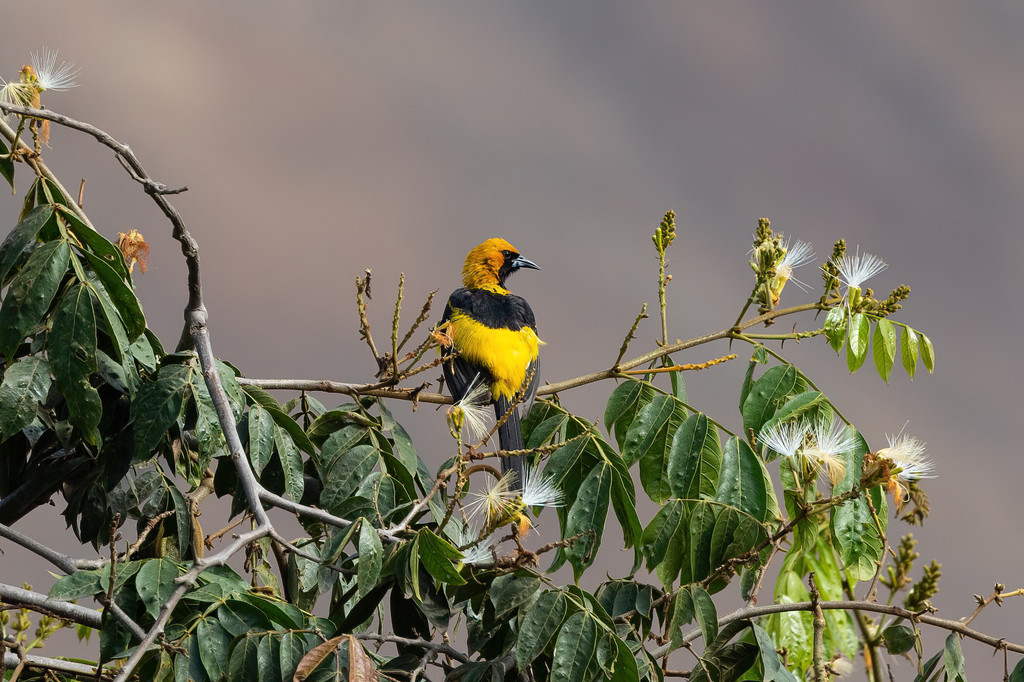
White-edged Oriole
Photo © Thibaud Aronson
Photo © Thibaud Aronson — CC BY-SA 4.0 — Source: iNaturalist photo #194581365Identification
The white-edged oriole is a small passerine, 19–20 cm long, with a striking and unmistakable plumage pattern. Both sexes are identical, predominantly orange-yellow with bold black markings: black lores and a distinctive black "mask" extending to a black "bib" from chin to upper breast, a black back, and mostly black wings. The bird's namesake feature is a large white patch visible on the closed wing, created by wide white edges on the innermost secondaries and tertials at their bases. The tail is mostly black with white edges on the outermost feathers and sometimes white tips on the next three pairs. Juveniles are considerably duller, with olive-tinted back feathers, dull blackish coverts with yellow tips, and much less prominent white markings on the flight feathers. Adults show a dark brown iris, black bill with a gray mandible base, and grayish-blue legs and feet.
Range & Habitat
This species has a relatively narrow Pacific coastal distribution, found in a band running from central Manabí Province in west-central Ecuador south into northwestern Peru's La Libertad Department. In Ecuador, the white-edged oriole stays mostly below 400 m elevation, while in Peru it is found locally as high as 1,800 m. It is a specialist of dry deciduous forests and arid scrublands, with populations in far southern Ecuador also occurring in the adjoining subtropical zone.
Behaviour & Diet
The white-edged oriole is believed to be a year-round resident throughout its range. It usually forages in pairs or family groups, and while its diet has not been formally studied, it is presumed to feed on arthropods, fruit, and nectar. Breeding occurs during at least February and March in Ecuador, possibly extending to May in Peru. This monogamous solitary breeder constructs a distinctive hanging bag nest made from plant fibers, typically suspended from a branch fork at heights of 1.8–4 m. Clutches consist of two or three cream-colored eggs marked with dark brown. Both parents feed the nestlings, though details of incubation period and fledging time remain undocumented. The shiny cowbird is known to parasitize their nests.
Best Time & Places to See It
The breeding season from February through May offers the best opportunity to observe this species, when birds are vocal and engaged in nesting activities. Its year-round residency means it can be found throughout the year in suitable habitat. Travellers should focus on dry deciduous forests and arid scrublands along the Pacific slope of Ecuador and northwestern Peru. The species seems relatively numerous and tolerant of moderate disturbances, making it reasonably accessible for patient observers in appropriate habitat.
Photography Tips
The white-edged oriole's striking black-and-yellow plumage and distinctive white wing patch make it visually distinctive and rewarding to photograph. Look for birds foraging in pairs or small family groups, particularly during early morning hours when vocalization is most frequent. The hanging bag nest, when located, offers an excellent opportunity for nest photography, though care must be taken not to disturb breeding birds. The bird's rich musical song—described as a series of phrases including "chiro-chowee" and "weeeenh-weh"—can help locate birds in dense scrubland habitat. A moderate telephoto lens will be necessary to capture detail from typical foraging distances.
No community photos yet. Log in to add the first one.
No community observations of this species yet.