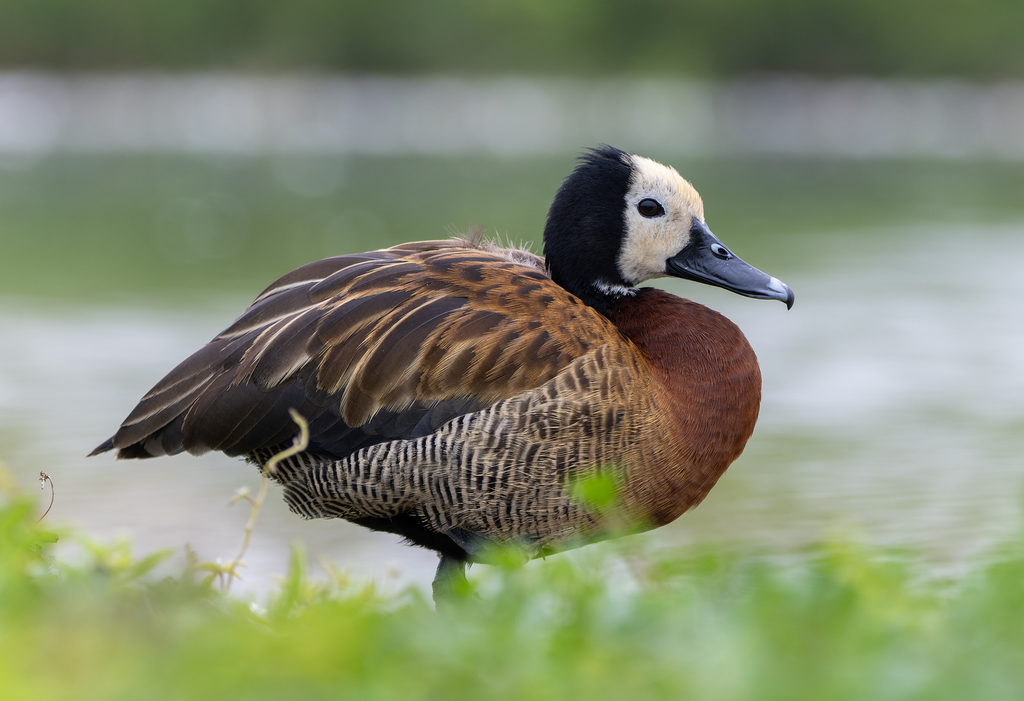
White-faced Whistling Duck
Photo © David F. Belmonte
Photo © David F. Belmonte — CC BY 4.0 — Source: iNaturalist photo #404836418Identification
The white-faced whistling duck is a striking and unmistakable waterfowl. Its most distinctive feature is its white face, which contrasts sharply with a black head and neck. The body is predominantly dark, with a chestnut neck, dark brown to black back and wings, and black underparts marked by fine white barring on the flanks. The bird has a long grey bill, an elongated head, and relatively long legs that give it an upright posture in the water. Males and females are similar in plumage, making identification straightforward. Juveniles resemble adults but have a much less contrasted head pattern, appearing duller overall.
Regional variation exists in the extent of white facial coloration, with birds in western Africa—where rainfall is more abundant—typically showing more extensive black markings than those in drier regions. This subtle variation adds character to the species across its range.
Range & Habitat
The white-faced whistling duck has a fascinating disjunctive distribution, occurring in sub-Saharan Africa and much of South America, with a gap between these regions. The origins of this unusual pattern remain intriguing, and it has been suggested that humans may have inadvertently transported birds to new locations, contributing to this distribution. The species is abundant throughout its range and is largely resident, though local movements of 100 kilometres or more do occur.
These ducks favour freshwater lakes and reservoirs with plentiful vegetation. The abundance of aquatic plants is crucial, as the birds feed primarily on seeds and other plant material found in these habitats.
Behaviour & Diet
White-faced whistling ducks are highly gregarious birds, often gathering in impressive flocks at favoured sites. They are noisy, vocal ducks with a distinctive clear three-note whistling call—hence their common name. Hearing these calls echoing across wetlands is a memorable experience for any visitor.
These ducks feed on seeds and other plant matter found in their freshwater habitats. Breeding birds nest in depressions on the ground or in reed beds, where both sexes share incubation duties. Clutches typically contain 6 to 12 eggs, which hatch after 26 to 28 days. Both parents attend the ducklings, keeping them hidden in reeds until they fledge after approximately two months.
Best Time & Places to See It
The white-faced whistling duck's resident status means it can be found year-round throughout its range in sub-Saharan Africa and South America. However, the most spectacular viewing opportunities occur at dawn, when massive flocks numbering a thousand or more birds arrive at preferred sites, creating an unforgettable sight and soundscape. Freshwater lakes, reservoirs, and reed-bordered wetlands with abundant vegetation are your best bets for encountering these birds.
Photography Tips
The striking contrast between the white face and black head makes the white-faced whistling duck a rewarding photographic subject. Early morning visits offer the best chances to photograph large, active flocks arriving at their feeding sites. The birds' relatively long legs and upright posture photograph well from low angles that emphasise their distinctive silhouette. Capture their vocal behaviour when possible, as their characteristic three-note whistles are integral to their identity. Patient photographers should position themselves quietly near reed beds and vegetated margins where these gregarious ducks congregate.
Bwindi Impenetrable National Park
Lake Mburo National Park
Mabamba Swamp
Murchison Falls National Park
Queen Elizabeth National Park
Aberdare National Park
Abijata-Shalla Lakes National Park
Addo Elephant National Park
Agulhas National Park
Nothing matches these filters.
No community photos yet. Log in to add the first one.
No community observations of this species yet.