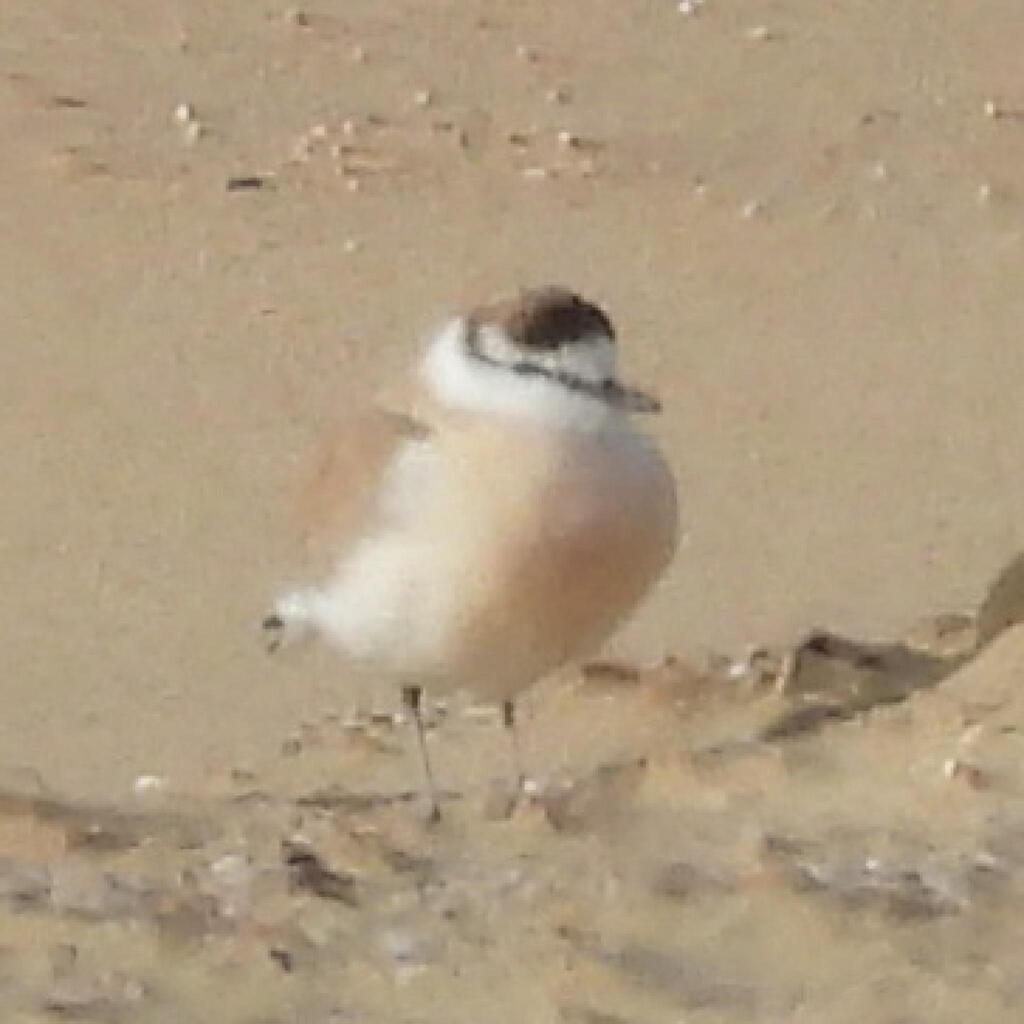
White-fronted Plover
Photo © Henry de Lange
Photo © Henry de Lange — CC BY 4.0 — Source: iNaturalist #325828916Identification
The white-fronted plover is a diminutive shorebird weighing only 45–50 grams, making it easy to overlook among the sand and shallows it frequents. Its most distinctive feature is a white forecrown contrasting with a dark band crossing the mid-crown, earning it the name "white-fronted." A blackish-brown stripe runs from behind each eye to the ear coverts, framing a predominantly white face. The back and mantle are light greyish-brown, while the underparts are white, sometimes with a washed chestnut tone on the lower breast and upper belly. The bill is black, eyes brown, and legs are pale grey or greenish. Females are subtly different from males, with a less defined or sometimes absent dark crown band and slightly longer wings. Juveniles lack the crown band entirely and show no black head markings, though the characteristic facial stripe pattern is still visible.
Range & Habitat
Endemic to sub-Saharan Africa and Madagascar, the white-fronted plover occurs at varying densities from Senegambia and Somalia southward to South Africa, where it inhabits the entire coastline as well as inland waters. Genetic studies have revealed distinct differentiation between Madagascar and mainland populations. The species shows both resident and partially migratory tendencies; coastal populations are largely sedentary, though they may retreat to sheltered shores during harsh winters. Inland populations occasionally undertake seasonal movements, particularly from December to May, when some birds migrate from inland lakes and rivers to the East Coast of South Africa, driven by flooding or habitat changes.
Behaviour & Diet
White-fronted plovers employ the characteristic run-stop-search foraging technique typical of plovers, rapidly moving then pausing to peck at prey before resuming. They also use foot-trembling, vibrating their toes to disturb small invertebrates and force them to the surface—a technique notably absent in Madagascar populations. Insects are occasionally caught mid-flight, and the birds readily feed on debris washed ashore. Their diet consists primarily of sand flies, grasshoppers, termites, mosquito pupae, fairy shrimp, gastropods, bivalves, isopods, crabs, and small worms. Foraging occurs day and night, with birds preferring the upper intertidal zone on sandy beaches and along high-water lines during summer, shifting lower on the shore in winter. They favour low-tide foraging but will exploit kelp wrack at high tide, often pausing mid-day to preen.
Best Time & Places to See It
Look for white-fronted plovers on sandy beaches, coastal dunes, estuaries, and the shores of rivers and lakes throughout sub-Saharan Africa and Madagascar. Coastal populations are resident year-round and relatively predictable. For the best viewing opportunities, visit the South African coast, where the species is present along the entire shoreline and at major inland water bodies. Timing your visit during low tide increases your chances, as plovers concentrate in the upper intertidal zone. December to May brings migrants from inland habitats to the East Coast of South Africa, potentially offering higher concentrations.
Photography Tips
Patience and stealth are essential when photographing this small, alert shorebird. Position yourself low to the ground before sunrise or in late afternoon, when light is soft and the bird's plumage patterns are most visible. Focus on the characteristic white forecrown and dark facial stripes, which make excellent identification features in images. Capture the bird's typical feeding behaviour—the distinctive run-stop-search pattern—rather than static poses. Low tide offers the best opportunities, with plovers actively foraging in open sandy areas where you can achieve clean, uncluttered backgrounds. A telephoto lens (at least 400mm) is recommended given the species' small size and wariness.
Addo Elephant National Park
Sundays River Valley Local Municipality, South Africa
+388 birds+55 mammals
Where the Eastern Cape's semi-arid scrublands meet transitional woodland, Addo sprawls across 13,478 square kilometres of one of southern Africa's most biodiverse landscapes. The terrain rises…
VIEW NATIONAL PARKSperrgebiet National Park
Barcelona, Namibia
+181 birds+18 mammals
Where the Namib's ancient gravel plains meet the Atlantic coast, one of Africa's most remote and geologically austere landscapes unfolds across more than 56,000 square kilometres.…
VIEW NATIONAL PARKDorob National Park
Henties Bay, Namibia
+230 birds+13 mammals
Where the Skeleton Coast meets the Namib Desert's inland reaches, Dorob National Park sprawls across 34,021 square kilometres of one of southern Africa's most austere and…
VIEW NATIONAL PARKSkeleton Coast Park
Barcelona, Namibia
+143 birds+7 mammals
Where the Atlantic's cold Benguela Current collides with one of Africa's most hostile coastlines, the Skeleton Coast Park sprawls across more than 104,000 square kilometres of…
VIEW OBSERVATION POINTNo community photos yet. Log in to add the first one.
No community observations of this species yet.