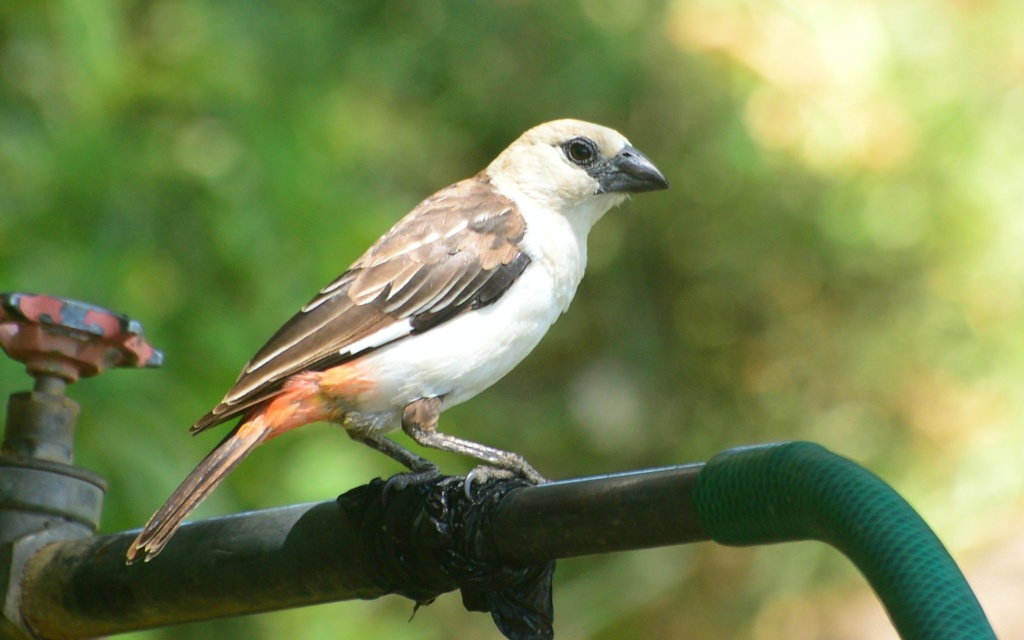
White-headed Buffalo Weaver
CC BY-SA 4.0
CC BY-SA 4.0 — Source: iNaturalist photo #136027451Identification
The white-headed buffalo weaver is a compact passerine measuring 170 to 190 mm in length and weighing 57 to 85 g. Its most distinctive feature is its striking white head and underparts, which contrast dramatically with a vividly orange-red rump and undertail coverts. Dark brown thighs and a conical black bill complete the plumage. Narrow white bands are visible on the wings, particularly when the bird spreads them sideways. Both sexes are similar in appearance and difficult to differentiate in the field. The two recognized subspecies differ in tail colour: D. d. dinemelli has a brown tail, while D. d. boehmi sports a black tail.
Range & Habitat
Native to East Africa, the white-headed buffalo weaver is found in Ethiopia, Kenya, Somalia, Sudan, Tanzania, and Uganda. The species shows a strong preference for arid and semi-arid environments, particularly dry brush and acacia thickets, though it also inhabits savanna and shrublands across its range.
Behaviour & Diet
This highly gregarious weaver is renowned for its habit of following African buffalo herds, feeding on insects disturbed by the grazing animals—a behaviour that inspired its common name. It forages on the ground in small groups of 3–6 birds, often in the company of starlings, feeding on beetles, butterflies, fruits, and seeds. The species is particularly vocal, producing various calls including parrot-like sounds such as "skwieeer" and "kiiyerr," along with ringing, repetitious "tew" notes and drawn-out trills. Flocks can be notably noisy at breeding and roosting sites, and birds frequently perch in trees where they hang upside-down with characteristic acrobatic movements.
White-headed buffalo weavers are monogamous breeders that nest colonially and can be quite defensive of their roosting sites, relying primarily on vocalization rather than physical altercation to deter intruders. Males display to females by spreading their wings to showcase white wing-patches and red-orange tail-coverts. Breeding pairs construct oval nests approximately 570 millimetres wide from pushed-together (rather than interwoven) materials, featuring a downward-opening entrance tube positioned 2 to 4 metres above ground. Nests are lined with soft materials, contain multiple rooms, and are fortified with defensive thorny branches. The female incubates 3–5 greyish to pale blue eggs marked with red, brown, and olive for 11–14 days, with both parents feeding the chicks. Multiple nests in a single large tree are common, and other birds such as African pygmy-falcons frequently adopt abandoned nests.
Best Time & Places to See It
The white-headed buffalo weaver's breeding season varies with local rainfall patterns, making timing dependent on regional conditions. Look for this species in dry acacia thickets and brushland habitats across Ethiopia, Kenya, Somalia, Sudan, Tanzania, and Uganda. Watching for active buffalo herds can increase your chances of locating foraging groups, and roosting and breeding sites are reliable locations where the birds' noisy activity makes them relatively easy to locate.
Photography Tips
The striking contrast between the white head and orange-red rump makes this species visually rewarding to photograph. Look for opportunities to capture birds displaying with spread wings to show their white wing-patches, or hanging upside-down in trees—behaviours that make dynamic wildlife images. Dawn and dusk visits to breeding and roosting sites offer chances to photograph multiple birds in close proximity. The acacia thicket habitats they prefer can present photographic challenges, so patient positioning and early morning light will yield the best results.
Arusha National Park
Tanzania
+555 birds+16 mammals
Where the slopes of Mount Mawenzi rise above the Arusha region, a compact yet ecologically rich national park unfolds across montane forest, moorland, and alpine zones.…
VIEW NATIONAL PARKKidepo Valley National Park
Uganda
+478 birds+24 mammals
Where the Narus and Kidepo rivers carve through northeastern Uganda's semi-arid lowlands, a landscape of sparse acacia woodland, grassland, and riverine thickets creates one of East…
VIEW NATIONAL PARKTsavo East National Park
Athi ward, Kenya
+468 birds+50 mammals
Across the semi-arid lowlands of southeastern Kenya, where acacia woodland fragments into scrubland and the landscape rolls toward the Indian Ocean horizon, lies one of Africa's…
VIEW NATIONAL PARKTsavo West National Park
Mwatate, Kenya
+513 birds+49 mammals
Where volcanic ridges and weathered lava flows meet the semi-arid lowlands of south-central Kenya, Tsavo West National Park unfolds across a landscape sculpted by fire and…
VIEW NATIONAL PARKAmboseli National Park
Etonet/Lenkism ward, Kenya
+501 birds+43 mammals
Where the Amboseli basin opens toward the Tanzanian frontier, a shallow alkaline lake mirrors vast skies across one of East Africa's most iconic savanna landscapes. The…
VIEW NATIONAL PARKKilimanjaro National Park
Kenya
+207 birds+16 mammals
Africa's highest mountain rises not in isolation but as the centerpiece of a vast national park that sweeps across the borderlands of northern Tanzania, where savanna…
VIEW NATIONAL PARKTarangire National Park
Tanzania
+527 birds+50 mammals
Acacia woodland and grassland sweep across the Manyara Region where the Tarangire River carves through low hills and volcanic soils, creating one of East Africa's most…
VIEW NATIONAL PARKNgorongoro Conservation Area
Tanzania
+626 birds+55 mammals
Volcanic calderas and open grassland dominate this high plateau in northern Tanzania, where the landscape rises above 2,000 metres and ancient geological forces have shaped both…
VIEW WILDLIFE MANAGEMENT AREAAbijata-Shalla Lakes National Park
Ethiopia
+438 birds+7 mammals
Two crater lakes of contrasting chemistry define this remote corner of Ethiopia's Rift Valley, where soda lakes and freshwater basins create a mosaic of distinct aquatic…
VIEW NATIONAL PARKBale Mountains National Park
Ethiopia
+397 birds+20 mammals
Where the Ethiopian highlands rise above 4,000 metres, the Bale Mountains create a landscape of stunning ecological extremes—from afroalpine grasslands swept by wind and mist to…
VIEW NATIONAL PARKMago National Park
Ethiopia
+128 birds+3 mammals
Where the Omo River cuts through southern Ethiopia's arid borderlands, Mago National Park sprawls across a landscape of dramatic escarpments, riverine forests, and semi-arid savanna that…
VIEW NATIONAL PARKOmo National Park
Ethiopia
+61 birds+4 mammals
Where the Omo River carves through southwestern Ethiopia, a landscape of riverine woodland, acacia savanna, and scattered grassland unfolds across one of East Africa's most remote…
VIEW NATIONAL PARKAwash National Park
Didiga, Ethiopia
+473 birds+23 mammals
Where the Ethiopian Rift Valley carves through volcanic plateaus, a ribbon of riverine forest winds through acacia scrubland and grassland, creating a mosaic of habitats that…
VIEW NATURAL PARKNech Sar National Park
Arba Minch, Ethiopia
+191 birds+10 mammals
Where the East African Rift Valley plateaus drop dramatically toward the shore of Lake Abaya, a mosaic of habitats unfolds across sun-scorched savanna and acacia woodland.…
VIEW NATIONAL PARKYabelo Wildlife Sanctuary
Bedewera, Ethiopia
+359 birds+5 mammals
Where acacia woodlands meet volcanic plateaus in southern Ethiopia, a landscape of austere beauty unfolds across nearly 2,500 square kilometers. Yabelo Wildlife Sanctuary sprawls across semi-arid…
VIEW WILDLIFE SANCTUARYChyulu Hills National Park
Kibwezi East, Kenya
+232 birds+30 mammals
Volcanic cones rise abruptly from the Kenyan savanna floor, their flanks clothed in dense acacia woodland and grassland that transforms the Chyulu Hills into an ecological…
VIEW NATIONAL PARKSibiloi National Park
Kenya
+118 birds
Where the northern deserts of Kenya meet the volcanic Chalbi Plain, Sibiloi National Park sprawls across a landscape shaped by millennia of tectonic upheaval and semi-arid…
VIEW NATIONAL PARKArabuko Sokoke Forest Reserve
Kilifi, Kenya
+383 birds+29 mammals
Coastal forest rises from the Indian Ocean plains of Kilifi County, where sandy soils and seasonal rainfall have sculpted a woodland ecosystem unlike anywhere else on…
VIEW NATURE RESERVENo community photos yet. Log in to add the first one.
No community observations of this species yet.