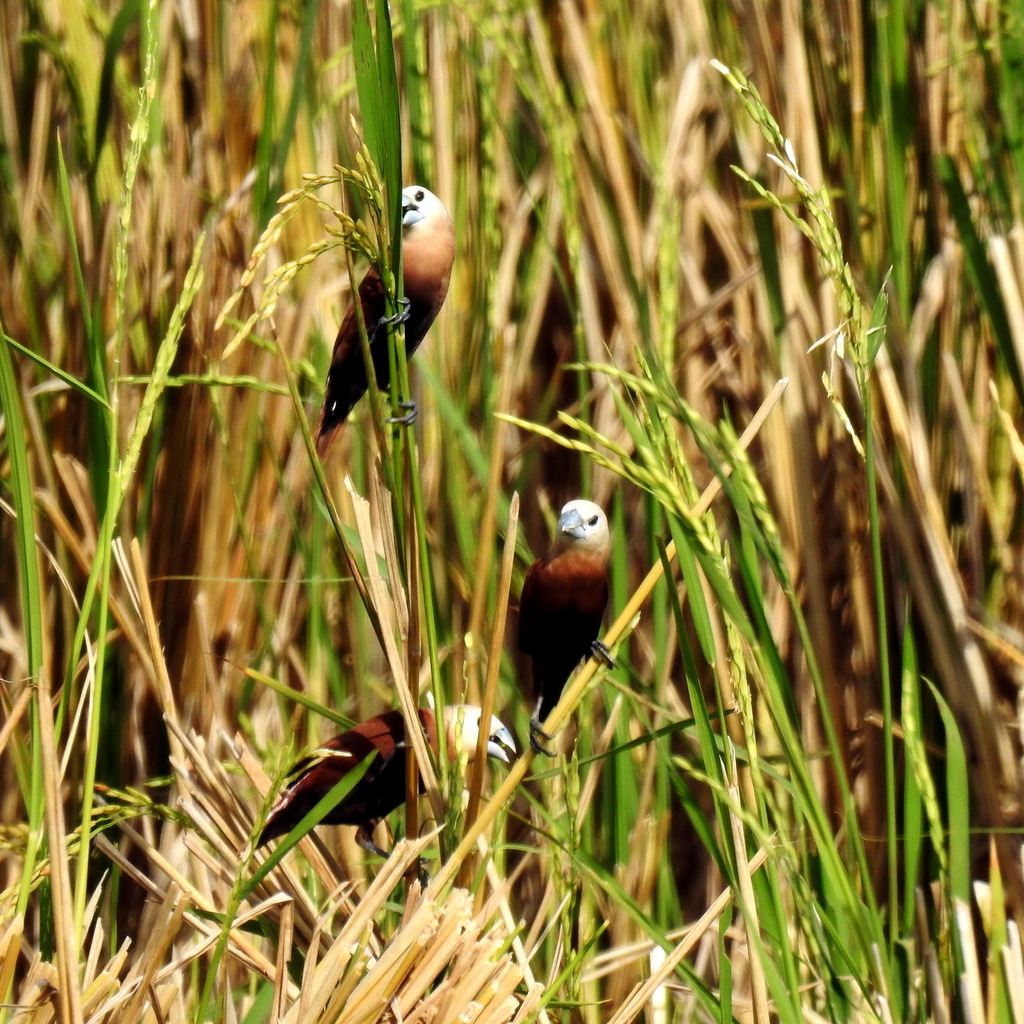
White-headed Munia
Photo © Abu Hamas
Photo © Abu Hamas — CC BY-SA 4.0 — Source: iNaturalist #77278900Identification
The White-headed Munia is a small passerine, typically 11 cm in length and weighing around 11 grams, with a striking and distinctive appearance. Its most characteristic feature is the contrasting white head and throat set against a chocolate-brown body. Adults display chestnut-brown upperparts, flanks, and wings, with an entirely white head, throat, and upper breast tinged with buff. The belly is black, the tail is black-brown, and the bill and legs are light grey.
This species is often confused with the Pale-headed Munia, but can be distinguished by its tan-coloured flanks, which are lighter than the brown wings, and by the absence of a black belly. Sexual dimorphism is subtle: males have a whiter head than females, becoming whiter with age, and show a more pronounced definition line between the breast and flanks. Juveniles are more cinnamon-coloured above with a buff face and underparts, making them practically impossible to differentiate from juveniles of related species.
Range & Habitat
The White-headed Munia is native to Southeast Asia, with populations found across Indonesia, Thailand, Malaysia, Vietnam, and Singapore. These birds favour tropical and subtropical habitats, showing a particular affinity for grasslands, wetlands, and cultivated areas. They are especially commonly associated with rice fields, where they can often be observed foraging among the crops.
Behaviour & Diet
White-headed Munias are highly social birds, typically encountered in flocks rather than singly or in pairs. Their diet consists primarily of seeds, with a particular preference for grass seeds and rice grains, making them well-adapted to agricultural landscapes.
During breeding season, both males and females participate in nest construction, building distinctive dome-shaped nests that are typically positioned low in vegetation, often near or over water. These nests are woven from grass, leaves, and other plant fibres into fairly bulky structures with a side entrance. A female typically lays a clutch of 4 to 7 white eggs, which both parents incubate for approximately 11–13 days. The breeding season usually coincides with the availability of food, often during or after the rainy season, though timing varies by location.
Best Time & Places to See It
White-headed Munias are most readily observed during the breeding season, which typically follows the rainy season when food becomes abundant. Look for them in rice-growing regions throughout their Southeast Asian range, particularly in Thailand, Malaysia, and Indonesia. Rice fields during the growing season offer the best opportunities to encounter flocks of these birds.
Photography Tips
The White-headed Munia's striking contrast between its white head and chocolate-brown body makes it visually distinctive and rewarding to photograph. Since these birds are gregarious and often found in flocks in relatively open habitat such as rice fields, patient photographers should find reasonable opportunities for close observation. Early morning visits to rice-field habitats will increase your chances of encountering active birds. The subtle sexual dimorphism—particularly the whiter head of adult males—provides an interesting detail to capture if you can observe multiple individuals together.
Taman Negara National Park
Kampong Samas, Malaysia
+393 birds+48 mammals
Where ancient rainforest meets limestone peaks, one of Southeast Asia's oldest protected wilderness preserves sprawls across 4,343 square kilometers of primordial landscape. Dipterocarp giants tower overhead,…
VIEW NATIONAL PARKTaman Nasional Baluran
Situbondo, Indonesia
+189 birds+9 mammals
Across the northeastern tip of East Java, where monsoon winds sweep down from the Bali Strait, a landscape of contrasts unfolds within 374 square kilometres of…
VIEW NATIONAL PARKTaman Nasional Meru Betiri
Jember, Indonesia
+93 birds+1 mammals
Across East Java's southeastern coast, where the Indian Ocean meets a landscape of volcanic soils and monsoon-fed forests, sprawls a national park that epitomizes the ecological…
VIEW NATIONAL PARKWest Bali National Park
Gerokgak, Indonesia
+240 birds+8 mammals
Across West Bali's northwestern reaches, where the Indian Ocean meets volcanic slopes and limestone cliffs plunge toward turquoise shallows, sprawls a protected realm of roughly 325…
VIEW NATIONAL PARKMount Merapi National Park
Hargobinangun, Indonesia
+150 birds+3 mammals
Where the volcanic slopes of central Java rise into mist and montane forest, Mount Merapi National Park guards one of Indonesia's most dynamic landscapes. Spanning roughly…
VIEW NATIONAL PARKKerinci Seblat National Park
Kerinci, Indonesia
+228 birds+16 mammals
Across nearly 67,000 square kilometres of Sumatra's spine, a mountainous realm of equatorial rainforest rises from steaming lowlands to volcanic peaks shrouded in cloud. Kerinci Seblat…
VIEW NATIONAL PARKWay Kambas National Park
Lampung Timur, Indonesia
+237 birds+20 mammals
Across the low swamplands of eastern Lampung, where freshwater wetlands merge into tidal mangrove forests along the Sunda Strait, sprawls one of Sumatra's most vital sanctuaries.…
VIEW NATIONAL PARKNo community photos yet. Log in to add the first one.
No community observations of this species yet.