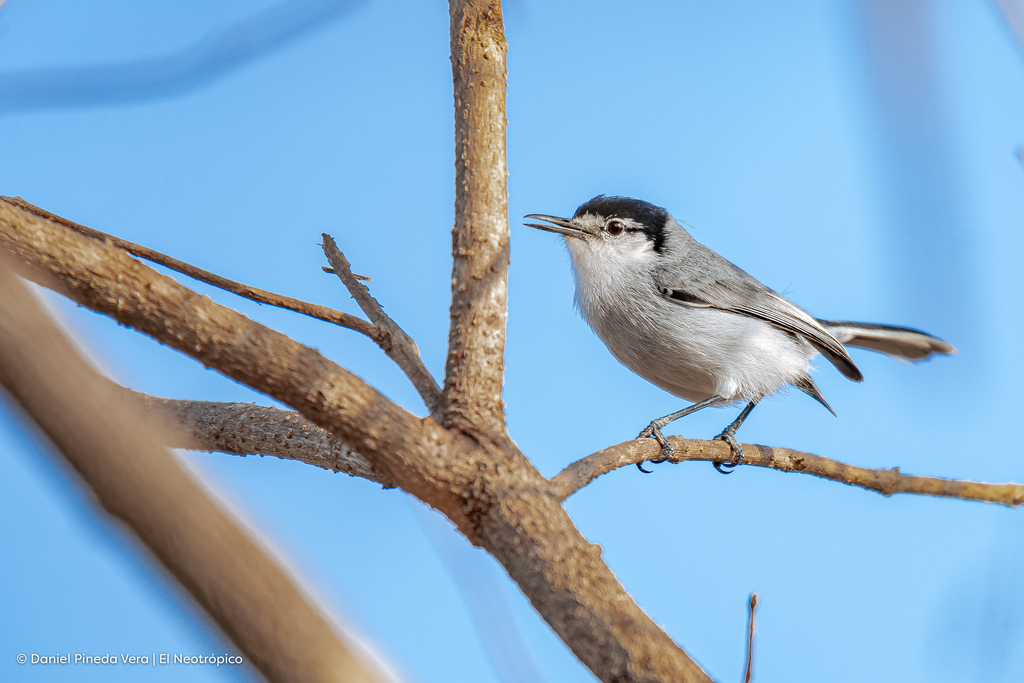
White-lored Gnatcatcher
Photo © Daniel Pineda Vera
Photo © Daniel Pineda Vera — CC BY 4.0 — Source: iNaturalist photo #178832567The white-lored gnatcatcher (Polioptila albiloris) is a species of bird in the family Polioptilidae. It is found in Costa Rica, El Salvador, Guatemala, Honduras, Mexico, and Nicaragua. == Taxonomy and systematics == The white-lored gnatcatcher was previously considered conspecific with the black-capped gnatcatcher (Polioptila nigriceps). The Yucatan gnatcatcher (P. albiventris) was previously a treated as a subspecies of the white-lored. The white-lored gnatcatcher has two subspecies, the nominate Polioptila albiloris albiloris and P. a. vanrossemi. == Description == The white-lored gnatcatcher is 11 to 12 cm (4.3 to 4.7 in) long and weighs 6 to 9 g (0.21 to 0.32 oz). The nominate male in breeding plumage has a black cap down to the eyes and including the nape. The rest of the upperparts are bluish gray. The tail is black with white outermost feathers. The throat is white becoming pale bluish gray on the breast and flanks. The female has a dark gray cap and the eponymous white lores and supercilium. The juvenile is similar to the female but has browner upperparts. The male P. a. vanrossemi has a larger black cap and longer wings and tail than the nominate. == Distribution and habitat == The nominate white-lored gnatcatcher…
Santa Rosa National Park
Santa Elena, Costa Rica
+359 birds+30 mammals
Where Pacific-facing slopes descend from volcanic uplands toward the Guanacaste lowlands, Santa Rosa National Park unfolds across a mosaic of tropical dry forest, gallery woodland, and…
VIEW NATIONAL PARKGuanacaste National Park
Santa Elena, Costa Rica
+461 birds+17 mammals
Where the Pacific slopes of northwestern Costa Rica rise toward the Continental Divide, dry tropical forest gives way to cloud-laden peaks and misty ridges—a landscape that…
VIEW NATIONAL PARKParque Nacional Grutas de Cacahuamilpa
Pilcaya, Mexico
+97 birds+12 mammals
Where limestone ridges rise abruptly from the tropical deciduous forests of central Guerrero, the Grutas de Cacahuamilpa National Park shelters one of Mexico's most extensive cave…
VIEW NATIONAL PARKCarara National Park
Tárcoles, Costa Rica
+397 birds+19 mammals
Where the Pacific coastal plain meets transitional forest, Carara National Park straddles one of Central America's most dynamic ecological boundaries. The park's landscape encompasses lowland deciduous…
VIEW NATIONAL PARKPalo Verde National Park
Bagaces, Costa Rica
+318 birds+24 mammals
Dry forest spreads across Palo Verde's low-lying terrain in northwestern Guanacaste, where seasonal rivers and lagoons etch through deciduous woodland that sheds its canopy each winter.…
VIEW NATIONAL PARKRincón de la Vieja National Park
Liberia, Costa Rica
+451 birds+30 mammals
Where volcanic slopes rise abruptly from the Guanacaste lowlands, Rincón de la Vieja National Park sprawls across a landscape shaped by geothermal drama and seasonal extremes.…
VIEW NATIONAL PARKVolcán Tenorio National Park
Guatuso, Costa Rica
+480 birds+12 mammals
Where volcanic slopes rise through Costa Rica's northwestern borderlands, Volcán Tenorio National Park sprawls across terrain shaped by ancient lava flows and mineral-rich springs. The park's…
VIEW NATIONAL PARKMarino Las Baulas National Park
Santa Cruz, Costa Rica
+246 birds+9 mammals
Where the Pacific meets a mosaic of dry forest and mangrove estuary, this coastal national park protects one of Central America's most dynamic wildlife theatres. The…
VIEW NATIONAL PARKCurú National Wildlife Refuge
Paquera, Costa Rica
+249 birds+8 mammals
Where the Pacific coast of Puntarenas dissolves into dry deciduous forest and mangrove fringe, Curú Wildlife Sanctuary holds one of Costa Rica's most ecologically vital yet…
VIEW WILDLIFE SANCTUARYNo community photos yet. Log in to add the first one.
No community observations of this species yet.