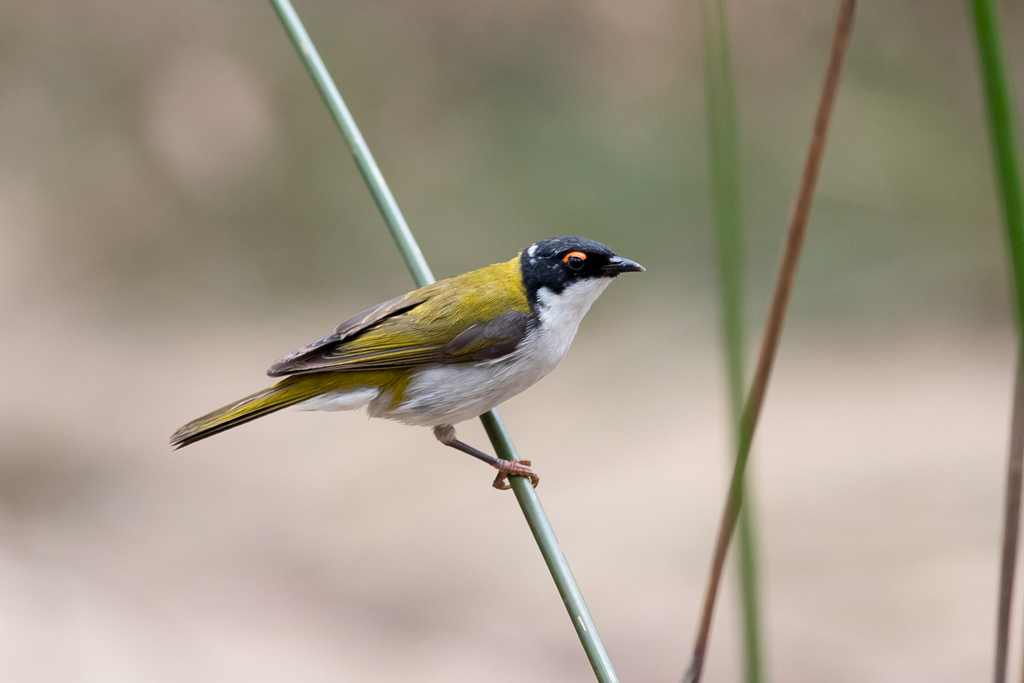
White-naped Honeyeater
Photo © Kym Nicolson
Photo © Kym Nicolson — CC BY 4.0 — Source: iNaturalist photo #64880294Identification
The white-naped honeyeater is a mid-sized honeyeater measuring 13–15 cm in length. Its most distinctive feature is the crescent-shaped white patch on the nape—the origin of its common name. The bird has a black head, nape, and throat contrasting sharply with olive-green upperparts and white underparts. A striking red patch sits over each eye, adding to its elegant appearance. It is noticeably thinner than other similar black-headed honeyeater species in the genus Melithreptus. Juveniles differ from adults, displaying brownish crowns and an orange base to the bill. The bird's call is a distinctive mjerp mjerp sound.
Range & Habitat
Native to eastern Australia, this species inhabits dry sclerophyll eucalypt woodlands and forests. It is closely related to the black-headed honeyeater of Tasmania and represents the eastern population of what was once considered a single widespread species. The southwestern Australian population, formerly classified as a subspecies, is now recognized as the distinct Gilbert's honeyeater.
Behaviour & Diet
The white-naped honeyeater is primarily a nectar feeder, drawing sustenance from the flowers of various plants throughout its range. It supplements this diet with insects and other invertebrates, making it an opportunistic forager. Breeding occurs from July to December, with pairs typically raising one or two broods during this season. The nest is a thick-walled bowl constructed from grasses and bark fragments, positioned in the fork of a tall tree, usually a eucalypt. Clutches typically consist of two or three eggs, which are shiny buff-pink with sparse red-brown spotting.
Best Time & Places to See It
The breeding season from July to December offers the best opportunity to locate this species, as birds are most active during nesting. Look for white-naped honeyeaters in eucalypt woodlands and forests throughout eastern Australia, particularly in areas with abundant flowering plants. Scanning tall eucalypts for movement and listening for their characteristic mjerp calls will aid in locating them.
Photography Tips
The white-naped honeyeater's striking black head and white nape marking make it visually distinctive, but patience is essential for good photography. Position yourself near flowering eucalypts where birds are likely to forage, and use a telephoto lens to maintain distance while capturing detail. The bird's small size and active foraging behavior demand fast shutter speeds. Early morning light will best reveal the contrast between its dark head and pale underparts, as well as the brilliant red eye patch that makes this species so photogenic.
Alpine National Park
Bald Rock National Park
Barrington Tops National Park
Belair National Park
Ben Boyd National Park
Blue Mountains National Park
Bouddi National Park
Bribie Island National Park
Budawang National Park
Nothing matches these filters.
No community photos yet. Log in to add the first one.
No community observations of this species yet.