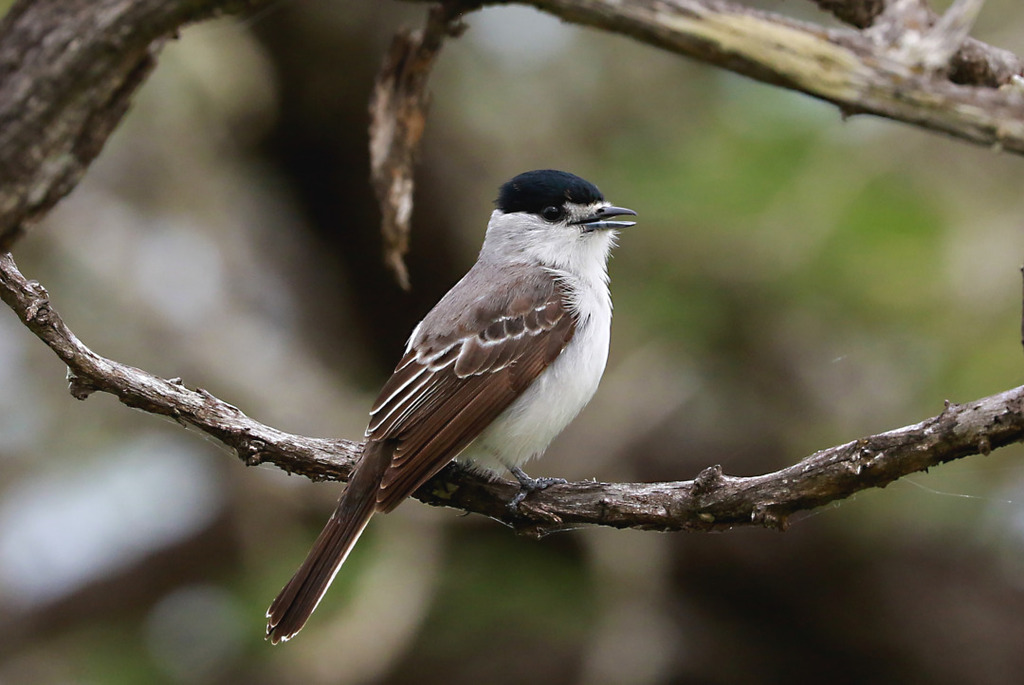
White-naped Xenopsaris
Photo © Lindolfo Souto
Photo © Lindolfo Souto — CC BY 4.0 — Source: iNaturalist photo #416031086The white-naped xenopsaris (; Xenopsaris albinucha), also known as the reed becard and white-naped becard, is a species of suboscine bird in the family Tityridae, the only member of the genus Xenopsaris. It is found in South America, in humid subtropical and tropical savanna climates in most of the countries east of the Andes: Venezuela, Brazil, Bolivia, Paraguay, Uruguay, and Argentina. Living in open woodland and other open forest habitats, it is mostly sedentary, though some populations may be migratory. The species, which is closely related to becards and tityras, was thought to be either a tyrant-flycatcher or cotinga, before it was placed in Tityridae. The bird is 12.5 to 13 cm (4.9–5.1 in) in length, with whitish undersides, a black crown, and grey-brown upperparts. The sexes are similar in appearance, though the females have duller upperparts. It feeds on insects in the foliage of trees and bushes, and sometimes on the ground. Nesting occurs in a simple cup nest placed in the fork of a tree. Both parents incubate the eggs and help feed the chicks. When the chicks fledge, the parents may divide up the brood to continue helping. The species is not common and little is known…
Morrocoy National Park
Municipio Silva
+290 birds
Where the Caribbean coast of northwestern Venezuela meets protected coastal waters, a mosaic of mangrove forests, sandy beaches, and coral reef systems defines Morrocoy National Park.…
VIEW NATIONAL PARKChapada dos Guimarães National Park
Brazil
+450 birds+1 mammals
Where weathered sandstone plateaus rise above the cerrado grasslands of central Brazil, Chapada dos Guimarães National Park protects 624 square kilometres of ecological transition zone that…
VIEW NATIONAL PARKPantanal Matogrossense National Park
Brazil
+322 birds+17 mammals
Where the flooded forests of central Brazil meet vast seasonally inundated grasslands, Pantanal Matogrossense National Park sprawls across nearly 2,900 square kilometers of one of the…
VIEW NATIONAL PARKChapada Diamantina National Park
Brazil
+346 birds+5 mammals
Where granite peaks and sandstone cliffs rise abruptly from the Brazilian interior, Chapada Diamantina National Park sprawls across 4,215 square kilometers of some of Brazil's most…
VIEW NATIONAL PARKRío Pilcomayo National Park
Argentina
+271 birds+13 mammals
Where the Río Pilcomayo cuts through northeastern Argentina's subtropical lowlands, a sprawling mosaic of wetlands, grasslands, and seasonally flooded forests creates one of South America's most…
VIEW NATIONAL PARKNo community photos yet. Log in to add the first one.
No community observations of this species yet.