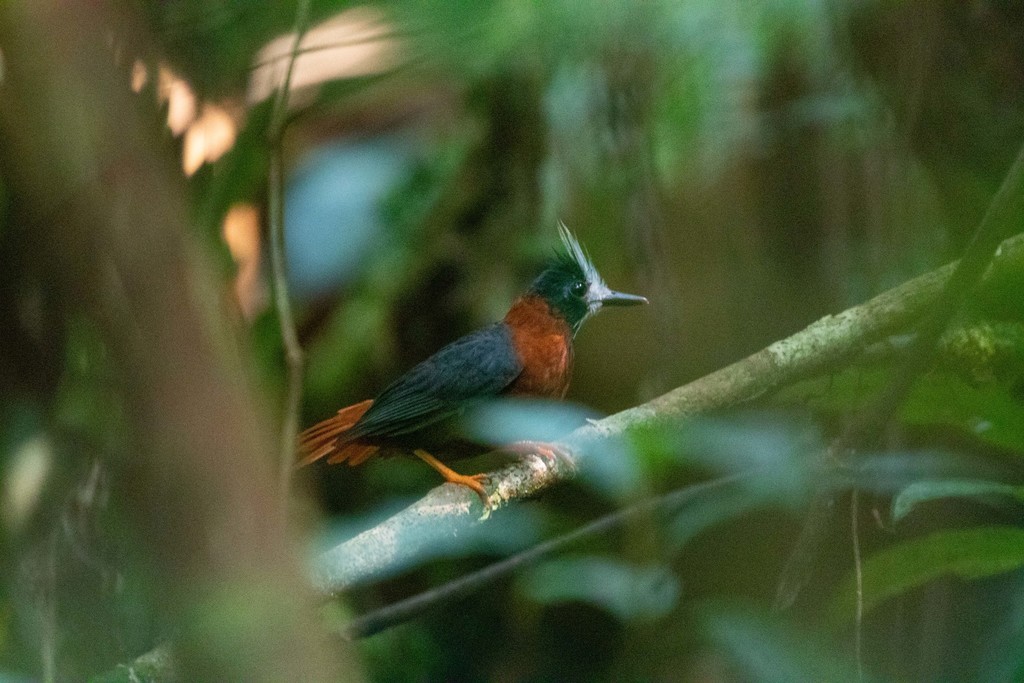
White-plumed Antbird
Photo © Thibaud Aronson
Photo © Thibaud Aronson — CC BY-SA 4.0 — Source: iNaturalist photo #94212054The white-plumed antbird (Pithys albifrons) is a small species of insectivorous bird in subfamily Thamnophilinae of family Thamnophilidae, the "typical antbirds". It is found in Brazil, Colombia, Ecuador, French Guiana, Guyana, Peru, Suriname, and Venezuela. == Taxonomy == The first formal description of the white-plumed antbird was by the Swedish naturalist Carl Linnaeus in 1766 in the twelfth edition of his Systema Naturae. He introduced the binomial name Pipra albifrons. The white-plumed antbird has two subspecies, the nominate P. a. albifrons (Linnaeus, 1766) and P. a. peruvianus (Taczanowski, 1884). Some taxonomists have separated a third subspecies, P. a. brevibarba, from peruvianus but this treatment has found little acceptance. It shares genus Pithys with the white-masked antbird (P. castaneus). Pithys and Phaenostictus are sister genera, and the two may be distinguished by smaller length and weight, shorter tails, and louder songs in Pithys than Phaenostictus. == Description == The white-plumed antbird is 11.5 to 12.5 cm (4.5 to 4.9 in) and weighs 18 to 23 g (0.63 to 0.81 oz). The species is monomorphic, meaning both sexes look the same. Adults of both subspecies have the eponymous white tufts on their forehead and chin. Their crown and the rest of their…
Monte Roraima National Park
Brazil
+226 birds+1 mammals
Where the tepuis rise from the Amazon basin like islands in a sea of forest, Monte Roraima National Park sprawls across 3,714 square kilometres of one…
VIEW NATIONAL PARKJaú National Park
Brazil
+354 birds+3 mammals
Vast floodplain forests and blackwater rivers define this remote corner of western Amazonas, where the Rio Negro and its tributaries have carved an intricate mosaic of…
VIEW NATIONAL PARKAnavilhanas National Park
Brazil
+468 birds+8 mammals
Across the Rio Negro in central Amazonas, an archipelago of over a thousand islands rises from the world's largest rainforest river system, creating a labyrinth of…
VIEW NATIONAL PARKNo community photos yet. Log in to add the first one.
No community observations of this species yet.