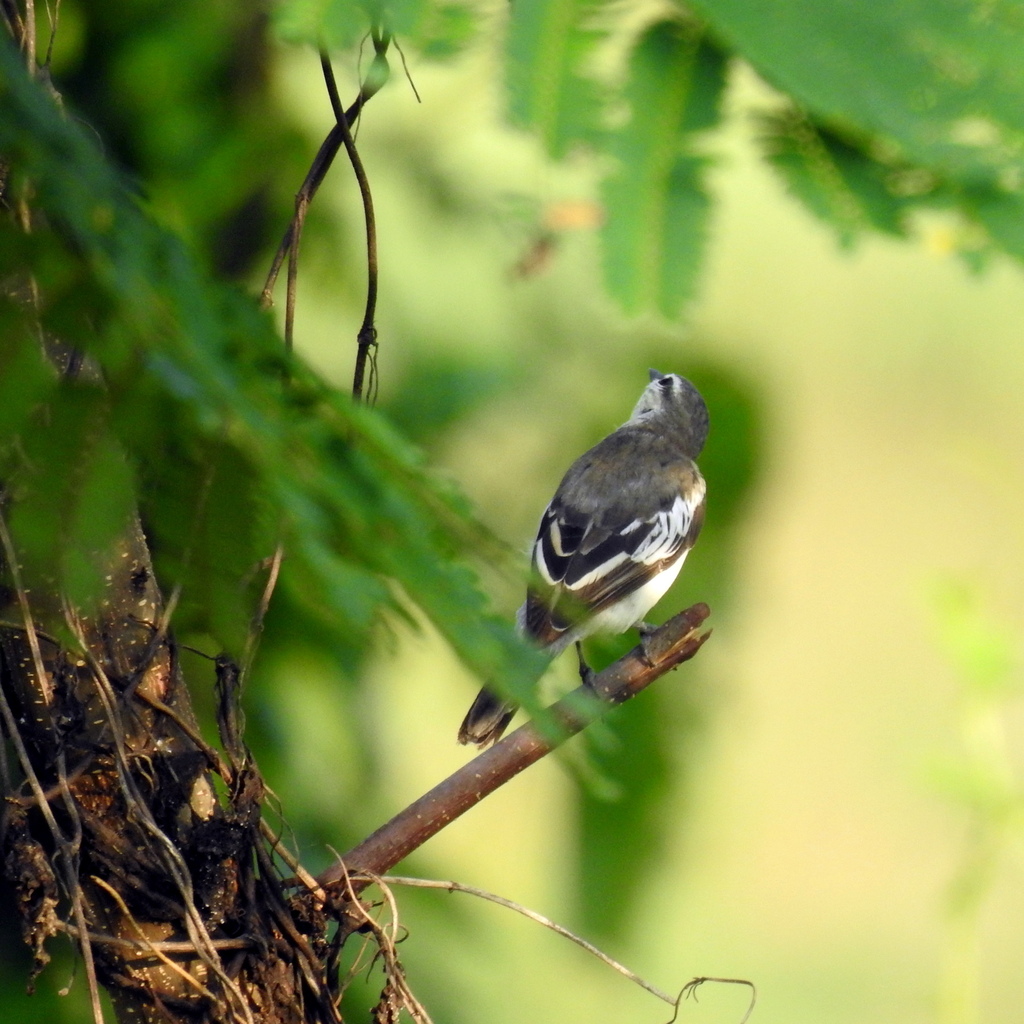
White-shouldered Triller
Photo © Abu Hamas
Photo © Abu Hamas — CC BY-SA 4.0 — Source: iNaturalist #196804181Identification
The white-shouldered triller is a fairly small passerine, measuring 17 centimetres in length. Males are striking birds with mainly black upperparts contrasted against white underparts. Key field marks include a grey rump, a white stripe over the eye, distinctive white wing-patches, and white on the outer tail-feathers. The bill is grey with a black tip, and the legs and feet are black.
Females show a similar overall pattern to males but are brown rather than black above, with fine black barring across the underparts. When identifying this species in the field, note the white supercilium, which distinguishes it from the similar male white-winged triller (which lacks this eye-stripe). The pied triller is also comparable but is slightly smaller with a broader stripe above the eye and more extensive white in the wing.
Range & Habitat
The white-shouldered triller is endemic to Indonesia and East Timor. Its range encompasses eastern Java, southern Sulawesi, Bali, and the Lesser Sunda Islands. The species prefers dry, lowland areas and is typically found in open woodland, savannas, and agricultural land where it can forage openly.
Behaviour & Diet
This is an insectivorous species that employs a characteristic foraging technique, swooping down from exposed perches to catch prey on the ground. The white-shouldered triller is vocal, producing a distinctive metallic whistling song that is sometimes delivered in flight. It also utters rapid series of harsh notes, making it detectable by ear even when visual contact is difficult.
Best Time & Places to See It
The species is best sought in open woodland and savanna habitats across its range in eastern Indonesia and East Timor. Look for birds in dry lowland areas where scattered trees provide suitable perches for hunting. Early morning hours are typically productive for observation, when the birds are most vocal and active.
Photography Tips
The white-shouldered triller's preference for open habitats and exposed perches makes it relatively approachable for photography compared to many forest species. Position yourself to backlight the white wing-patches and tail markings, which are key field marks. The metallic whistling calls provide an audio cue to locate birds, allowing you to anticipate their movements and be ready when they swoop to the ground to feed. Use a shutter speed fast enough to freeze the bird's characteristic hunting dives.
Bogani Nani Wartabone National Park
Boodjamulla National Park
Chiltern-Mt Pilot National Park
Kakadu National Park
Komodo National Park
Lore Lindu National Park
Mutis Timau National Park
Taman Nasional Baluran
West Bali National Park
Nothing matches these filters.
No community photos yet. Log in to add the first one.
No community observations of this species yet.