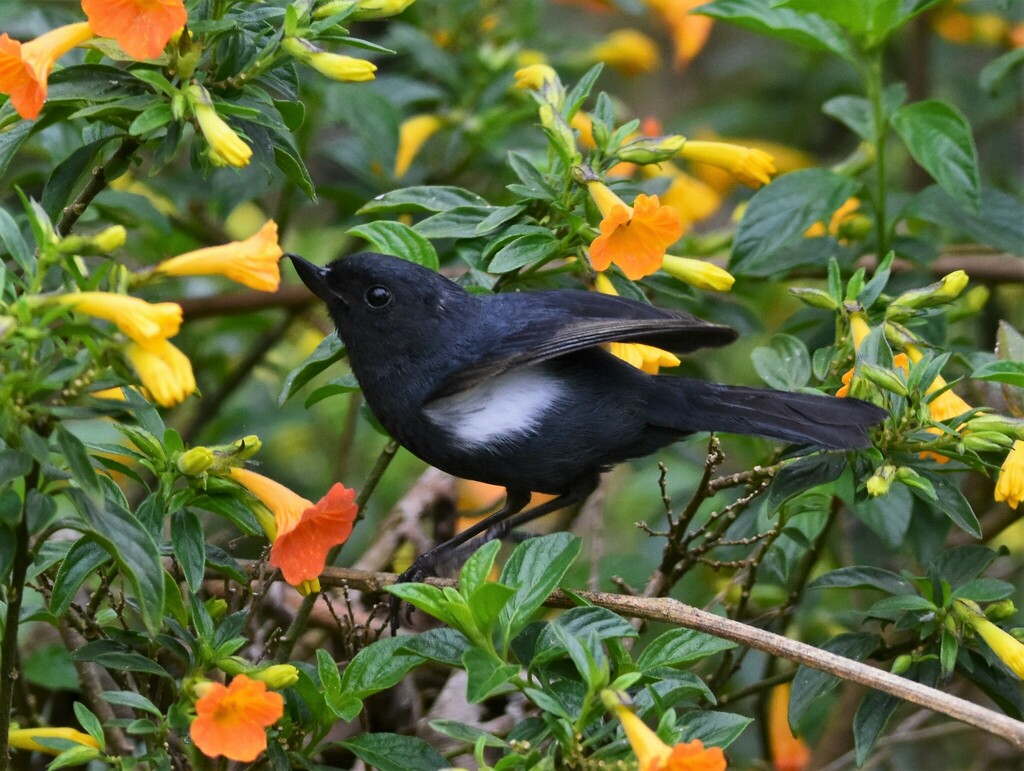
White-sided Flowerpiercer
Photo © Zac Peterson
Photo © Zac Peterson — CC BY 4.0 — Source: iNaturalist photo #226798057Identification
The white-sided flowerpiercer is a fairly small bird, slightly larger than a black-capped chickadee and slightly smaller than a great tit, measuring 12.2–13.2 cm in length. The most distinctive feature of both sexes is the bright white on the sides: pectoral tufts and underwing linings that flash conspicuously when the bird flicks its wings in flight. Males are blackish-slate overall with these white markings, while females are olive-brown above and buffy-brown below, also showing the characteristic white sides. Both sexes have dark brown irises, blackish bills (sometimes paler at the base of the lower mandible), and grey legs. Immature males resemble females but are duller with blurred streaks on the breast, while juveniles are dark grey-brown with faintly scaled plumage.
Range & Habitat
This fairly common and widespread flowerpiercer is found in Colombia, Ecuador, Peru, and Venezuela across four recognized subspecies. The nominate subspecies occupies the highest elevations, ranging from the Andes of Venezuela, the Serranía del Perijá on the Colombia-Venezuela border, and the Sierra Nevada de Santa Marta, south through all three Andean ranges to southern Ecuador and probably northern Peru. Other subspecies occupy more restricted ranges: D. a. federalis in coastal cordillera of northern Venezuela, D. a. schistacea in extreme southwest Ecuador and northwest Peru, and D. a. affinis in southeastern Peru. The species inhabits subtropical and tropical moist montane forests, and has adapted to heavily degraded former forest habitats.
Behaviour & Diet
Like all flowerpiercers, Diglossa albilatera possesses a specially adapted bill that enables it to pierce the sides of flower blossoms to access nectar—a behaviour that gives the genus its common name. This adaptation allows the species to exploit nectar sources inaccessible to other birds. The bird frequently flicks its wings, a behavioural habit that regularly displays its distinctive white side markings, making it recognizable even when perched among vegetation.
Best Time & Places to See It
The white-sided flowerpiercer's preference for montane forest habitats means it is best encountered at higher elevations throughout its Andean range. The species' widespread occurrence across Colombia, Ecuador, Peru, and Venezuela, combined with its fairly common status, makes it accessible to nature travellers exploring cloud forests and humid mountain slopes across these countries. Look for it in subtropical and tropical moist forests where flowering plants are abundant.
Photography Tips
The key to photographing this species is anticipating its frequent wing flicks, which reveal the diagnostic white underwing and pectoral patches. Position yourself where the light is behind or to the side of the bird to capture the contrast between the dark plumage and bright white markings. In montane forest habitats, early morning light often provides the best conditions. Males' darker plumage may require slightly faster shutter speeds than females' lighter colouration to ensure detail in both highlights and shadows.
Sangay National Park
Cebadas, Ecuador
+320 birds+10 mammals
High in Ecuador's Andean spine, where the Western Cordillera rises to touch perpetual snow, a landscape of volcanic drama and ecological intensity unfolds across Sangay National…
VIEW NATIONAL PARKPodocarpus National Park
Zamora, Ecuador
+496 birds+6 mammals
Where the Andes descend toward the Amazon basin, Podocarpus National Park sprawls across nearly 2,800 square kilometres of the most biodiverse terrain in Ecuador's southern highlands.…
VIEW NATIONAL PARKYacuri National Park
Las Juntas, Ecuador
+166 birds+1 mammals
Where the eastern slopes of the Andes descend into Ecuador's southern frontier, Yacuri National Park unfolds across nearly 1,300 square kilometers of montane cloud forest and…
VIEW NATIONAL PARKSumaco Napo-Galeras National Park
Loreto, Ecuador
+563 birds+4 mammals
Where Ecuador's Amazon transitions into cloud forest, a massive shield volcano rises from the emerald lowlands of Orellana Province, anchoring one of the continent's most biodiverse…
VIEW NATIONAL PARKAntisana National Park
Quijos, Ecuador
+432 birds+21 mammals
Where the eastern Andean slopes descend into the Amazon basin, Antisana National Park sprawls across roughly 2,500 square kilometers of some of South America's most dramatic…
VIEW NATIONAL PARKCotopaxi National Park
Mulaló, Ecuador
+211 birds+6 mammals
High in Ecuador's volcanic corridor, where the páramo transitions into cloud forest along the slopes of Cotopaxi volcano, the national park unfolds across nearly 500 square…
VIEW NATIONAL PARKLlanganates National Park
Tena, Ecuador
+239 birds+8 mammals
Where the eastern slopes of the Andes plunge toward the Amazon basin, Llanganates National Park sprawls across nearly 3,500 square kilometers of montane wilderness, its terrain…
VIEW NATIONAL PARKCajas National Park
Cuenca, Ecuador
+190 birds+7 mammals
High in the Andes above Cuenca, where elevation ranges from 3,100 to 4,200 metres, the páramo landscape dominates—a windswept realm of cushion plants, alpine grasses, and…
VIEW NATIONAL PARKNatural Munchique National Park
El Tambo, Colombia
+194 birds
Where the Western Cordillera rises steeply from the Pacific plains of southwestern Colombia, Natural Munchique National Park sprawls across 1,078 square kilometers of montane forest that…
VIEW NATIONAL PARKNatural Serranía de los Yariguíes National Park
El Carmen de Chucurí, Colombia
+320 birds+3 mammals
Where the northern cordilleras of Colombia rise toward cloud forest, the Serranía de los Yariguíes unfolds across nearly 1,820 square kilometers of some of the most…
VIEW NATIONAL PARKNatural Farallones de Cali National Park
Buenaventura, Colombia
+733 birds+27 mammals
Where the Pacific coastal plain meets the western slopes of the Andes, Farallones de Cali National Park sprawls across nearly 3,500 square kilometers of dramatic topography…
VIEW NATIONAL PARKNatural Chingaza National Park
Junín, Colombia
+285 birds+6 mammals
Where the Andes rise above three thousand metres in the Cundinamarca region, high-altitude grasslands and cloud forests converge in a landscape shaped by both geology and…
VIEW NATIONAL PARKNatural Pisba National Park
Socotá, Colombia
+95 birds
High-altitude grasslands and páramo ecosystems sweep across the Andean terrain of this national park, where thin soils and cool, windswept conditions define a landscape shaped by…
VIEW NATIONAL PARKPuracé National Natural Park
Puracé, Colombia
+327 birds+2 mammals
Where the Andes thrust upward across southwestern Colombia, Puracé National Natural Park spans nearly 2,631 square kilometers of some of South America's most dramatic montane terrain.…
VIEW NATIONAL PARKGuácharos Cave National Natural Park
Acevedo, Colombia
+359 birds
High in the Andean foothills of southern Huila, where mist-laden slopes rise above 1,600 metres, lies a landscape carved by underground rivers and crowned by karst…
VIEW NATIONAL PARKNatural Sumapaz National Park
Cubarral, Colombia
+368 birds+1 mammals
Where the Andes descend toward the Amazon basin, the high páramo grasslands of Sumapaz National Park sprawl across more than five thousand square kilometers of Meta…
VIEW NATIONAL PARKEl Tamá National Park
Toledo, Colombia
+435 birds
Where the Andes descend toward the Caribbean coastal lowlands of northern Colombia, El Tamá National Park sprawls across nearly 3,800 square kilometres of montane forest, cloud…
VIEW NATIONAL PARKNatural Nevado del Huila National Park
Planadas, Colombia
+117 birds
Where the Colombian Andes rise above 5,000 metres, tropical cloud forest yields to páramo and glaciated peaks, and the Planadas region of Tolima contains one of…
VIEW NATIONAL PARKYanachaga–chemillén National Park
Palcazu, Peru
+639 birds+6 mammals
Where the eastern slopes of Peru's central cordillera plunge into cloud forest, Yanachaga–Chemillén National Park protects nearly three thousand square kilometres of montane wilderness that few…
VIEW NATIONAL PARKNo community photos yet. Log in to add the first one.
No community observations of this species yet.