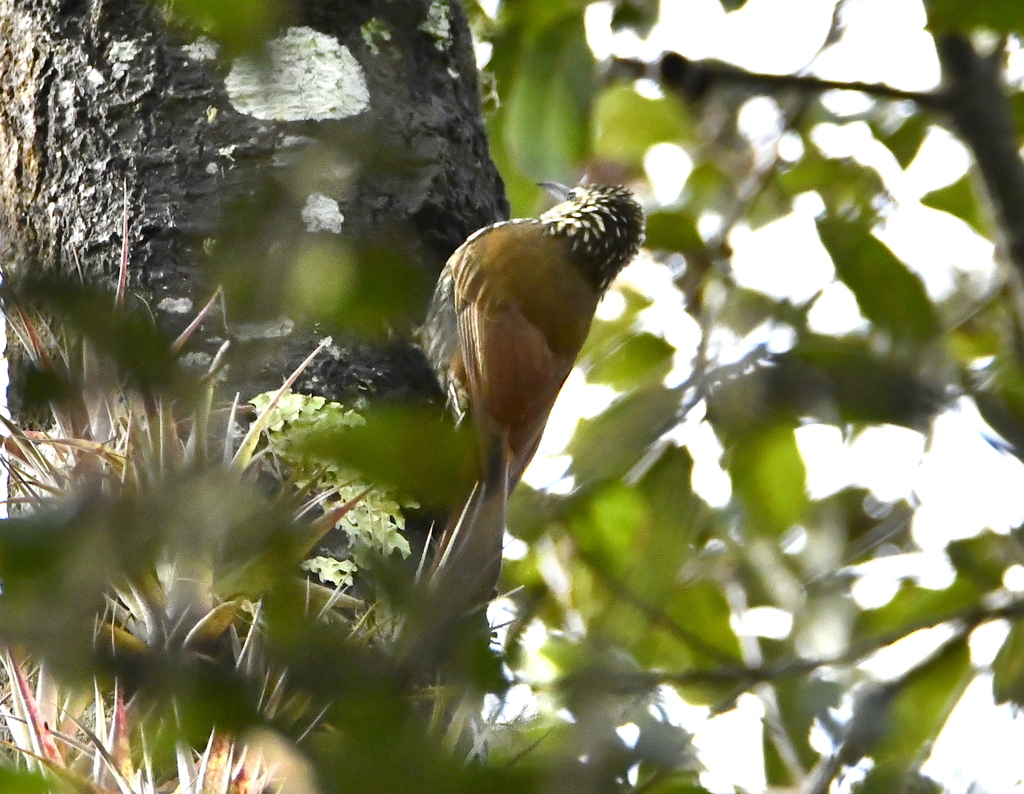
White-striped Woodcreeper
Photo © Javier Hernandez
Photo © Javier Hernandez — CC BY 4.0 — Source: iNaturalist #330045843Identification
The white-striped woodcreeper is a slim, medium-sized woodcreeper measuring 21.5 to 23.5 cm long and weighing 30 to 40 g. Its most distinctive features are a long, slender, decurved bill and striking head markings: a pale face with white to buff-white ear coverts, supercilium, and eyering contrasting with a blackish stripe behind the eye. The crown and nape are dark brown to blackish, adorned with buffy to whitish spots that extend as streaks onto the back. Upperparts are olive-brown or tawny, while flight feathers, rump, and tail are cinnamon-rufous to rufous-chestnut. The throat is white and unmarked, but the breast has a distinctive blackish scaly appearance. Remaining underparts are dusky gray with white streaks. Males and females are identical in plumage, though juveniles show more olive tones, less regular markings, and a shorter bill.
Range & Habitat
This species is endemic to Mexico, occurring in two subspecies: the northwestern L. l. umbrosus (from Sonora and Chihuahua south to Durango, Nayarit, and Jalisco) and the western and southern L. l. leucogaster (from Jalisco and Zacatecas south to Oaxaca on the Pacific side, and from Veracruz to Oaxaca on the Caribbean side). The white-striped woodcreeper inhabits humid montane forests and drier oak, pine-oak, and pine-fir forests in subtropical and temperate zones, as well as lowland tropical deciduous and mixed coniferous forests at higher elevations. It strongly favors mature forest but occasionally uses secondary growth, typically occurring between 900 and 3,500 m elevation, with recorded extremes from 400 to 4,000 m.
Behaviour & Diet
This species is essentially a year-round resident throughout its range, though some populations move to lower elevations during winter. The white-striped woodcreeper feeds primarily on arthropods, foraging singly or in pairs while often joining mixed-species feeding flocks. It actively searches all forest levels, characteristically hitching in a spiral motion up trunks and branches, flaking bark and probing crevices to capture prey. Its breeding season spans at least February to May, and it apparently nests in tree cavities, though details of its breeding biology remain poorly known. The bird's vocalizations are distinctive: its song is described as a sputtering trill ('zzzzzzzzztztztztztzttt-t-t-bt-bt-bt'), and its call is a short rough trill ('tsisirr').
Best Time & Places to See It
The white-striped woodcreeper is fairly common to common in middle-elevation forests throughout its range, though rare at lower and higher elevations. Its year-round residency makes it visible in suitable habitat year-round, though breeding season (February to May) offers opportunities to locate birds through their distinctive vocalizations. Focus your search in humid montane and pine-oak forests across Mexico's Pacific and interior regions, particularly in the established range of both subspecies. Mixed-species feeding flocks provide good opportunities to locate this bird, which can be difficult to spot otherwise.
Photography Tips
The white-striped woodcreeper's behavior of spiraling up tree trunks offers excellent opportunities for photography, though patience is essential. Position yourself along likely foraging routes in montane forest and use the bird's vocalizations to locate individuals. Early morning often produces the best light and most active foraging. The bird's striking head markings—particularly the pale face with dark eye-stripe and crown—are key features to capture. Its tendency to join mixed-species flocks means scanning feeding flocks carefully during your forest walks. A telephoto lens is recommended, as the bird often forages high in the canopy and may be wary. The warm rufous tones of the flight feathers and tail are most visible when the bird is in flight or stretching its wings.
No community photos yet. Log in to add the first one.
No community observations of this species yet.