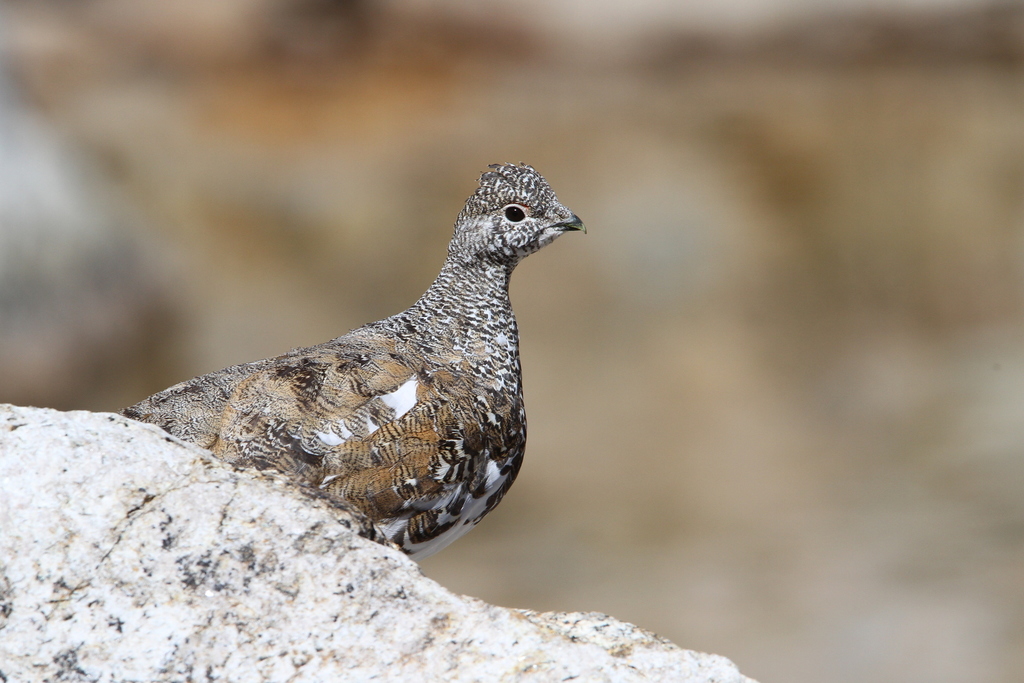
White-tailed Ptarmigan
Photo © Christoph Moning
Photo © Christoph Moning — CC BY 4.0 — Source: iNaturalist photo #93254005Identification
The white-tailed ptarmigan is the smallest bird in the grouse tribe, measuring 31 to 34 centimetres long and weighing around 325 grams on average. It is a stocky, rounded bird with short feathered legs extending to the toes, a small black beak, and a square-ended tail. The most distinctive feature year-round is its white tail and wing feathers, which remain white in all seasons. Males can be identified by their reddish eyecombs—fleshy growths above the eyes—which are present throughout the year.
The bird's plumage undergoes dramatic seasonal changes. In summer, it displays a finely barred greyish-brown coloration on the back with white underparts, making it easy to distinguish from the much browner willow and rock ptarmigans. As fall approaches, the plumage becomes a reddish-brown color with white feathers beginning to grow through. By winter, the bird is completely white, providing perfect camouflage in alpine snowfields. A spring molt returns it to summer plumage before the breeding season.
Range & Habitat
The white-tailed ptarmigan is native to Alaska and the mountainous regions of western Canada and the United States, ranging south to northern New Mexico. It is the only bird in North America to reside permanently in the alpine zone, occupying high mountains above or near the timber line. This species is a permanent resident, staying year-round in its alpine home rather than migrating seasonally.
Its specialized habitat includes open alpine areas with boulders, krummholz (stunted, gnarled trees), snowfields, rock slides, frost-heaved soil, and upland herbage. Even during winter, the bird remains in high valleys and mountain slopes where alder, willow, birch, and spruce poke through the snow cover, allowing it to access food and shelter. The white-tailed ptarmigan flies more than forest grouse species, though it still prefers running to flying.
Behaviour & Diet
The white-tailed ptarmigan is predominantly herbivorous, with a diet that varies seasonally according to what is available. In spring, it favors nitrogen-rich snow buttercup leaves. Summer foods include willow catkins, mountain avens flowers, chickweed blooms, other flowers and leaves, lichens, and berries. As fall and winter arrive, the bird shifts to pine needles, seeds, and willow and alder buds and twigs. Winter food sources have much higher cellulose content than summer forage, so the bird relies on bacteria-aided digestion in its cecum to extract essential nutrients.
In general, the white-tailed ptarmigan is a silent bird, though it sometimes produces quiet, low-pitched hoots and soft clucking noises. Breeding males return to spruce-willow timber line territories in April, with females arriving in early May to form pairs. The nest is a simple ground depression where up to eight eggs are laid. After hatching, chicks soon leave the nest and initially eat insects before transitioning to an adult plant-based diet, guided by their mother's vocalizations to find suitable food.
Best Time & Places to See It
The white-tailed ptarmigan can be found year-round in high alpine areas from Alaska through western Canada and the mountainous western United States down to northern New Mexico. Spring and early summer, when the bird's reddish-brown and white transitional plumage or summer gray-brown plumage makes it more visible against alpine vegetation, may offer the best viewing opportunities. The breeding season in April and May, when males are establishing territories, is another productive time to search for this species.
Winter observations are possible but challenging, as the completely white plumage provides excellent camouflage against snow. Hikers and mountaineers exploring alpine zones above the tree line are most likely to encounter this species. The bird's preference for running over flying means it may be spotted on open slopes and rocky terrain, though it will take flight when disturbed.
Photography Tips
Photographing the white-tailed ptarmigan requires patience and access to high alpine terrain. The bird's cryptic seasonal plumage demands careful attention to lighting and background to capture its subtle coloration effectively. During summer, when the bird is speckled gray and brown, position yourself against contrasting alpine backgrounds to make the bird stand out. The white tail and wings are always prominent features that can help guide composition.
Winter photography presents unique challenges and opportunities, as the bird's pure white plumage can be striking against darker rocks or vegetation. The bird's preference for running means you may need to move slowly and carefully to avoid flushing it into flight. Early morning and late afternoon light will best reveal the bird's fine barring and detail. A telephoto lens is essential, as approaching too closely will cause the ptarmigan to flee.
Glacier National Park
Glacier, Canada
+162 birds+12 mammals
Where granite peaks pierce the clouds above the Columbia River valley, Glacier National Park protects one of the most dramatic mountain wilderness areas in western Canada.…
VIEW NATIONAL PARKKootenay National Park
Area G (Forster Creek/Mount Assiniboine), Canada
+181 birds+23 mammals
Where the spine of the Canadian Rockies rises above 3,000 metres, the high alpine realm around Forster Creek and Mount Assiniboine reveals one of the continent's…
VIEW NATIONAL PARKMount Revelstoke National Park
Area B (Shelter Bay/Mica Creek), Canada
+155 birds+8 mammals
Where the Columbia River carves through the western ranges of British Columbia, Shelter Bay and Mica Creek mark the entrance to a wilderness where subalpine meadows…
VIEW NATIONAL PARKBanff National Park
Improvement District No. 9, Canada
+264 birds+33 mammals
Where the Canadian Rockies thrust skyward in a cathedral of limestone and ice, Banff National Park preserves a wilderness of astounding vertical drama. Glacier-carved valleys cradle…
VIEW NATIONAL PARKJasper National Park
Improvement District No. 12, Canada
+235 birds+34 mammals
Where the Canadian Rockies rise in dramatic succession across western Alberta, Jasper National Park spans over 11,000 square kilometres of subalpine and alpine terrain, glaciated valleys,…
VIEW NATIONAL PARKKenai Fjords National Park
Kenai Peninsula Borough, United States
+164 birds+19 mammals
Granite peaks and tidewater glaciers dominate Alaska's Kenai Peninsula, where nearly 7,900 square kilometers of pristine coastal wilderness descend from the Harding Icefield toward the Gulf…
VIEW NATIONAL PARKGlacier Bay National Park
Unorganized Borough, United States
+221 birds+15 mammals
Tidewater glaciers calving into fjords of impossible blue, where temperate rainforest rises steeply from the water's edge and alpine peaks pierce the clouds—this is the ecological…
VIEW NATIONAL PARKDenali National Park
Denali Borough, United States
+144 birds+18 mammals
Across nearly 31,000 square kilometres of interior Alaska, subarctic boreal forest gives way to alpine tundra, where the raw architecture of mountains—including the continent's tallest peak—shapes…
VIEW NATIONAL PARKYosemite National Park
Mariposa County, United States
+224 birds+28 mammals
Granite cliffs soar nearly a kilometer above the valley floor in this expanse of high Sierra wilderness, where glacial U-shaped valleys sculpt a landscape of dramatic…
VIEW NATIONAL PARKMount Rainier National Park
Pierce County, United States
+187 birds+25 mammals
A volcanic colossus dominates the Cascade Range in western Washington, its 4,392-meter summit crowned year-round with glacial ice that cascades down toward temperate rainforest and subalpine…
VIEW NATIONAL PARKRocky Mountain National Park
Larimer County, United States
+259 birds+33 mammals
Where granite peaks rise above 12,000 feet and alpine tundra gives way to subalpine forest, Rocky Mountain National Park spans the Continental Divide across nearly 1,600…
VIEW NATIONAL PARKSequoia National Park
Tulare County, United States
+187 birds+27 mammals
Granite peaks rising above 3,600 meters dominate the southern Sierra Nevada, where Sequoia National Park sprawls across one of North America's most vertically compressed wilderness zones.…
VIEW NATIONAL PARKKings Canyon National Park
Fresno County, United States
+186 birds+20 mammals
Where granite peaks fracture the Sierra Nevada skyline and the Kings River has carved one of North America's most dramatic canyons, a landscape of extreme relief…
VIEW NATIONAL PARKWrangell-Saint Elias National Park
Unorganized Borough, United States
+155 birds+13 mammals
Where granite peaks thrust above 5,400 metres and vast fields of glacial ice dominate the landscape, Wrangell-Saint Elias encompasses one of North America's most extreme wilderness…
VIEW NATIONAL PARKWaterton Lakes National Park
Improvement District No. 04, Canada
+252 birds+31 mammals
Where the Continental Divide plunges toward the prairies of Alberta, glacier-carved valleys and emerald lakes pierce a landscape where montane forest meets alpine tundra. Waterton Lakes…
VIEW NATIONAL PARKNahanni National Park
Dehcho Region, Canada
+151 birds+11 mammals
Where the South Nahanni River carves through the Mackenzie Mountains, a landscape of extraordinary wildness unfolds across more than 61,000 square kilometres of boreal forest, alpine…
VIEW NATIONAL PARKYoho National Park
Area A (Kicking Horse/Kinbasket Lake), Canada
+207 birds+19 mammals
Where the Canadian Rockies meet the Columbia River watershed, a vast wilderness of 2,211 square kilometres unfolds across Yoho National Park in British Columbia. The landscape…
VIEW NATIONAL PARKKluane National Park and Reserve
Canada
+171 birds+17 mammals
Where granite peaks thrust through boreal forest to touch the sky, Kluane National Park and Reserve sprawls across southwestern Yukon as one of North America's most…
VIEW NATIONAL PARKTombstone Territorial Park
Dawson City, Canada
+150 birds+17 mammals
Where granite peaks pierce the Yukon sky and tundra stretches endlessly toward the Arctic horizon, the Tombstone Range commands attention with uncompromising beauty. This subarctic wilderness…
VIEW NATURE RESERVEGlacier National Park
United States
+246 birds+39 mammals
Where jagged peaks pierce a subarctic sky and glacial valleys carve through ancient rock, Glacier National Park spans the spine of the Northern Rockies along Montana's…
VIEW NATIONAL PARKLake Clark National Park
United States
+158 birds+11 mammals
Where subarctic tundra meets volcanic terrain and pristine waterways, Lake Clark National Park unfolds across southwestern Alaska as a landscape carved by ice age glaciers and…
VIEW NATIONAL PARKNorth Cascades National Park
Whatcom County, United States
+120 birds+18 mammals
Jagged peaks rise abruptly from the western foothills of Washington's Cascade Range, where glaciers cling to elevations above 10,000 feet and meltwater feeds a landscape of…
VIEW NATIONAL PARKKenai National Wildlife Refuge
United States
+152 birds+16 mammals
Across Alaska's Kenai Peninsula, where glacial valleys descend toward the Cook Inlet and the Gulf of Alaska, lies one of North America's most expansive subarctic wildlife…
VIEW WILDLIFE SANCTUARYAlaska Maritime National Wildlife Refuge
Alaska, United States
+391 birds+58 mammals
Where the North Pacific collides with Alaska's rugged coastline, a sprawling archipelago of islands, rocky outcrops, and coastal headlands forms one of North America's most remote…
VIEW WILDLIFE SANCTUARYNo community photos yet. Log in to add the first one.
No community observations of this species yet.