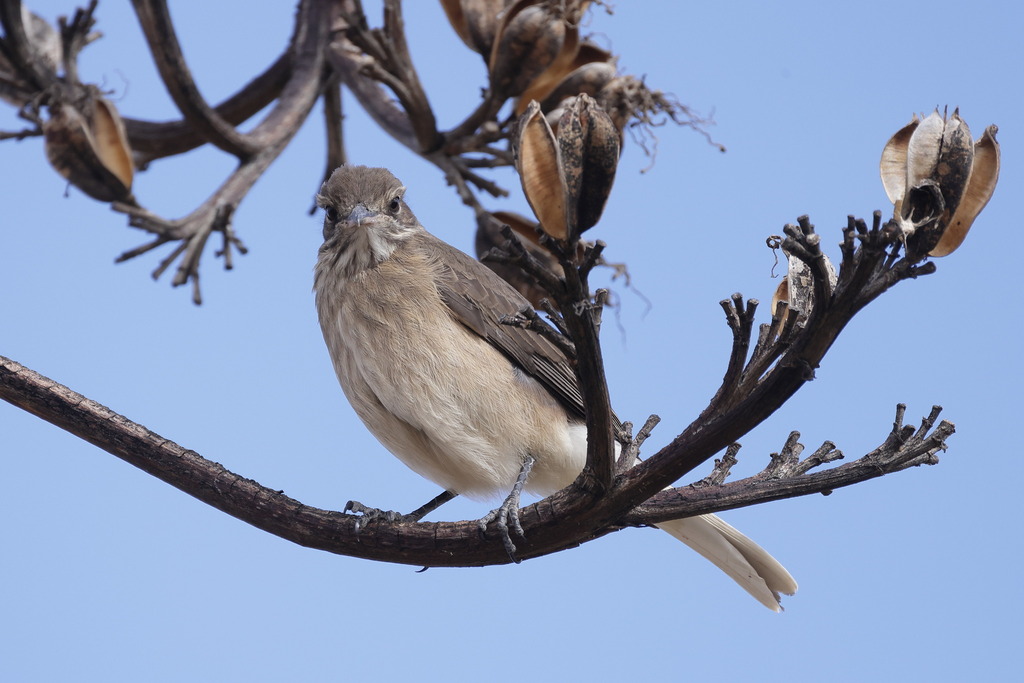
White-tailed Shrike-Tyrant
Photo © Manuel Roncal
Photo © Manuel Roncal — CC0 1.0 — Source: iNaturalist photo #320737053Identification
The White-tailed Shrike-Tyrant is a medium-sized flycatcher, 25 to 28 cm long, with a distinctive appearance suited to high-altitude environments. Both sexes are identical in plumage. The bird features a dark gray-brown crown and upperparts, a narrow buff supercilium, and a streaked face that gives it a characterful expression. The most striking field mark is the white tail with dark markings at the tips of the outer feathers, contrasting sharply with the dark central tail feathers. The throat is white with blackish streaks, while the upper breast and sides are gray-brown, grading to whitish underparts with a buff tinge. Look for the thick, hooked black bill with a yellowish mandible—a raptor-like feature befitting its predatory habits—and dark brown to black iris and legs.
Range & Habitat
This species has a disjunct distribution across the Andes of western South America, found in Ecuador, Peru, Bolivia, Chile, and Argentina. The northern subspecies (A. a. pollens) inhabits the Ecuadorian Andes intermittently, while the nominate subspecies occupies a broken range from southern Peru through Bolivia and into northern Chile, with an isolated population in northwestern Argentina. The White-tailed Shrike-Tyrant favors high-elevation open landscapes between 2,400 and 4,600 meters, including páramo, puna grassland, temperate shrubby grasslands, and montane scrublands with rocks, boulders, and rocky slopes. It also occurs in Polylepis woodlands, around abandoned human structures, and in Eucalyptus farmland in Ecuador.
Behaviour & Diet
Generally considered a year-round resident, though movement patterns remain incompletely understood. The White-tailed Shrike-Tyrant is a predatory flycatcher that hunts insects, small mammals, and small lizards, typically foraging singly or in pairs. It captures prey by dropping from a perch or hawking in mid-air. Males perform an impressive undulating aerial courtship flight in circles. Breeding occurs during austral spring and summer (at least October to January), with clutches of one or two eggs. Nests, made of grass and moss lined with mammal hair and feathers, have been found on the ground and in pine trees. Both parents feed nestlings, though other breeding details remain poorly known.
Best Time & Places to See It
Target the austral breeding season (October to January) for the best chance of locating this species, when males are most vocal and conspicuous during courtship displays. The White-tailed Shrike-Tyrant is generally rare and local throughout its range, making it a challenging find even for experienced observers. Look in high-altitude shrubby grasslands and rocky terrain between 2,400 and 4,600 meters. Several national parks in Ecuador, Peru, and Chile protect populations, offering the most reliable opportunities. The species is particularly scarce in Ecuador and Peru, where it was formerly more widespread.
Photography Tips
Photograph this species in open, rocky high-altitude terrain where perching birds are easily visible against clear Andean skies. The white tail is diagnostic and photogenic—position yourself to capture the contrast between dark and white tail feathers. Early morning light on the crown and upperparts will reveal the subtle gray-brown plumage details. If you encounter a displaying male during breeding season, be ready for rapid, acrobatic flight; use a fast shutter speed to freeze the undulating aerial maneuvers. The thick hooked bill and distinctive facial pattern reward close-up work. Given the species' rarity and wariness, patience and respect for the bird's space are essential for obtaining quality images.
Antisana National Park
Cotopaxi National Park
Lauca National Park
Podocarpus National Park
Reserva Nacional las Vicuñas
Salar de Surire Natural Monument
Nothing matches these filters.
No community photos yet. Log in to add the first one.
No community observations of this species yet.