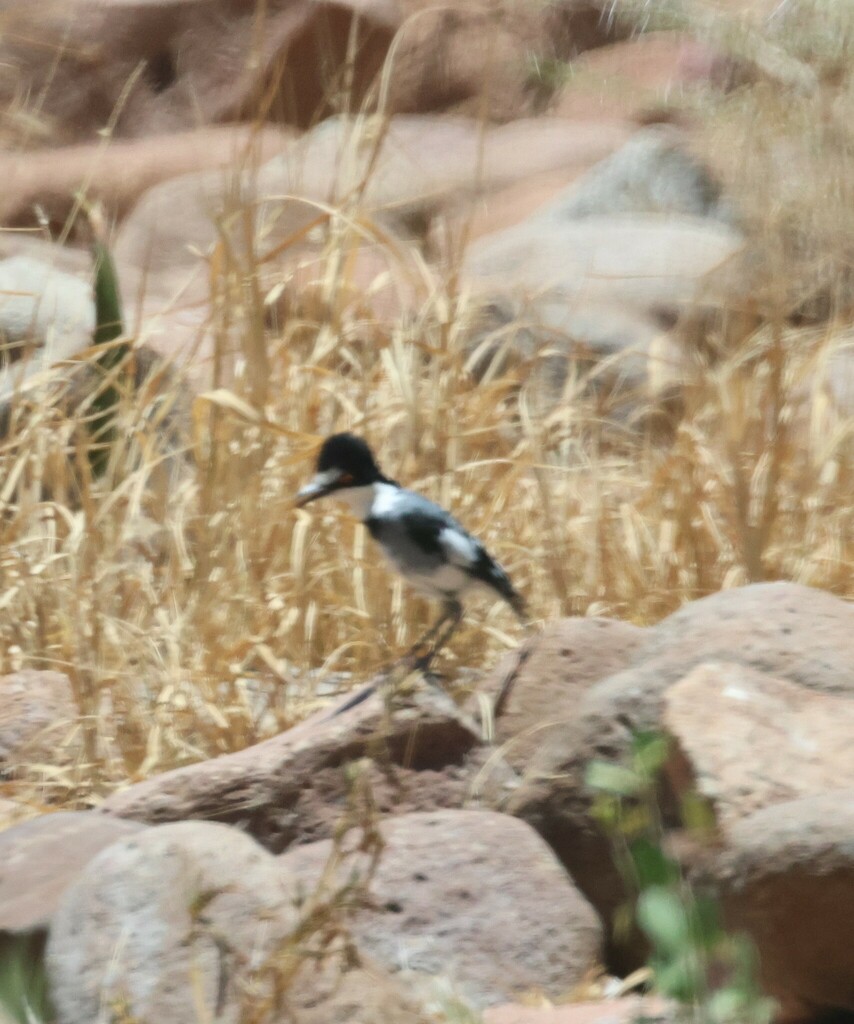
White-tailed Shrike
Photo © scaup
Photo © scaup — CC BY 4.0 — Source: iNaturalist #199067254The white-tailed shrike (Lanioturdus torquatus) is a small passerine bird from the family Platysteiridae. It is also known as the chatshrike or ground batis. It occurs only in western Angola and Namibia in thorn scrub. It forages from ground level, where it hops about in large bounds and upright posture, to 25m above ground, scanning for insects. The very short tail, with a small black mark at the tip of the central two feathers, is always carried down, never sticking up. Its range of calls includes loud ringing territorial whistles. This curious bird, which some consider to have close affinities with the batises and others the bushshrikes, was discovered in 1837 by James Edward Alexander in the Naukluft Mountains of Namibia. Waterhouse subsequently described it in 1838, the name Lanioturdus ('shrike-thrush') reflecting the uncertainty of its classification, and torquatus denoting 'collared'. The sexes have a similar appearance. It is a common, endemic, breeding resident in the region, small seasonal migrations taking place. Its favoured habitat is scrub-savanna, thornbush and mopane-veld. It is found singly or in pairs during the breeding season, and in small groups at other times. It is a clumsy flier with shallow and rapid wingbeats like other…
Namib-Naukluft National Park
Namibia
+217 birds+33 mammals
Across nearly 94,000 square kilometers of southwestern Namibia, a landscape of extremes unfolds where towering sand dunes meet rugged mountain ranges, and ancient riverbeds carve through…
VIEW NATIONAL PARKEtosha National Park
Namibia
+356 birds+58 mammals
Across northern Namibia's stark semi-arid plateau, a vast shallow depression transforms seasonally into one of Africa's most dramatic wildlife theaters. Etosha National Park, encompassing more than…
VIEW NATIONAL PARKWaterberg Plateau National Park
Okambukonde, Namibia
+198 birds+27 mammals
Where ancient sandstone cliffs rise 200 metres above the surrounding bushveld, a fortress of geology creates one of southern Africa's most compelling ecosystems. The plateau's steep…
VIEW NATIONAL PARKNo community photos yet. Log in to add the first one.
No community observations of this species yet.