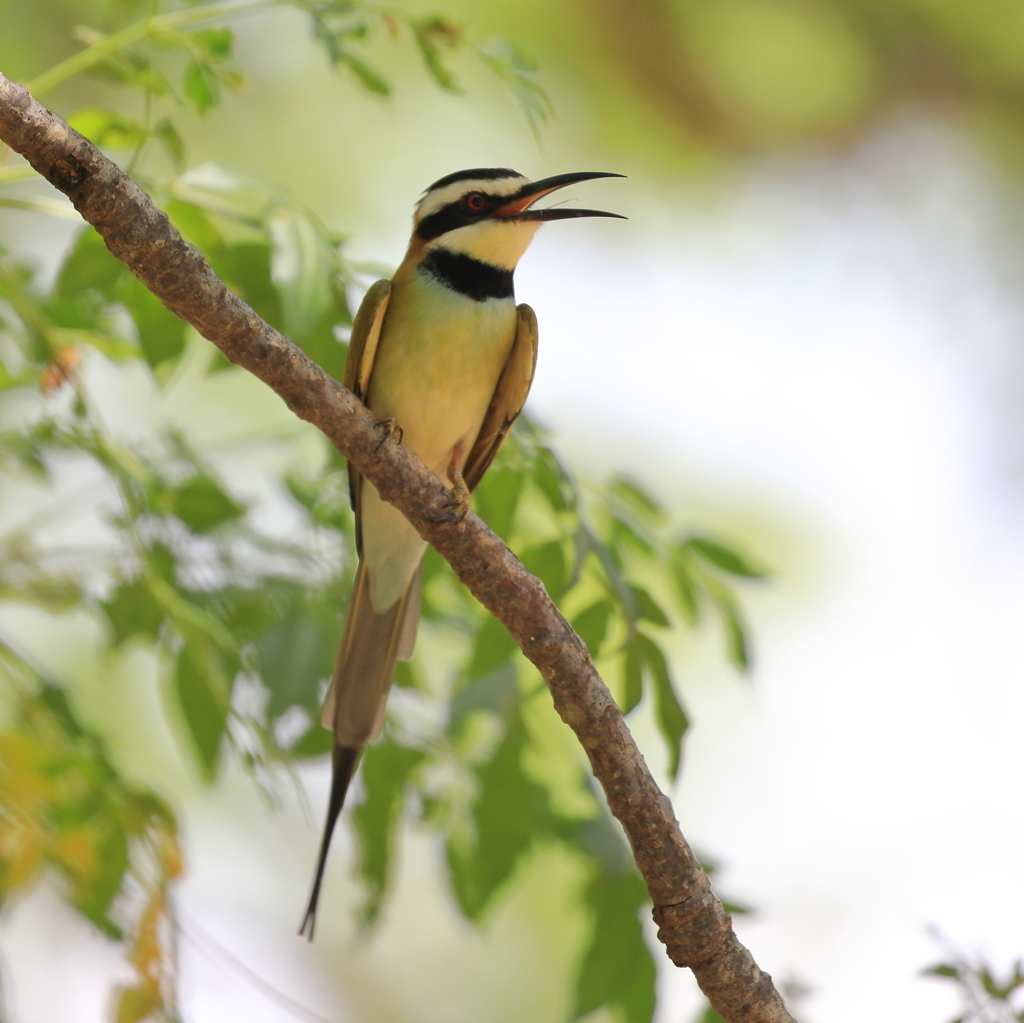
White-throated Bee-eater
Photo © Darren Obbard
Photo © Darren Obbard — CC BY 4.0 — Source: iNaturalist #201515917Identification
The white-throated bee-eater is a richly coloured, slender bird predominantly green in plumage. Its most distinctive features are its white face and throat contrasting sharply with a black crown, eye stripe, and neckband. The underparts are pale green, shading to blue on the breast, while the eye is striking red and the beak is black. This species reaches 19–21 cm in length, excluding two very elongated central tail feathers that can add a further 12 cm. Weighing between 20 and 28 grams, the sexes are alike except that males display longer tail feathers. The call resembles that of the European bee-eater.
Range & Habitat
The white-throated bee-eater is a migratory species with two distinct seasonal ranges. It breeds in semi-desert habitats along the southern edge of the Sahara, favouring dry sandy open country including thorn scrub and near-desert environments. During winter, the species undergoes a remarkable migration to completely different habitat, moving to equatorial rain forests of Africa, ranging from southern Senegal eastward to Uganda.
Behaviour & Diet
These bee-eaters are highly gregarious birds, feeding and roosting communally. As their name suggests, they are insectivorous, though this species probably takes mainly flying ants and beetles rather than exclusively bees and wasps. They hunt by making sorties from open perches, catching prey in the air with characteristic agility. White-throated bee-eaters are colonial nesters, excavating relatively long tunnels of 1–2 metres in sandy banks or open flat areas where they lay 6 to 7 spherical white eggs. Both parents incubate and care for eggs and chicks, with up to five additional helpers assisting in rearing the young.
Best Time & Places to See It
As a widespread and common species throughout its large range, white-throated bee-eaters are readily encountered in appropriate habitats. During the breeding season, look for them in semi-desert regions along the Sahara's southern edge, where colonial nesting sites along sandy banks make them relatively easy to locate. In the non-breeding season, seek them in equatorial rain forest regions of West and Central Africa from Senegal to Uganda. Their gregarious nature and preference for open perches make them conspicuous and accessible for observation.
Photography Tips
The striking colour contrast and slender form of the white-throated bee-eater make it an attractive photographic subject. Position yourself near active nesting colonies or communal roosting sites where birds will be most active and predictable. The red eye and bold facial markings are key features to capture in detail. Early morning light is ideal for highlighting the green plumage and blue breast. Since they hunt from open perches and catch prey in flight, be prepared with fast shutter speeds to capture their aerial sorties. The elongated tail feathers are a defining feature—include these in full-length portraits when possible.
Bwindi Impenetrable National Park
Lake Mburo National Park
Mabamba Swamp
Murchison Falls National Park
Queen Elizabeth National Park
Abijata-Shalla Lakes National Park
Amboseli National Park
Arabuko Sokoke Forest Reserve
Arusha National Park
Nothing matches these filters.
No community photos yet. Log in to add the first one.
No community observations of this species yet.