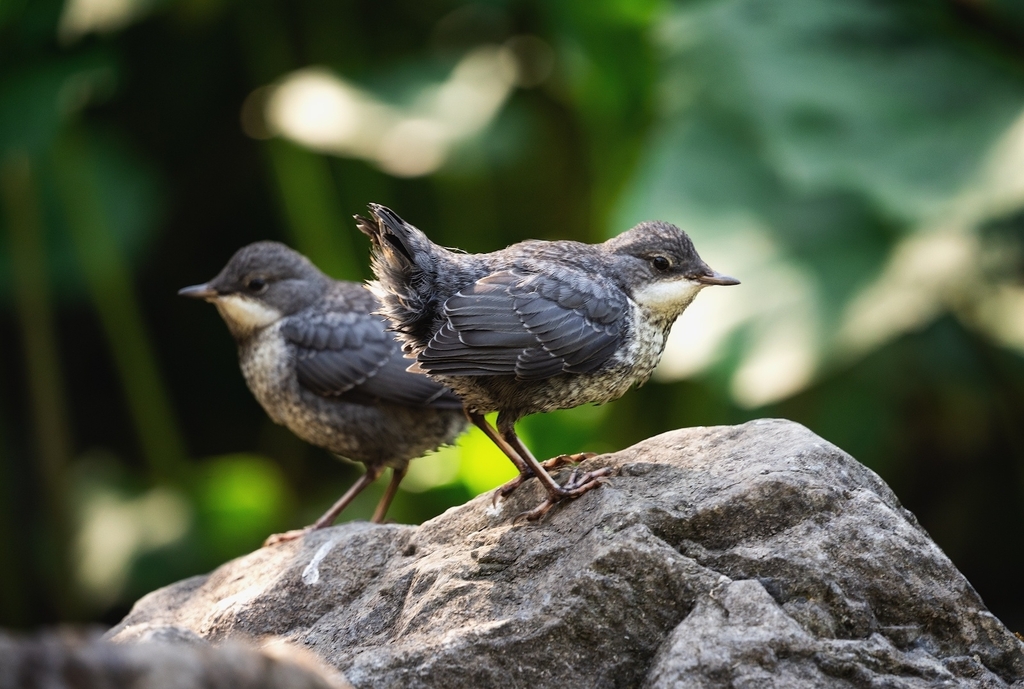
White-throated Dipper
Photo © Евгений Егорейченков
Photo © Евгений Егорейченков — CC BY 4.0 — Source: iNaturalist photo #349148807Identification
The white-throated dipper is a compact, rotund passerine about 18 cm long with a characteristically short tail. Adults display striking plumage: a brown head, slate-grey back mottled with black, and brown wings and tail. The most distinctive features are the white throat and upper breast, followed by a warm chestnut band that merges into black on the belly and flanks. The bill is almost black, and the legs and irises are brown. Subspecies variation exists primarily in the pectoral band coloration; for instance, C. c. cinclus has a black belly band rather than chestnut. Juveniles are duller, with greyish-brown plumage and no chestnut band, making them less conspicuous along waterways.
Range & Habitat
This species is found across Europe, the Middle East, Central Asia, and the Indian subcontinent, with 14 subspecies distributed across this vast range. Habitat preferences are highly specific: white-throated dippers are closely associated with swiftly running rivers and streams, as well as the lakes into which they flow. They are rarely found away from moving water, where rocky outcrops and turbulent sections provide essential perching and hunting grounds. The bird's distribution spans from Ireland and western Scotland in the west to the Himalayas and western China in the east, with populations occupying diverse terrains from lowland streams to mountain torrents.
Behaviour & Diet
The white-throated dipper is an active and animated bird, often seen bobbing spasmodically on rocks with its short tail lifted, a behaviour that inspired its common name. It flies rapidly and directly on whirring wings, calling shrilly as it moves between feeding sites. When hunting, it either plunges directly into the water or walks deliberately from a perch, submerging to search the riverbed. Contrary to popular assumption, the dipper cannot walk along the bottom due to buoyancy; instead, it swims using its wings to "fly" underwater, propelled by muscular exertion with its body held obliquely and head down. Its diet consists primarily of aquatic invertebrates, particularly caddis worms and other insect larvae, beetles, and freshwater molluscs. The amphipod shrimp Gammarus is a favourite food, and the bird also takes small fish and amphibians, supplementing these with terrestrial invertebrates found on banks and rocks.
Best Time & Places to See It
White-throated dippers are year-round residents across much of their range, though winter behaviour varies individually. When swift hill streams freeze, birds are forced to descend to lowland rivers or even coastal waters, making them more accessible to observers. The best locations are clean, fast-flowing rivers and streams with rocky margins and good riparian habitat. Look for them perched on rocks in the middle of the water or hunting in white-water sections. Early morning is often productive for observation and photography, as birds are most active at this time. In regions where streams remain unfrozen, dippers maintain their territories throughout winter.
Photography Tips
Photographing white-throated dippers requires patience and positioning. Since they frequent rocky streams and rivers, scout locations beforehand and identify likely perching sites. Use a fast shutter speed—at least 1/1000th of a second—to freeze the bird's rapid, jerky movements and wing motion during dives. The bird's white breast and throat provide good contrast against dark water and rocks; expose carefully to preserve detail in both highlight and shadow areas. Approach slowly and quietly from downstream, as the bird's alertness makes sudden movements counterproductive. Early morning light reflecting off water and rocks adds dimension to images; avoid harsh midday sun that creates excessive contrast. Capturing the characteristic diving behaviour or the bird submerged underwater requires persistence, but rewards patient photographers with distinctive action shots.
Abruzzo, Lazio and Molise National Park
Altai Tavan Bogd National Park
Appennino Lucano Val d’Agri Lagonegrese National Park
Appennino Tosco-Emiliano National Park
Aspromonte National Park
Avesnois Regional Nature Park
Baikal National Park
Baima Snow Mountain National Nature Reserve
Bannau Brycheiniog National Park
Nothing matches these filters.
No community photos yet. Log in to add the first one.
No community observations of this species yet.