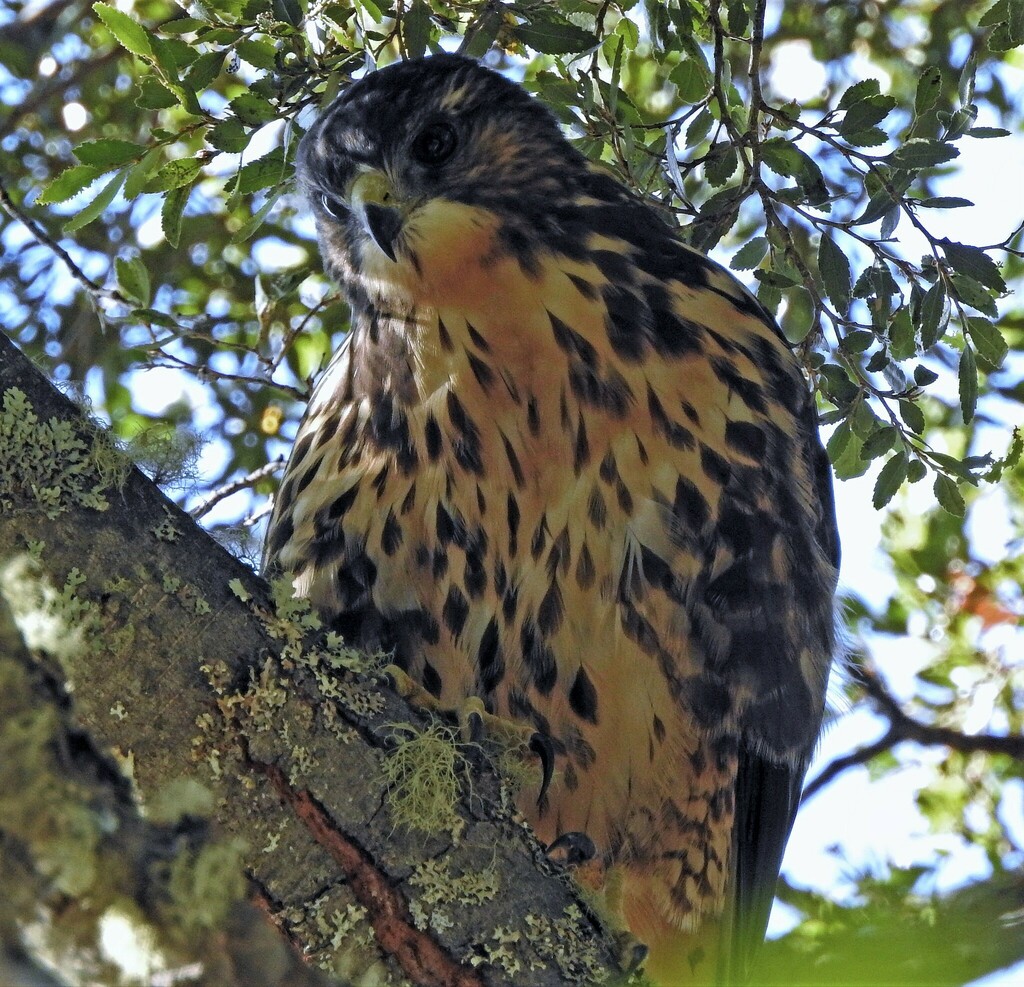
White-throated Hawk
Photo © Hugo Hulsberg
Photo © Hugo Hulsberg — CC0 1.0 — Source: iNaturalist #166245572Identification
The white-throated hawk is a medium-sized raptor measuring 38 to 48 cm in length with a wingspan of 84 to 102 cm. Females are noticeably larger than males, reaching up to 20% greater size, though both sexes share identical plumage. Adults are distinguished by brownish-black faces and upperparts contrasting sharply with white chins, throats, and underparts. The breast and belly display brown streaking, while rufous barring marks the thighs. The tail features a dark brown upper surface and grayish lower surface decorated with up to 10 narrow dark bands. Adults have characteristic brown eyes, yellow ceres, legs, and feet. Juveniles are similar to adults but appear heavier, with pronounced blackish streaking across the breast and flanks, streaked cheeks, and buff thighs barred with brown.
Range & Habitat
This Andean hawk is found across a vast range spanning northwestern Venezuela south through Colombia and Ecuador, continuing into Peru and Bolivia, with additional populations in central Chile and western Argentina. The species inhabits humid montane forests, elfin forests, and cloudforests, frequently venturing into adjacent open landscapes such as puna grassland. Elevation preferences vary geographically: in its northern range it occupies elevations between 1,700 and 3,500 metres, whereas in Patagonia it ranges from 1,000 to 2,000 metres, and in Chile from near sea level to 1,200 metres.
Behaviour & Diet
The white-throated hawk is certainly migratory in southern portions of its range, moving northward during the non-breeding season. Its behaviour in northern regions remains poorly understood, with ornithologists debating whether northern populations are year-round residents or purely migratory visitors. The species is considered a non-breeding visitor to Bolivia and Ecuador. The hunting strategy of this raptor has not been documented, but its diet includes insects, rodents, and birds—occasionally taking prey as large as the Magellanic woodpecker. The species is thought to be mostly silent, though it produces a distinctive "squealing 'kee-ah'" during the breeding season.
Best Time & Places to See It
The white-throated hawk breeds only in Chile and Argentina, with a breeding season spanning from September through at least April. In its known breeding range, it is considered uncommon to fairly common, though it remains rare and local throughout much of its northern range. The species shows tolerance of disturbed habitat and favours altitudinal zones relatively less affected by human activities. Travellers seeking this species should focus on the temperate forests and adjacent open grasslands of Chile and Argentina during the breeding season, or explore montane cloudforest habitats across the Andes during migratory periods.
Photography Tips
Photographing the white-throated hawk requires patience and knowledge of its preferred habitats. The species' contrasting plumage—dark upperparts against a white throat and underparts—provides excellent tonal subjects, particularly in the variable lighting conditions of montane cloudforests. Watch for birds soaring along mountain ridges or perched in tall trees above 1,000 metres elevation. During the breeding season, observers may witness spectacular undulating display flights, which offer dynamic photography opportunities. Early morning and late afternoon light works well to emphasize the hawk's distinctive markings, especially the pale throat patch that gives the species its name.
Sangay National Park
Cebadas, Ecuador
+320 birds+10 mammals
High in Ecuador's Andean spine, where the Western Cordillera rises to touch perpetual snow, a landscape of volcanic drama and ecological intensity unfolds across Sangay National…
VIEW NATIONAL PARKPodocarpus National Park
Zamora, Ecuador
+496 birds+6 mammals
Where the Andes descend toward the Amazon basin, Podocarpus National Park sprawls across nearly 2,800 square kilometres of the most biodiverse terrain in Ecuador's southern highlands.…
VIEW NATIONAL PARKYacuri National Park
Las Juntas, Ecuador
+166 birds+1 mammals
Where the eastern slopes of the Andes descend into Ecuador's southern frontier, Yacuri National Park unfolds across nearly 1,300 square kilometers of montane cloud forest and…
VIEW NATIONAL PARKAntisana National Park
Quijos, Ecuador
+432 birds+21 mammals
Where the eastern Andean slopes descend into the Amazon basin, Antisana National Park sprawls across roughly 2,500 square kilometers of some of South America's most dramatic…
VIEW NATIONAL PARKNatural Farallones de Cali National Park
Buenaventura, Colombia
+733 birds+27 mammals
Where the Pacific coastal plain meets the western slopes of the Andes, Farallones de Cali National Park sprawls across nearly 3,500 square kilometers of dramatic topography…
VIEW NATIONAL PARKGuácharos Cave National Natural Park
Acevedo, Colombia
+359 birds
High in the Andean foothills of southern Huila, where mist-laden slopes rise above 1,600 metres, lies a landscape carved by underground rivers and crowned by karst…
VIEW NATIONAL PARKYanachaga–chemillén National Park
Palcazu, Peru
+639 birds+6 mammals
Where the eastern slopes of Peru's central cordillera plunge into cloud forest, Yanachaga–Chemillén National Park protects nearly three thousand square kilometres of montane wilderness that few…
VIEW NATIONAL PARKManu National Park
Manu, Peru
+892 birds+26 mammals
Across the eastern slopes of the Peruvian Andes, tropical rainforest descends into the Amazon basin with a complexity that few terrestrial ecosystems match. Manu National Park…
VIEW NATIONAL PARKHuascarán National Park
Independencia, Peru
+201 birds+5 mammals
Where granite peaks pierce the Andean sky above 6,000 metres, Huascarán National Park sprawls across more than 11,500 square kilometres of Peru's Cordillera Blanca, a landscape…
VIEW NATIONAL PARKChiloé National Park
Dalcahue, Chile
+122 birds+6 mammals
Temperate rainforest cloaks the Chiloé archipelago's northwestern reaches, where granite ridges thrust through dense, moisture-laden canopy and freshwater streams carve ravines toward the Pacific. Across approximately…
VIEW NATIONAL PARKTorres del Paine National Park
Torres del Paine, Chile
+143 birds+10 mammals
Where granite spires pierce the Patagonian sky, Torres del Paine commands one of South America's most dramatic landscapes. Across 4,106 square kilometres of southern Chile, jagged…
VIEW NATIONAL PARKLaja National Park Lagoon
Antuco, Chile
+123 birds+1 mammals
Where the Andes descend into the Biobío Region's temperate forests, a vast lagoon fills the caldera of the extinct Antuco volcano, cradled by steep native woodland…
VIEW NATIONAL PARKPuyehue National Park
Puyehue, Chile
+110 birds+4 mammals
Across the volcanic spine of the Los Lagos Region, where the Andes descend toward temperate rainforest, Puyehue National Park encompasses nearly 2,600 square kilometers of one…
VIEW NATIONAL PARKLauca National Park
Putre, Chile
+139 birds+17 mammals
Where the Andes rise toward the altiplano in Chile's far north, Lauca National Park sprawls across more than 3,000 square kilometres of some of South America's…
VIEW NATIONAL PARKVicente Pérez Rosales National Park
Puerto Varas, Chile
+109 birds+8 mammals
Where the Andes descend toward the temperate rainforests of Chile's Lake District, nearly 4,641 square kilometers of pristine wilderness unfolds across Vicente Pérez Rosales National Park.…
VIEW NATIONAL PARKCerro Castillo National Park
Coyhaique, Chile
+89 birds+3 mammals
Granite peaks and windswept steppe converge across this vast Patagonian landscape, where the Andes' eastern flank drops into terrain sculpted by ice age glaciers and relentless…
VIEW NATIONAL PARKParque Provincial Península de Magallanes
Argentina
+125 birds+4 mammals
Granite peaks and windswept steppe converge across this 415-square-kilometre peninsula jutting into the cold Atlantic waters of southern Patagonia, where the Magallanes landscape embodies the raw,…
VIEW NATIONAL PARKParque Municipal Llao Llao
San Carlos de Bariloche, Argentina
+73 birds+1 mammals
Where the Andes meet the Patagonian lakes, granite peaks rise above temperate rainforest in a landscape of startling contrasts. Parque Municipal Llao Llao, sprawling across 23…
VIEW NATIONAL PARKLos Glaciares National Park
Argentina
+121 birds+3 mammals
Where granite peaks and sprawling ice fields dominate the landscape, Los Glaciares National Park encompasses over ten thousand square kilometres of Patagonian wilderness in southern Argentina.…
VIEW NATIONAL PARKNahuel Huapi National Park
Argentina
+124 birds+11 mammals
Where the Andes descend toward Patagonia, vast glacial lakes cut through a landscape of southern beech forest and granite peaks, creating one of South America's most…
VIEW NATIONAL PARKLanín National Park
Argentina
+128 birds+7 mammals
Where the volcanic spine of the Andes plunges into Patagonian steppe, Lanín National Park sprawls across nearly 4,700 square kilometers of one of Argentina's most visually…
VIEW NATIONAL PARKLago Puelo National Park
Argentina
+109 birds+1 mammals
Where temperate forests descend to crystalline waters in the foothills of the Andes, Lago Puelo National Park sprawls across nearly 300 square kilometers of pristine wilderness…
VIEW NATIONAL PARKLos Alerces National Park
Argentina
+84 birds+3 mammals
Where the temperate rainforests of southern Patagonia sweep down towards crystalline lakes, Los Alerces National Park unfolds across nearly 3,000 square kilometres of one of South…
VIEW NATIONAL PARKNo community photos yet. Log in to add the first one.
No community observations of this species yet.