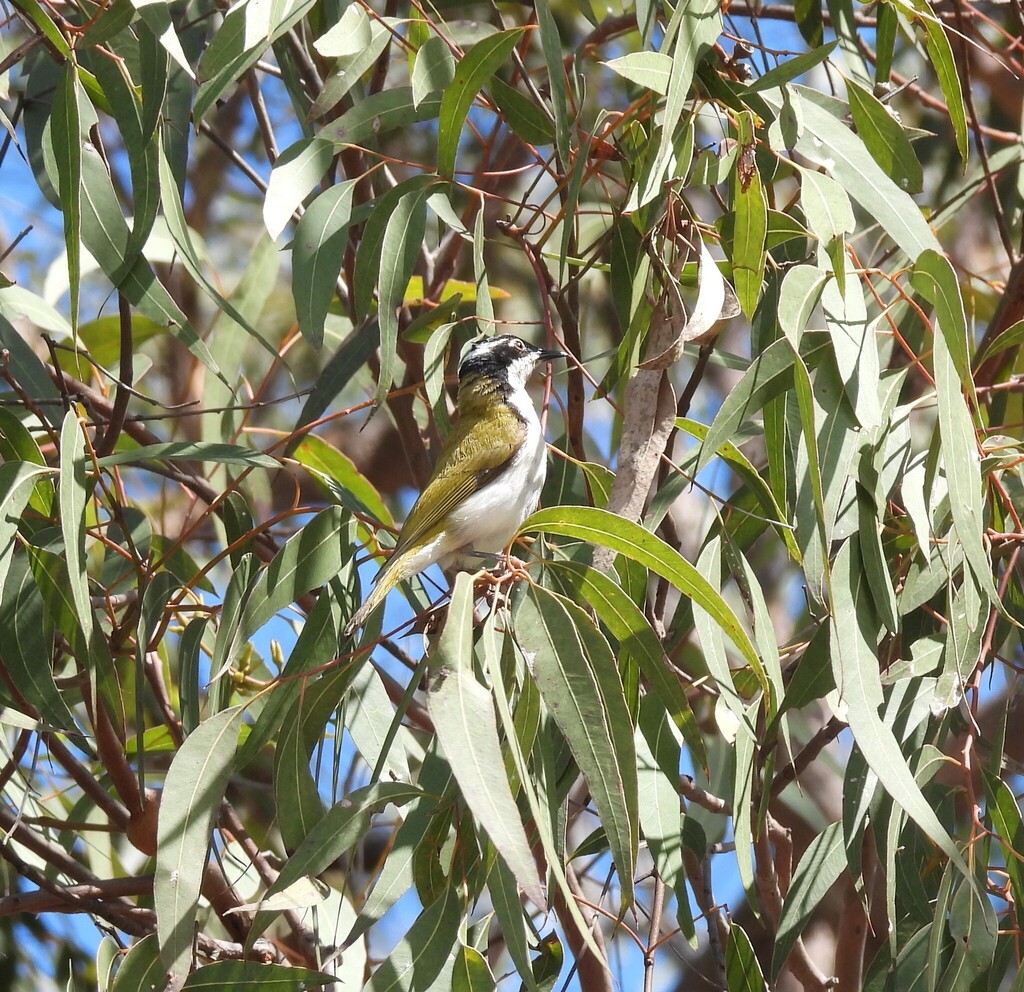
White-throated Honeyeater
Photo © Mark Clarke
Photo © Mark Clarke — CC BY 4.0 — Source: iNaturalist #313465254Identification
The white-throated honeyeater is a small bird measuring 11.5 to 14.5 cm in length. Adults are striking in appearance, with a black head, olive-green or yellow-green upperparts (yellower on the rump), and white throat and underparts. The most distinctive feature is a blue-white patch of bare skin over the eye, paired with a white stripe across the nape. The bill is black, the eyes are red-brown, and the legs are purple-brown. The two subspecies differ slightly: the nominate albogularis is found in northwestern Australia, the Northern Territory, and Cape York, while the larger and duller-backed inopinatus occurs in Queensland. Within its range, the white-throated honeyeater is unlikely to be confused with other species, though Gilbert's honeyeater also possesses a white eye-patch—however, these two species do not overlap geographically.
Range & Habitat
Native to New Guinea and eastern and northern Australia, the white-throated honeyeater is widely distributed across suitable habitat. It favours open, dry sclerophyll forests and savannah woodlands where it forages in foliage and canopy rather than on bark or branches. The species is found from northwestern Australia and the Northern Territory through to Cape York and into Queensland, with populations in both central and southeastern parts of the state.
Behaviour & Diet
The white-throated honeyeater is an insectivorous specialist, gleaning insects from foliage and canopy vegetation. It typically congregates in larger flocks rather than remaining solitary, and is active in pursuit of its prey among the trees. The species is vocal, with various calls recorded throughout its range.
Best Time & Places to See It
Breeding occurs throughout the species' range from July or August through to December, with populations in northwestern Australia breeding until April. This extended breeding season offers opportunities to observe birds throughout much of the year. Look for them in open sclerophyll forests and savannah woodlands in northern and eastern Australia, particularly in Queensland, the Northern Territory, and northwestern Australia.
Photography Tips
The distinctive white eye-patch and nape stripe make this species rewarding to photograph in good light. A telephoto lens is essential for capturing detail as these birds forage actively in the canopy. Early morning light will best reveal the contrast between the black head and white facial markings. Photographing flocking birds requires patience and fast shutter speeds to freeze movement among the foliage.
Annan River (Yuku Baja-Muliku) National Park
Bald Rock National Park
Boodjamulla National Park
Bribie Island National Park
Bunya Mountains National Park
Cania Gorge National Park
Carnarvon National Park
Daintree National Park
Endeavour River National Park
Nothing matches these filters.
No community photos yet. Log in to add the first one.
No community observations of this species yet.