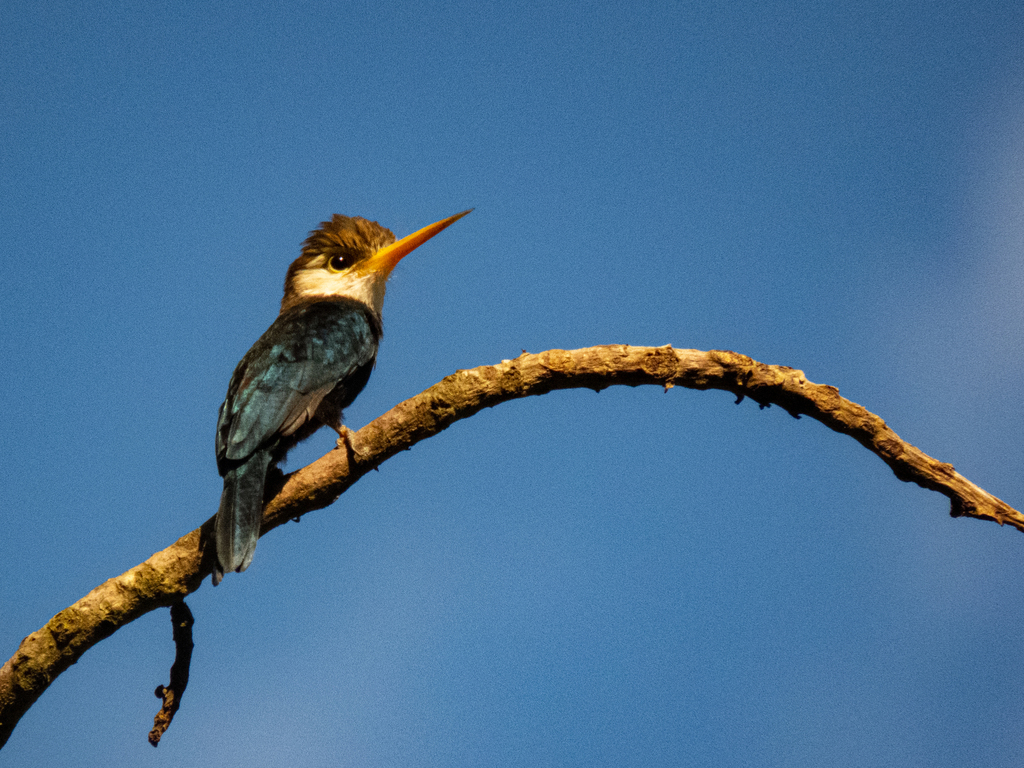
White-throated Jacamar
Photo © Martin Vallejos
Photo © Martin Vallejos — CC BY 4.0 — Source: iNaturalist photo #343820923Identification
The white-throated jacamar is a small bird, measuring just 15 to 16 cm in length, making it a delicate jewel of the Amazon canopy. Males are instantly recognizable by their striking white face and throat, which contrasts sharply with dark brown to black upper parts that gleam with a greenish-blue gloss in sunlight. The belly is similarly dark, but features a distinctive chestnut patch in the centre. Females are similar to males, though they typically display a larger chestnut belly patch.
Range & Habitat
This species occupies a relatively small range in the upper Amazon Basin at the tri-border region where Peru, Brazil, and Bolivia meet. It shows a strong preference for várzea forest edges and young growth along whitewater river systems, particularly river islands and dense stands of Gynerium cane and bamboo. Birds are typically found from mid-canopy heights up to the highest reaches of the forest, with records in Peru reaching elevations of up to 600 m.
Behaviour & Diet
The white-throated jacamar feeds primarily on flying insects, with Hymenoptera (wasps and bees) and Lepidoptera (butterflies and moths) confirmed in its diet, though its complete feeding ecology remains poorly known. True to its family's hunting style, it perches alertly on exposed branches in small groups before sallying out to snatch prey from the air. During breeding season, up to four adults work together to provision the young, nesting in partially hidden burrows excavated in vertical stream banks. Studies from Peru's Manu National Park found active nests during August and September.
Best Time & Places to See It
Finding white-throated jacamars requires travel to the remote tri-border region of Peru, Brazil, and Bolivia in the upper Amazon. Manu National Park in Peru is a productive location where breeding birds have been documented. The species is most reliably found along whitewater river systems during the breeding season of August and September, though year-round residents may be encountered. Early morning hours when the canopy is active offer the best viewing opportunities.
Photography Tips
Photographing this canopy specialist demands patience and attention to exposed perches where birds sally for insects. The striking white facial markings of males provide excellent contrast for capturing detail, while early morning light illuminates the subtle greenish-blue gloss of the plumage. A telephoto lens is essential given the species' preference for mid- to high-canopy perches. Listen carefully for its distinctive high, thin whistled song—a series of sharp 'pee-pipi-peeee' notes followed by 'tewee tewee tewee'—which often betrays the bird's location before it becomes visible.
Serra do Divisor National Park
Brazil
+448 birds+10 mammals
Where the western Amazon meets the Andes foothills, Serra do Divisor National Park sprawls across one of South America's most biodiverse and least accessible frontiers. Spanning…
VIEW NATIONAL PARKManu National Park
Manu, Peru
+892 birds+26 mammals
Across the eastern slopes of the Peruvian Andes, tropical rainforest descends into the Amazon basin with a complexity that few terrestrial ecosystems match. Manu National Park…
VIEW NATIONAL PARKBahuaja Sonene National Park
San Pedro de Putina Punco, Peru
+602 birds+8 mammals
Where the Madre de Dios and Heath rivers converge in southeastern Peru rises one of South America's most biodiverse wilderness regions: a vast protected realm of…
VIEW NATIONAL PARKNo community photos yet. Log in to add the first one.
No community observations of this species yet.