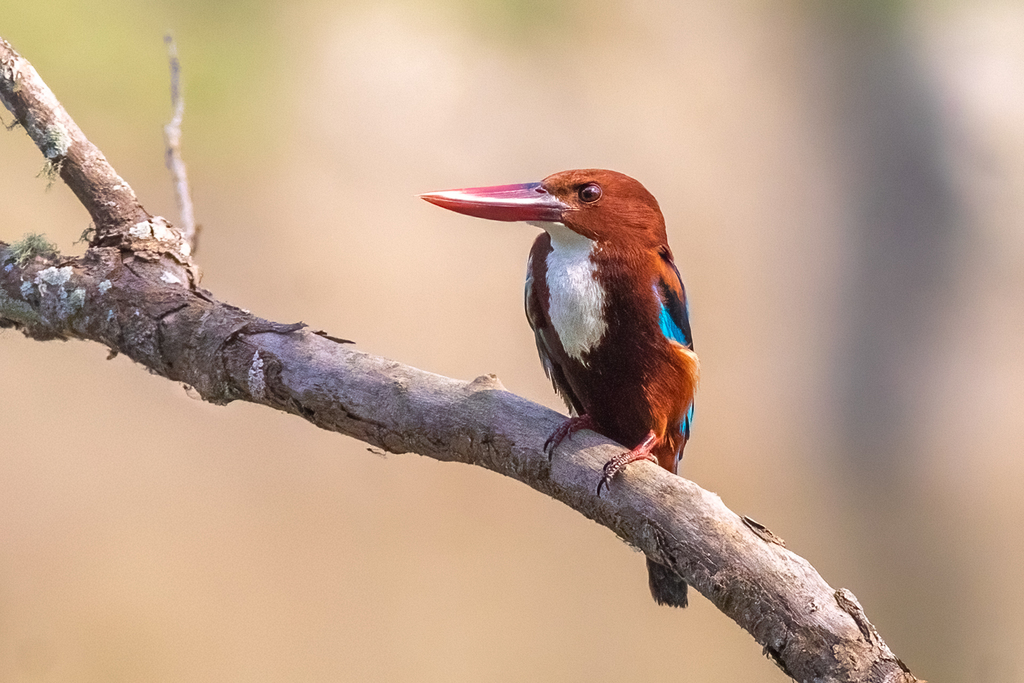
White-throated Kingfisher
Photo © egorbirder
Photo © egorbirder — CC BY 4.0 — Source: iNaturalist photo #448855152Identification
The white-throated kingfisher is a large kingfisher, measuring 27–28 cm in length. Adults are striking and unmistakable: they feature a bright blue back, wings and tail contrasted against chestnut head, shoulders, flanks and lower belly. The throat and breast are pure white, and the large bill and legs are bright red. In flight, large white patches are visible on the blue and black wings, created by the rapid, direct wingbeats of their short, rounded wings. The sexes are similar in appearance, though juveniles present a duller version of the adult plumage.
Range & habitat
The white-throated kingfisher is widely distributed across Asia, ranging from the Sinai east through the Indian subcontinent to China and Indonesia. Five subspecies are recognized across this vast range, varying slightly in size and the precise shades of their plumage. The species is a common resident over much of its range, though some populations make short-distance movements.
This adaptable kingfisher inhabits a variety of habitats, preferring open country in the plains with trees, wires or other perches, though it has been recorded at elevations up to 7,500 feet in the Himalayas. Notably, this species can often be found well away from water—a characteristic that distinguishes it from many other kingfisher species. The range of the white-throated kingfisher is expanding, and it is increasingly encountered in urban areas.
Behaviour & diet
The white-throated kingfisher is an opportunistic and versatile hunter. It feeds on a wide range of prey including large crustaceans, insects, earthworms, small rodents, lizards, snakes, fish and frogs. It will also hunt small birds such as sparrows and munias. The species perches conspicuously on wires or other exposed perches within its territory, making it a frequent and easily observed sight across south Asia.
During the breeding season, which begins at the onset of the monsoons, males call loudly in the mornings from prominent perches, including the tops of buildings in urban areas. Breeding pairs excavate tunnel nests in earth banks, typically 50 cm long, laying a single clutch of 4–7 round white eggs. The eggs hatch after 20–22 days, and chicks fledge within 19 days.
Best time & places to see it
The white-throated kingfisher is widely distributed and common throughout its range, making it a reliable species for wildlife travellers across Asia. The early mornings during the breeding season offer the best opportunities to locate birds, as males call loudly from prominent perches at this time. Look for the species perching conspicuously on wires, trees and buildings in open countryside and increasingly in urban settings across the Indian subcontinent, Southeast Asia and China.
Photography tips
The white-throated kingfisher's bold colours and habit of perching openly on conspicuous perches make it an excellent photographic subject. The brilliant blue plumage contrasted with chestnut and white markings, combined with the striking red bill and legs, provides vibrant colour for photography. Capture the species in early morning light when males are most vocal and active. The bird's rapid, direct flight with whirring wingbeats offers dynamic shooting opportunities, particularly when the large white wing patches are visible in flight.
Kanha Tiger Reserve
Minneriya National Park
Angamedilla National Park
Bandhavgarh National Park
Bandipur National Park
Banke National Park
Bardiya National Park
Berbak National Park
Chitwan National Park
Nothing matches these filters.