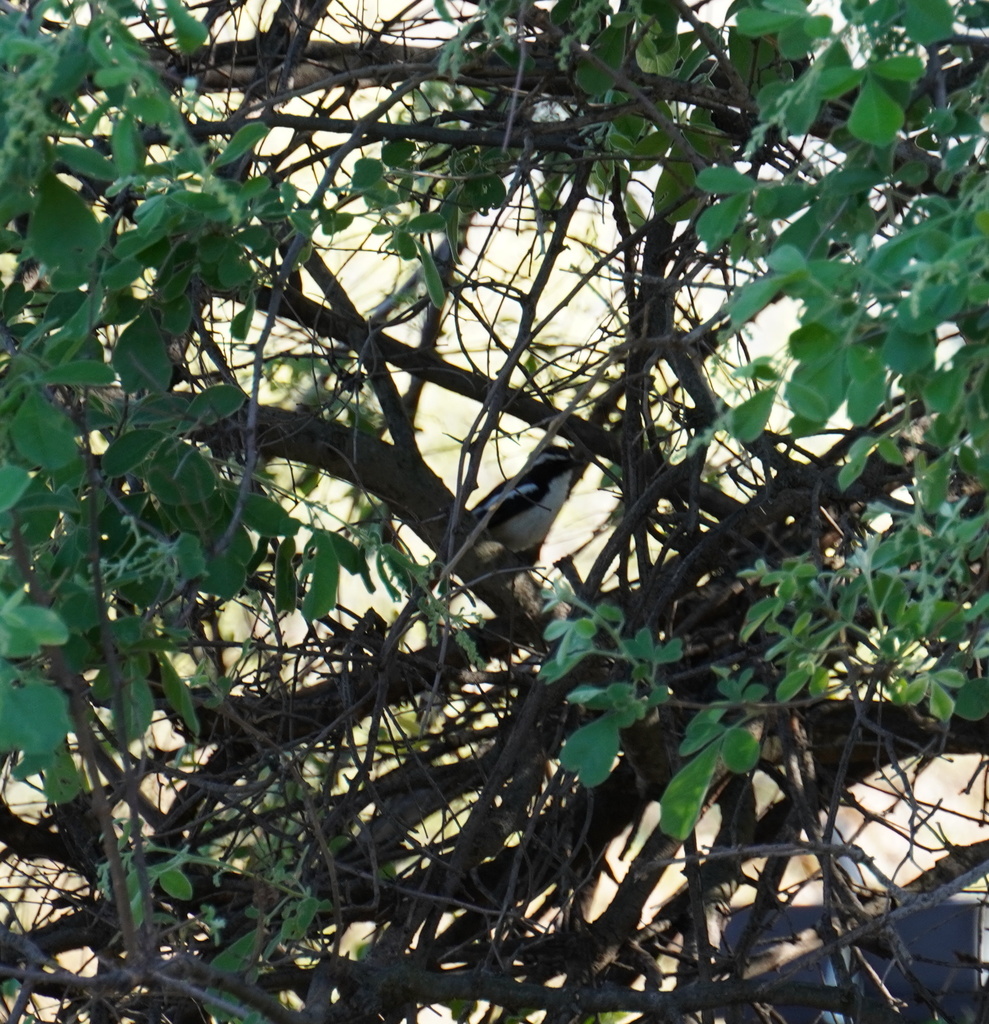
White-throated Robin-Chat
Photo © Matthew Fainman
Photo © Matthew Fainman — CC BY 4.0 — Source: iNaturalist #99221518Identification
The White-throated Robin-Chat is a member of the Old World Flycatcher family, characterized by its distinctive white throat patch that gives the species its common name. This feature makes it relatively straightforward to identify in the field, particularly when the bird is perched openly. Like other robin-chats, it has the compact, upright posture typical of insectivorous songbirds adapted to foraging on or near the ground.
Range & Habitat
This species is endemic to southern Africa, with its range spanning parts of Botswana, Zimbabwe, Mozambique, Eswatini, and South Africa—covering approximately 645,000 square kilometres. The White-throated Robin-Chat favours dry savannah woodland and shrubland habitats, making it well-adapted to the arid and semi-arid regions of the subcontinent.
Behaviour & Diet
The White-throated Robin-Chat is primarily insectivorous, with a varied diet reflecting its foraging prowess. It hunts beetles, termites, ants, crickets, caterpillars, bugs, spiders, and millipedes, but also supplements its diet with small vertebrates and plant material. The species shows particular fondness for the fruits of several shrubs found in its range, including the woolly caper-bush, tassel-berry, sand raisin, magic guarrie, and dune guarrie.
Breeding occurs during spring, with peak activity in October and November. The species constructs a cup-shaped nest typically located on or near the ground, favouring sheltered spots such as hollow stumps, vine roots, or abandoned human items. Nests are built from twigs, dry grasses, and leaves, lined with rootlets, tendrils, stalks, and leaf fragments. Clutches normally contain two or three eggs, incubated solely by the female for fourteen to fifteen days. Both parents feed the chicks, which fledge after approximately a fortnight and remain dependent on their parents for a further six to seven weeks. The species occasionally falls victim to brood parasitism by the Red-chested Cuckoo.
Best Time & Places to See It
The White-throated Robin-Chat is common throughout much of its range in southern Africa, making it a reliable subject for visiting birders and wildlife enthusiasts. The breeding season—October and November—is an excellent time to observe birds, as parents are actively foraging and defending territories. Your best opportunities lie within protected areas and suitable habitat across Botswana, Zimbabwe, Mozambique, Eswatini, and South Africa.
Photography Tips
The White-throated Robin-Chat's preference for ground-level foraging and open perching offers good photographic opportunities. Early morning sessions are ideal, as birds are most active during cooler hours. The distinctive white throat patch is the key identifying feature to capture sharply in your images. Watch for the species foraging among leaf litter and low vegetation, where patient positioning can yield excellent documentary shots of natural behaviour.
Mapungubwe National Park
Musina Local Municipality, South Africa
+358 birds+29 mammals
Where the Limpopo River cuts through sandstone ridges at the convergence of South Africa, Botswana, and Zimbabwe, Mapungubwe National Park preserves a landscape of profound ecological…
VIEW NATIONAL PARKPilanesberg National Park
Moses Kotane Local Municipality, South Africa
+364 birds+49 mammals
Granite peaks and volcanic ridges rise unexpectedly from the savanna floor across this 734-square-kilometre expanse in the North West province, creating a landscape of profound ecological…
VIEW NATIONAL PARKKruger National Park
Ba-Phalaborwa Local Municipality, South Africa
+540 birds+91 mammals
Across the low-lying savanna of northeastern South Africa unfolds one of Africa's largest and most ecologically intact protected areas, where acacia woodlands merge into mopane scrub…
VIEW NATIONAL PARKIthala Game Reserve
uPhongolo Local Municipality, South Africa
+328 birds+26 mammals
Rolling thornbush savanna and acacia woodland dominate the landscape of this 494-square-kilometre national park in KwaZulu-Natal's uPhongolo Local Municipality, where granite outcrops punctuate grassland plateaus and…
VIEW NATIONAL PARKMarakele National Park
Modimolle Local Municipality, South Africa
+341 birds+36 mammals
Granite ridges and sprawling grasslands dominate this 1,176-square-kilometre reserve in Limpopo's heartland, where bushveld transitions between rocky outcrops and open savanna. The park's rugged topography creates…
VIEW NATIONAL PARKNo community photos yet. Log in to add the first one.
No community observations of this species yet.