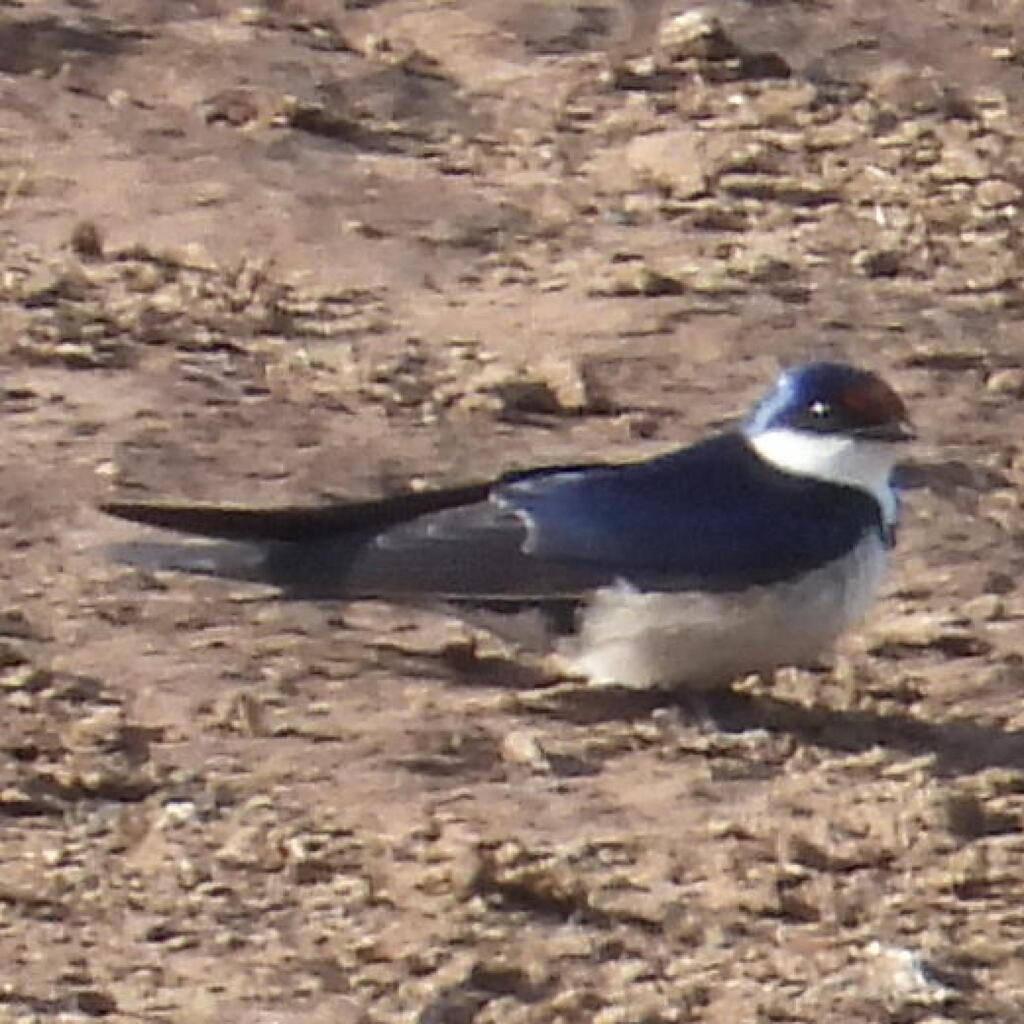
White-throated Swallow
Photo © Henry de Lange
Photo © Henry de Lange — CC BY 4.0 — Source: iNaturalist #342568531Identification
The white-throated swallow is a small bird measuring 14–17 cm in length, with striking plumage that makes it distinctive among African swallows. It features glossy dark blue upperparts contrasted by a bright chestnut crown. The most characteristic feature is the pure white throat separated from greyish-white underparts by a prominent dark blue-black breast band. The upper wings and forked tail are blackish-blue, while the undertail coverts bear distinctive white patches near the feather tips. Juveniles are noticeably duller, with a browner crown, shorter outer tail feathers, and less defined markings. The call consists of a mix of warbles and twitters. Males have slightly longer outer tail feathers than females.
Range & Habitat
This common species is found throughout southern Africa, breeding from Angola and Zambia southwards to the Cape in South Africa. It is primarily migratory, wintering in Angola, Zambia, and southern Zaire. The white-throated swallow favours open country and grassland, particularly in highland areas near water sources. It has adapted well to human development and is frequently encountered around man-made structures, having benefited greatly from the increased nesting opportunities provided by bridges, dams, and buildings.
Behaviour & Diet
This agile flier feeds almost exclusively on flying insects, which it pursues with a fast, twisting flight reminiscent of the barn swallow. The species is a skilled aerial hunter, adeptly maneuvering through open skies to catch prey on the wing.
During breeding season, white-throated swallows construct distinctive bowl-shaped mud nests lined with soft grass or hair, typically positioned on ledges beneath rock overhangs or on man-made structures such as buildings, dam walls, culverts, and bridges—with a preference for uninhabited buildings over occupied houses. A typical clutch consists of three white eggs marked with brown and blue blotches. The female alone incubates for 15–16 days, while both parents feed the chicks after hatching. Fledging occurs after 20–21 days, though young birds return to roost in the nest for several days following their first flight. Remarkably, young swallows can swim short distances to safety if they fall from the nest. Nests are often reused for subsequent broods or in following years.
Best Time & Places to See It
Look for white-throated swallows in open grasslands and highlands of southern Africa during the breeding season. They are commonly spotted around water sources, particularly near dams, bridges, and other water-related infrastructure. Open country habitats with scattered man-made structures offer the best viewing opportunities. The species' preference for highlands and proximity to water makes these landscape features key indicators of suitable habitat.
Photography Tips
Photograph these swallows from vantage points overlooking open grassland or near water sources where they hunt. Early morning and late afternoon often provide the best light for capturing their glossy blue upperparts and chestnut crown. The white throat and black breast band create strong contrast—use these distinctive markings to identify birds in flight. Try to capture them in their characteristic fast, twisting flight, or photograph them perched near their mud nests on structures like bridges and dams. Patient positioning near known nest sites may yield opportunities to photograph both adults and juveniles.
Addo Elephant National Park
Agulhas National Park
Augrabies Falls National Park
Bontebok National Park
Bwabwata National Park
Camdeboo National Park
Cederberg Wilderness Area
Chobe National Park
Dorob National Park
Nothing matches these filters.
No community photos yet. Log in to add the first one.
No community observations of this species yet.