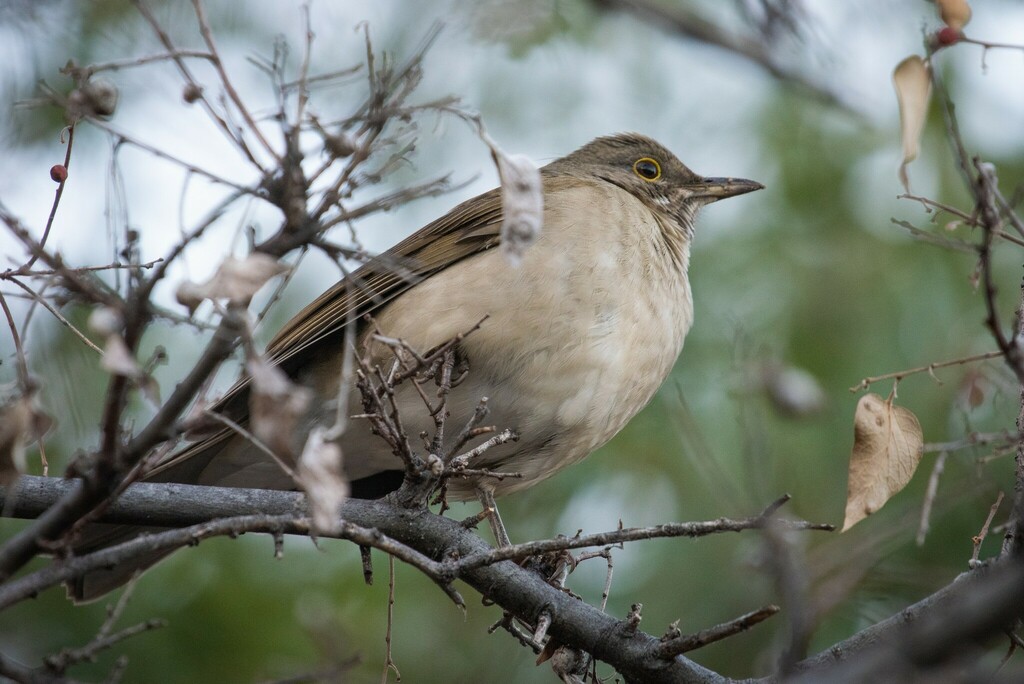
White-throated Thrush
Photo © Adam Jackson
Photo © Adam Jackson — CC0 1.0 — Source: iNaturalist photo #339583874Identification
The white-throated thrush is a medium-sized thrush measuring 22 to 26.5 cm in length and weighing 61 to 90 grams. Both sexes share identical plumage. The nominate subspecies displays a rusty-brown head and upperparts with a distinctive white throat marked by dark brown streaks and a white crescent below. The breast is pale olive-brown, fading to whitish on the belly and vent, while undertail coverts remain white. A yellow eye-ring is prominent, and the bird sports a reddish-brown iris with a dark maxilla and mixed yellow-and-dark mandible. Legs and feet are dirty yellow.
Geographic variation across the species' 13 subspecies is considerable. Some populations, such as T. a. rubicundus, display richer reddish-brown tones and brighter yellow orbital rings, legs, and bill, while others like T. a. atrotinctus show deep slaty-black upperparts with correspondingly darker underparts. The striking white throat and pale eye-ring remain helpful field marks across most forms.
Range & Habitat
The white-throated thrush has a disjunct distribution spanning Mexico, Central America, and occasionally the southwestern United States. It ranges from northwestern Mexico through central and southern regions, with populations scattered across Guatemala, El Salvador, Honduras, Nicaragua, Costa Rica, and Panama, extending to Coiba Island. The species has strayed north to Texas (18 records since 1990) and twice to Arizona.
Habitat preferences vary geographically but consistently favor wooded areas. In Mexico, birds occupy coniferous, deciduous, and evergreen forests alongside plantations, with a preference for moist, shaded undergrowth. Central American populations inhabit humid broadleaf and tropical forests, gallery forests in canyons, and secondary growth. In Costa Rica, the species adapts to primary and mature secondary forest, brushy savanna, pastures, coffee plantations, and canebrakes. The Coiba Island subspecies occupies dry tropical lowland forest and occasionally mangrove edges. Migratory populations favor more open landscapes during the non-breeding season.
Behaviour & Diet
As a member of the thrush family, the white-throated thrush is likely an active forager in woodland understory, though detailed behavioral descriptions remain limited in available literature. The species exhibits both resident and migratory populations depending on geographic location, with some subspecies remaining year-round in their territories while others show seasonal movements to more open habitats during non-breeding periods.
Best Time & Places to See It
White-throated thrushes are most reliably found in humid forest regions of Central America, particularly in Guatemala, Honduras, and Costa Rica. In Mexico, the species is resident year-round in suitable habitat. The best strategy involves searching wooded areas with dense understory during early morning hours when thrushes are most vocal and active. In the southwestern United States, rare sightings occur primarily in Texas, making casual observation there unlikely without considerable patience and local knowledge of previous occurrence sites.
Photography Tips
The white-throated thrush's preference for dense woodland understory presents significant photographic challenges. Early morning light filtering through canopy gaps offers the best opportunities for capturing detail. The bird's white throat and pale eye-ring provide useful focal points; use these features to draw composition. Forest canopy photography requires fast lenses and higher ISO settings to compensate for dim, dappled light typical of humid tropical understory.
Patient observation near fruiting trees or along stream courses in suitable habitat may yield closer encounters. The nominate and brightly marked subspecies (such as rubicundus and atrotinctus) offer striking color contrasts that reward careful framing and positioning relative to background vegetation.
Arenal Volcano National Park
Baru Volcano National Park
Braulio Carrillo National Park
Caño Negro National Wildlife Refuge
Chagres National Park
Chirripó National Park
Coiba National Park
Corcovado National Park
Darién National Park
Nothing matches these filters.
No community photos yet. Log in to add the first one.
No community observations of this species yet.