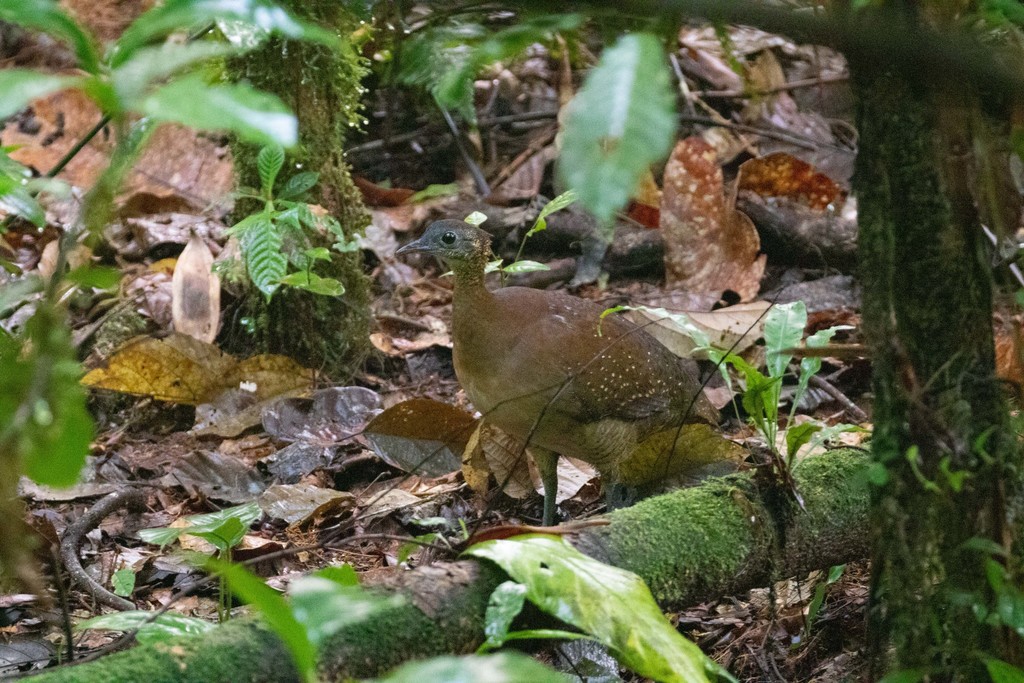
White-throated Tinamou
Photo © Thibaud Aronson
Photo © Thibaud Aronson — CC BY-SA 4.0 — Source: iNaturalist photo #94199419Identification
The white-throated tinamou is a compact forest bird measuring between 32 and 36 centimetres in length, making it the smallest member of its genus. Its plumage is distinctive: chestnut-brown upperparts are streaked with black on the lower back and adorned with small yellowish-white spots—a feature reflected in its scientific name, guttatus, meaning "speckled" in Latin. The underparts are paler, with wider dark barring on the flanks. The head and neck are grey, contrasting with a conspicuous white throat that gives the species its common name. The bird has a brown eye and brown bill, completing an understated but elegant appearance.
Range & habitat
The white-throated tinamou is native to the Amazon rainforest, occurring across Brazil, northern Bolivia, southeastern Colombia, northeastern Ecuador, eastern Peru, and southern Venezuela. These birds inhabit subtropical and tropical lowland forests at elevations of around 500 metres or lower. They are relatively abundant within their preferred habitat, occupying a substantial range of approximately 4,000,000 square kilometres.
Behaviour & diet
Like other tinamous, this species forages on or near the ground, feeding on fallen fruit from low-lying bushes, seeds, invertebrates, flower buds, tender leaves, and roots. The breeding system of the white-throated tinamou is unusual and fascinating: males incubate eggs that may come from as many as four different females, then care for the chicks until they are independent—typically two to three weeks after hatching. Nests are simple ground scrapes located in dense brush or nestled between the raised root buttresses of rainforest trees.
Best time & places to see it
Travellers seeking this species should focus on lowland rainforest regions across the Amazon basin, particularly in protected areas within Brazil, Peru, Ecuador, Colombia, and Venezuela. The bird's preference for dense undergrowth and ground-level foraging means it can be elusive, though its relatively abundance in suitable habitat improves the chances of encounters. Patient observers exploring primary and mature secondary lowland forests at dawn or dusk may have the best opportunities for sightings.
Photography tips
Photographing the white-throated tinamou presents challenges typical of ground-dwelling rainforest species. The bird's cryptic coloration and preference for dense vegetation demand patience and careful positioning. Early morning or late afternoon light filtering through the forest canopy can highlight the subtle yellowish-white spotting on the lower back and the distinctive white throat. A telephoto lens is advisable to maintain distance and avoid flushing the bird, and fast film or high ISO settings will help compensate for the dim understory conditions of its rainforest habitat.
Yasuní National Park
Aguarico, Ecuador
+601 birds+43 mammals
Where the western Amazon basin converges with Ecuador's Orellana Province, lowland rainforest reaches toward the horizon in an unbroken canopy of staggering botanical density. Yasuní National…
VIEW NATIONAL PARKSumaco Napo-Galeras National Park
Loreto, Ecuador
+563 birds+4 mammals
Where Ecuador's Amazon transitions into cloud forest, a massive shield volcano rises from the emerald lowlands of Orellana Province, anchoring one of the continent's most biodiverse…
VIEW NATIONAL PARKNatural Sierra de Chiribiquete National Park
Solano, Colombia
+359 birds+27 mammals
Massive table-top mountains rise abruptly from the lowland rainforest of southeastern Colombia, their sheer sandstone cliffs and isolated summits creating some of the most dramatic topography…
VIEW NATIONAL PARKNatural Sierra de la Macarena National Park
Vista Hermosa, Colombia
+566 birds+15 mammals
Across nearly 20,000 square kilometres of Colombia's Meta Department, the terrain rises from lowland savanna into Andean foothills through a mosaic of gallery forests, palm-fringed wetlands,…
VIEW NATIONAL PARKAmacayacu National Park
Leticia, Colombia
+567 birds+25 mammals
Where the Rio Amazonas curves through the tri-border region where Colombia, Peru, and Brazil converge, Amacayacu National Park sprawls across more than 5,250 square kilometres of…
VIEW NATIONAL PARKSerra do Pardo National Park
Brazil
+153 birds
Vast upland forests and weathered plateaus define this 7,129-square-kilometre protected expanse in the heart of Pará's remote interior, where ancient bedrock and swollen rivers have carved…
VIEW NATIONAL PARKAmazônia National Park
Brazil
+439 birds+6 mammals
Where the Rio Amazonas and its tributaries weave through the heart of Pará state, a vast tapestry of rainforest stretches across 23,611 square kilometers of unbroken…
VIEW NATIONAL PARKMapinguari National Park
Brazil
+354 birds
Vast tracts of western Amazonian rainforest blanket the remote terrain of this 56,827 square kilometre national park in Amazonas state, where seasonal rivers wind through dense…
VIEW NATIONAL PARKCampos Amazónicos National Park
Amazonas, Brazil
+434 birds+7 mammals
Sprawling across the southwestern Amazon basin in Amazonas state, this 27,263-square-kilometre national park encompasses some of the region's most pristine lowland rainforest, where terra firme forest…
VIEW NATIONAL PARKSerra do Divisor National Park
Brazil
+448 birds+10 mammals
Where the western Amazon meets the Andes foothills, Serra do Divisor National Park sprawls across one of South America's most biodiverse and least accessible frontiers. Spanning…
VIEW NATIONAL PARKYanachaga–chemillén National Park
Palcazu, Peru
+639 birds+6 mammals
Where the eastern slopes of Peru's central cordillera plunge into cloud forest, Yanachaga–Chemillén National Park protects nearly three thousand square kilometres of montane wilderness that few…
VIEW NATIONAL PARKManu National Park
Manu, Peru
+892 birds+26 mammals
Across the eastern slopes of the Peruvian Andes, tropical rainforest descends into the Amazon basin with a complexity that few terrestrial ecosystems match. Manu National Park…
VIEW NATIONAL PARKSierra del Divisor National Park
Alto Tapiche, Peru
+298 birds+2 mammals
Where the western Amazon meets the Andes foothills, nearly 41,000 square kilometres of pristine rainforest rise across Peru's Alto Tapiche region in a landscape of extraordinary…
VIEW NATIONAL PARKBahuaja Sonene National Park
San Pedro de Putina Punco, Peru
+602 birds+8 mammals
Where the Madre de Dios and Heath rivers converge in southeastern Peru rises one of South America's most biodiverse wilderness regions: a vast protected realm of…
VIEW NATIONAL PARKCordillera Azul National Park
Pampa Hermosa, Peru
+322 birds+1 mammals
Where the eastern Andes descend into the western Amazon basin, Cordillera Azul National Park sprawls across nearly 38,000 square kilometres of some of Peru's most pristine…
VIEW NATIONAL PARKNo community photos yet. Log in to add the first one.
No community observations of this species yet.