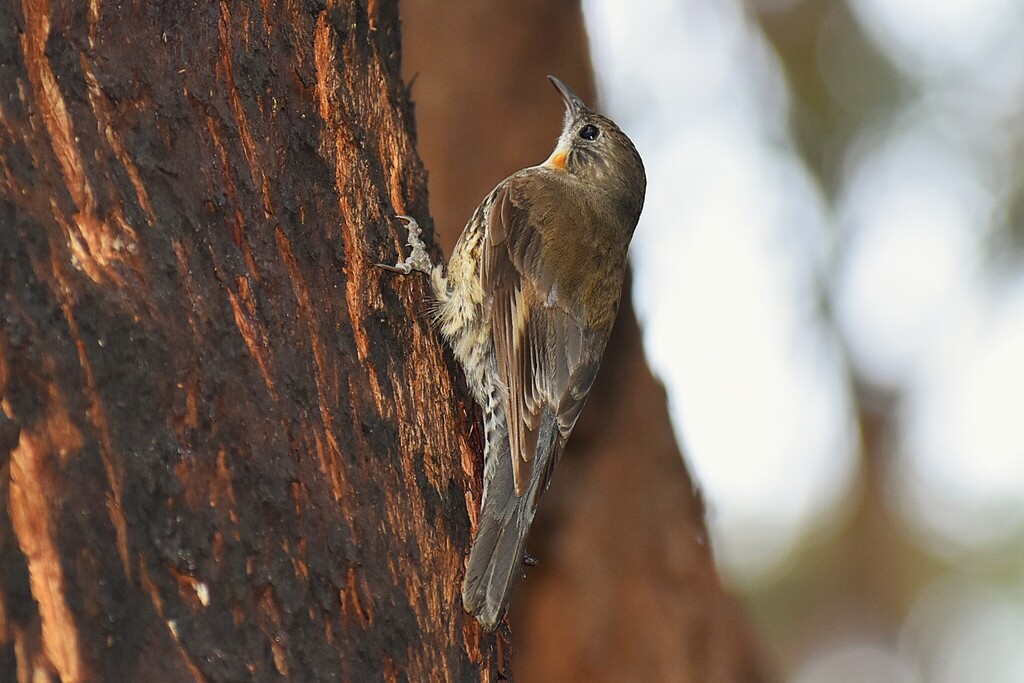
White-throated Treecreeper
Photo © Jake B
Photo © Jake B — CC0 1.0 — Source: iNaturalist photo #572636068Identification
The white-throated treecreeper is a small passerine measuring 13–17 cm in length, with a wingspan of 19–26 cm and weighing around 22 g. Its most distinctive feature is the white throat and breast that give the species its name. The upperparts and wings are dark greyish brown, with a buff patch visible on the wings. The belly and flanks are barred dark brown and white. Unlike other treecreepers, it lacks a pale eyebrow stripe. The bill and feet are black. Females are identifiable by a pale orange-brown patch on the cheek, while immature birds show an orange-brown rump and white markings on the scapulars. The call is a shrill peeping sound.
Range & Habitat
This species is endemic to eastern Australia, ranging from the Gulf St Vincent in South Australia, through Victoria and eastern New South Wales, extending into southeastern Queensland and further north to Mount Spec and Cooktown. It shows a preference for wet sclerophyll forest and rainforest habitats, where it actively forages along tree trunks and branches.
Behaviour & Diet
The white-throated treecreeper is predominantly insectivorous, with ants forming the bulk of its diet, though it also consumes nectar. It forages by gleaning prey while perched, peering into bark crevices, and drilling into dead wood. Unlike the related genus Climacteris, this species does not engage in cooperative breeding. Where its range overlaps with Climacteris species, it typically feeds on looser bark and uses different trees, reducing direct competition.
Best Time & Places to See It
The breeding season runs from August to December, a period when birds are particularly active. Look for this species in wet sclerophyll forests and rainforests of eastern Australia, particularly in areas with rough-barked eucalypts such as red stringybark. It is protected under Australia's National Parks and Wildlife Act, 1974.
Photography Tips
The white-throated treecreeper's small size and active foraging behaviour require patience and a fast shutter speed. Focus on capturing the distinctive white throat and breast against the dark upperparts. Early morning light in wet forests will best reveal the subtle barring on the belly and flanks. Position yourself at eye level with foraging birds to showcase their characteristic behaviour of moving up and down tree trunks. The buff wing patch and subtle plumage details reward closer attention with telephoto lenses.
Alpine National Park
Bald Rock National Park
Barrington Tops National Park
Belair National Park
Ben Boyd National Park
Blue Mountains National Park
Bouddi National Park
Bribie Island National Park
Budawang National Park
Nothing matches these filters.
No community photos yet. Log in to add the first one.
No community observations of this species yet.