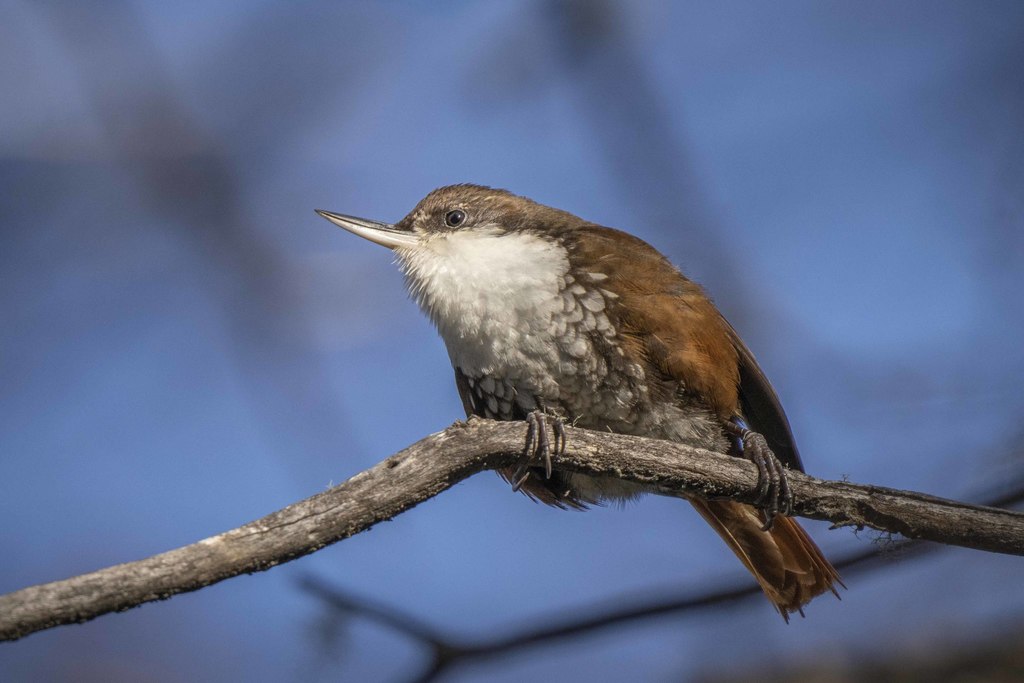
White-throated Treerunner
Photo © Luciano Massa
Photo © Luciano Massa — CC BY 4.0 — Source: iNaturalist photo #149748481Identification
The white-throated treerunner is a small bird, about 15 cm long, with a distinctive appearance that recalls a nuthatch despite no close relationship. Its most striking feature is the brilliant white throat and chest, which contrasts sharply with dark brown upperparts that transition to deep red on the lower back and tail. The rest of the underparts are coarsely mottled with white. The bird has a characteristic long, slightly upward-curved bill and a stiff, rounded tail that aids in trunk-climbing.
Range & Habitat
This species is endemic to the southern tip of South America, occurring in Chile and Argentina from Santiago and Mendoza south to Tierra del Fuego. It inhabits forests with large, mature trees—essential for finding suitable nesting cavities and foraging opportunities—across both lowland and highland regions in various forest densities. The white-throated treerunner remains relatively common throughout its range, and conservation status is listed as least concern.
Behaviour & Diet
Like nuthatches, this bird tirelessly searches tree trunks and branches for small arthropods, spiraling upward or occasionally moving head-down along bark. It feeds exclusively on small invertebrates gleaned from tree surfaces and nests in natural cavities within old trunks. Outside the breeding season, individuals may join mixed-species foraging flocks, increasing feeding efficiency and vigilance against predators.
Best Time & Places to See It
Look for white-throated treerunners year-round throughout their range in southern Chile and Argentina. They are most easily located in forests containing old-growth trees with substantial trunks. Careful observation of bark-foraging birds, particularly in mixed flocks, will often reveal this species. Patient watching of established territories yields the best sightings.
Photography Tips
The white-throated treerunner's small size and restless behaviour present challenges, but its striking white throat offers a strong focal point for composition. Use a fast shutter speed to freeze movement along trunks and branches. Early morning light best reveals the contrast between dark upperparts and bright underparts. Focus on birds moving up tree trunks where background is clean, and be prepared with at least a 400mm lens to fill the frame with this diminutive species.
Alerce Costero National Park
Cerro Castillo National Park
Chiloé National Park
Corcovado National Park
Lago Puelo National Park
Laja National Park Lagoon
Lanín National Park
Los Alerces National Park
Los Glaciares National Park
Nothing matches these filters.
No community photos yet. Log in to add the first one.
No community observations of this species yet.