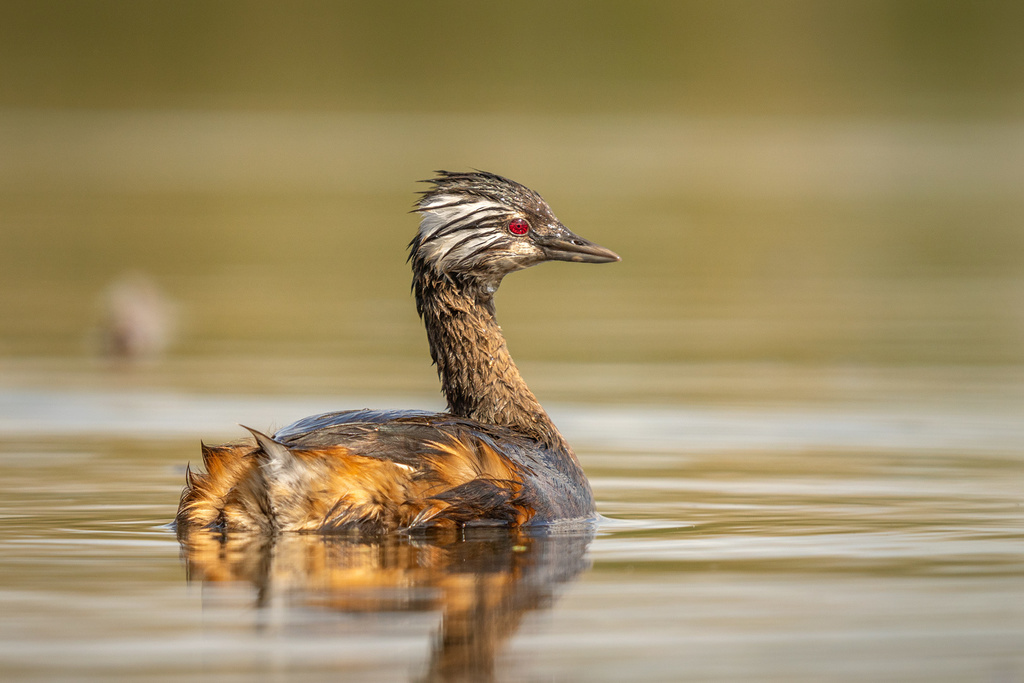
White-tufted Grebe
Photo © Luciano Massa
Photo © Luciano Massa — CC BY 4.0 — Source: iNaturalist photo #103739937Identification
The white-tufted grebe is a small to medium-sized waterbird, measuring 24–36 cm in length, with size varying by subspecies. In breeding plumage, adults display a striking black head with a prominent crest on the back and a distinctive large white tuft of feathers around the ear. The neck, back and mantle are black with a greenish sheen, while underparts are dull reddish-brown, often mottled. The secondary wing feathers show white or pale grey patches. Non-breeding birds are considerably duller, with dark brown plumage, an inconspicuous crest, white sides to the head and throat, and buff on the neck and chest fading to white on the belly. Both sexes look identical. The eye is red, the bill is black, and legs are grey to olive-brown.
Range & Habitat
This grebe is found across southern and western South America, from southeastern Brazil south through Paraguay, Uruguay, Bolivia, Chile, Peru, and Argentina to Cape Horn and Tierra del Fuego, as well as the Falkland Islands. Three subspecies are recognized, with notable size differences among populations. The species occurs from lowland areas up to 4,500 m elevation. It favors freshwater lakes, marshy ponds, slow-moving rivers and streams. Birds in southernmost regions migrate northward along the coast after breeding, where they frequent sheltered bays and marine locations.
Behaviour & Diet
White-tufted grebes vary in breeding behavior by population. The widespread mainland subspecies is strongly territorial and usually nests solitarily, though loose colonies may form where suitable sites are limited. The Falkland Islands population nests solitarily and is notably less territorial even during breeding, with some pairs mating on firm land rather than floating platforms—unique among grebes. Nests are constructed from floating or grounded platforms of reeds and aquatic vegetation. Clutches typically contain one to three eggs, occasionally up to six. These grebes feed primarily on small fish up to about 15 cm long, supplemented with arthropods and aquatic vegetation, catching prey through sluggish dives lasting up to 20 seconds or by head-dunking while swimming.
Best Time & Places to See It
White-tufted grebes are widespread and stable across their range, making them relatively accessible to dedicated birdwatchers. The nominate subspecies is found in the Falkland Islands, while R. r. chilensis occurs throughout mainland South America. The localized R. r. morrisoni inhabits Lake Junin in the Peruvian highlands. Birds are most active and visible during the breeding season when territorial and displaying, and again during post-breeding migrations along South American coasts. Freshwater lakes and ponds with suitable vegetation provide the best viewing opportunities.
Photography Tips
The striking head pattern and white ear tufts make white-tufted grebes rewarding subjects, particularly in breeding plumage. Early morning light will enhance the greenish sheen on black plumage and illuminate the red eye. Approach slowly and quietly from the shore or from a boat to avoid disturbing birds. The bird's sluggish diving behavior offers opportunities to anticipate submersion and capture the characteristic pose. Position yourself with the sun behind you to capture detail in the dark plumage, and focus on the prominent crest and facial markings. In non-breeding birds, the white head patches and throat provide useful compositional contrast. Patient stalking of birds in sheltered bays during migration can yield excellent flight and diving sequences.
Campos del Tuyú National Park
Chiloé National Park
El Palmar National Park
El Rey National Park
Huascarán National Park
Lago Puelo National Park
Laja National Park Lagoon
Lanín National Park
Los Alerces National Park
Nothing matches these filters.
No community photos yet. Log in to add the first one.
No community observations of this species yet.