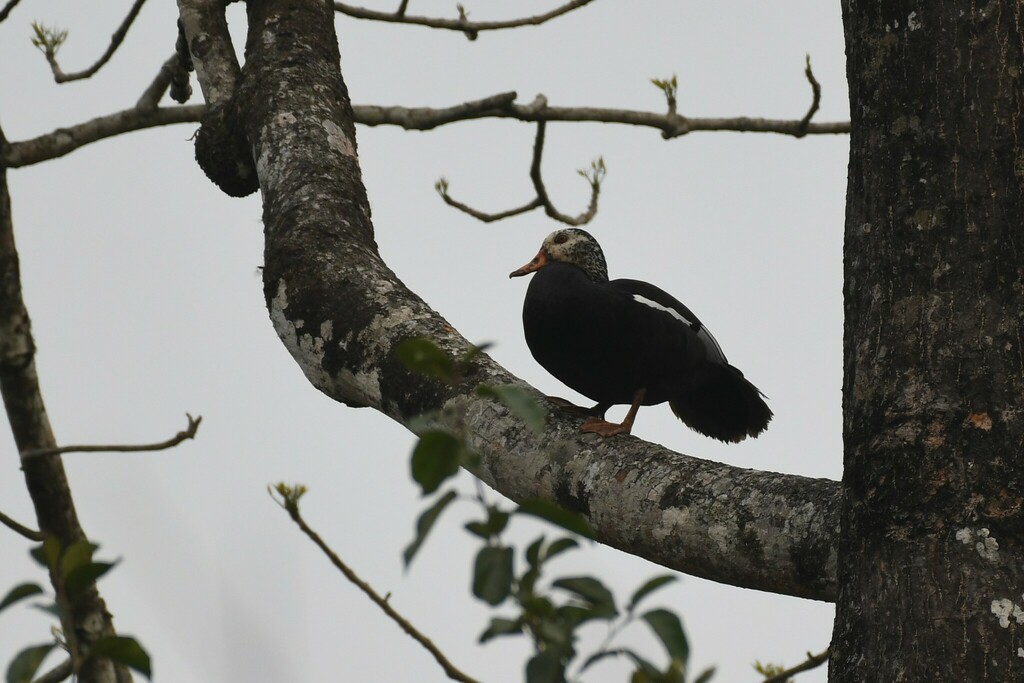
White-winged Duck
Photo © Tristan Jobin
Photo © Tristan Jobin — CC BY 4.0 — Source: iNaturalist photo #364417160Identification
The white-winged duck is one of the largest living duck species, with a length of 66–81 cm and wingspan of 116–153 cm. Males weigh 2.94–3.9 kg, while females are noticeably smaller at 1.95–3.05 kg. The most striking feature is the dramatic contrast between the dark body and whitish head and neck of adult birds. Males display a dull yellowish bill with blackish mottling on the head and upper neck, white lesser median coverts and inner tertial edges, and bluish-grey secondaries. In flight, the white wing-coverts create a distinctive pattern against the darker wings. Females are smaller with more densely mottled head and neck plumage, while juveniles appear duller and browner overall.
Range & Habitat
Historically widespread from northeastern India and Bangladesh throughout Southeast Asia to Java and Sumatra, the white-winged duck now occupies a fragmented range. It is extinct on Java and probably extinct in Bangladesh, Lao PDR, Vietnam, and Peninsular Malaysia. Surviving populations persist in eastern Assam and Arunachal Pradesh in India; Myanmar, particularly along the Chindwin River and in the Hukaung Valley Wildlife Sanctuary (regarded as the global stronghold); remnant populations on Sumatra; a few wild birds in remote Thai forests plus a reintroduced population at Phu Khieo Wildlife Sanctuary; and Cambodia at Preah Vihear. In India, key populations are found in Nameri National Park and the Dihing–Patkai complex.
The species inhabits stagnant or slow-flowing natural and artificial wetlands within or adjacent to evergreen, deciduous, or swamp forests, which it depends on for roosting and nesting in tree-holes. While lowland areas below 400 m provide optimal habitat, it occurs up to 1,400 m, especially on plateaux with sluggish perennial rivers and pools.
Behaviour & Diet
This is a highly secretive species that feeds primarily at dawn and dusk while moving between daytime roosts and feeding sites. The white-winged duck is omnivorous, regularly consuming pondweed, small fish, aquatic snails, spiders, and insects. Breeding seasons vary across the range, timed so that hatching coincides with the early wet season. Clutch sizes range from 6 to 13 in captivity and 2 to 12 in the wild, with eggs laid in tree cavities.
Best Time & Places to See It
Finding white-winged ducks requires patience and access to remote forested wetlands. Myanmar's Hukaung Valley Wildlife Sanctuary offers the best opportunity as the global stronghold. In India, Nameri National Park and the Dihing–Patkai complex are key locations, with smaller populations at Namdapha National Park. Early morning and dusk provide the best viewing windows, as the species is most active during these periods. Thailand's Phu Khieo Wildlife Sanctuary holds a reintroduced population, though its viability is uncertain. Given the species' extreme rarity and secretive nature, guided birdwatching trips through protected areas in these regions offer the most realistic chance of sightings.
Photography Tips
Photographing white-winged ducks presents significant challenges due to their secretive habits and rarity. The contrast between the whitish head and dark body provides distinctive photographic potential when birds are visible. Dawn and dusk shooting will require higher ISO settings and fast lenses given the low light conditions when ducks are most active. The white wing-coverts visible in flight create dramatic contrast opportunities if you can capture birds in flight. Access to remote forested rivers and wetlands requires planning expeditions through protected areas, ideally with local guides familiar with the species' behavior and preferred roosting and feeding sites. Patience is essential—extended time observing wetlands during peak activity periods offers the best chance of obtaining quality images.
No community photos yet. Log in to add the first one.
No community observations of this species yet.