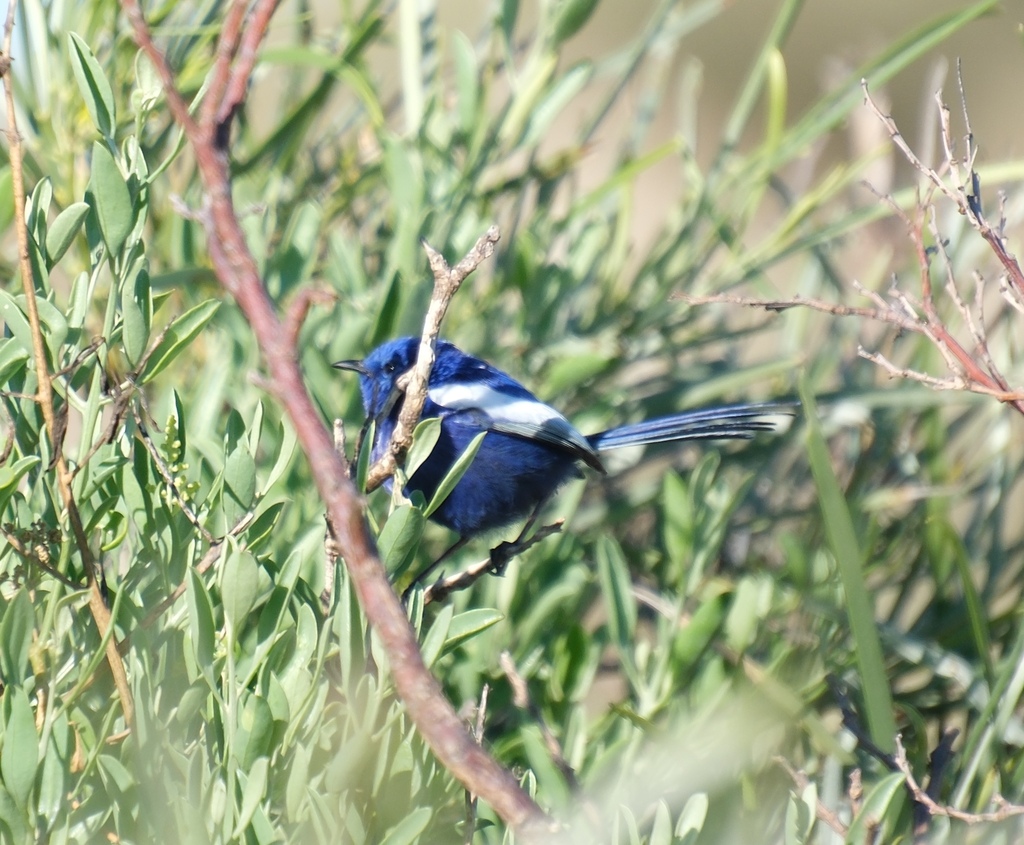
White-winged Fairywren
Photo © marsyd
Photo © marsyd — CC0 1.0 — Source: iNaturalist #372531154The white-winged fairywren (Malurus leucopterus) is a species of passerine bird in the Australasian wren family, Maluridae. It lives in the drier parts of Central Australia; from central Queensland and South Australia across to Western Australia. Like other fairywrens, this species displays marked sexual dimorphism and one or more males of a social group grow brightly coloured plumage during the breeding season. The female is sandy-brown with light-blue tail feathers; it is smaller than the male, which, in breeding plumage, has a bright-blue body, black bill, and white wings. Younger sexually mature males are almost indistinguishable from females and are often the breeding males. In spring and summer, a troop of white-winged fairywrens has a brightly coloured older male accompanied by small, inconspicuous brown birds, many of which are also male. Three subspecies are recognised. Apart from the mainland subspecies, one is found on Dirk Hartog Island, and another on Barrow Island off the coast of Western Australia. Males from these islands have black rather than blue breeding plumage. The white-winged fairywren mainly eats insects, supplementing this with small fruits and leaf buds. It occurs in heathland and arid scrubland, where low shrubs provide cover. Like other fairywrens, it is…
Uluru-Kata Tjuta National Park
Petermann, Australia
+146 birds+10 mammals
Uluru-Kata Tjuta National Park is one of Australia’s most iconic protected areas, renowned for its breathtaking desert landscapes, extraordinary geological formations, and deep cultural significance. Located…
VIEW NATIONAL PARKIkara-Flinders Ranges National Park
Australia
+149 birds+10 mammals
Where ancient quartzite ridges rise across the semi-arid heart of South Australia, Ikara-Flinders Ranges National Park unfolds across nearly two thousand square kilometres of one of…
VIEW NATIONAL PARKVulkathunha-Gammon Ranges National Park
Australia
+97 birds+8 mammals
Granite ridges and quartzite peaks rise abruptly from the red earth of South Australia's mid-north, their steep slopes carved into gorges where seasonal waterfalls cascade through…
VIEW NATIONAL PARKMungo National Park
Australia
+135 birds+7 mammals
Across the semi-arid inland plains of New South Wales, where sparse shrubland and scattered grassland stretch beneath enormous skies, lies a landscape shaped by ancient geological…
VIEW NATIONAL PARKMurray-Sunset National Park
Australia
+205 birds+2 mammals
Across the semi-arid borderlands of northwestern Victoria, where the Murray River defines the state's edge, sprawls a landscape of remarkable resilience and subtle beauty. Murray-Sunset National…
VIEW NATIONAL PARKKalbarri National Park
Australia
+157 birds+6 mammals
Where ochre cliffs and weathered gorges slice through Western Australia's semi-arid interior, Kalbarri National Park reveals a landscape shaped by millions of years of erosion and…
VIEW NATIONAL PARKKarijini National Park
Australia
+117 birds+5 mammals
Ochre ridges and rust-coloured gorges slice through the Pilbara's ancient landscape, where Karijini National Park sprawls across a wilderness of iron-rich plateaus and plunging ravines carved…
VIEW NATIONAL PARKNambung National Park
Grey, Australia
+124 birds+2 mammals
Where limestone pinnacles rise like sharpened teeth from golden sand, Nambung National Park unveils one of Western Australia's most distinctive landscapes. The Pinnacles Desert, the park's…
VIEW NATIONAL PARKCape Range National Park
Australia
+159 birds+15 mammals
Where arid limestone ridges plunge toward turquoise waters, Cape Range National Park frames one of Australia's most dramatic desert-ocean interfaces. The park's spine—a stark, weathered range…
VIEW NATIONAL PARKNo community photos yet. Log in to add the first one.
No community observations of this species yet.