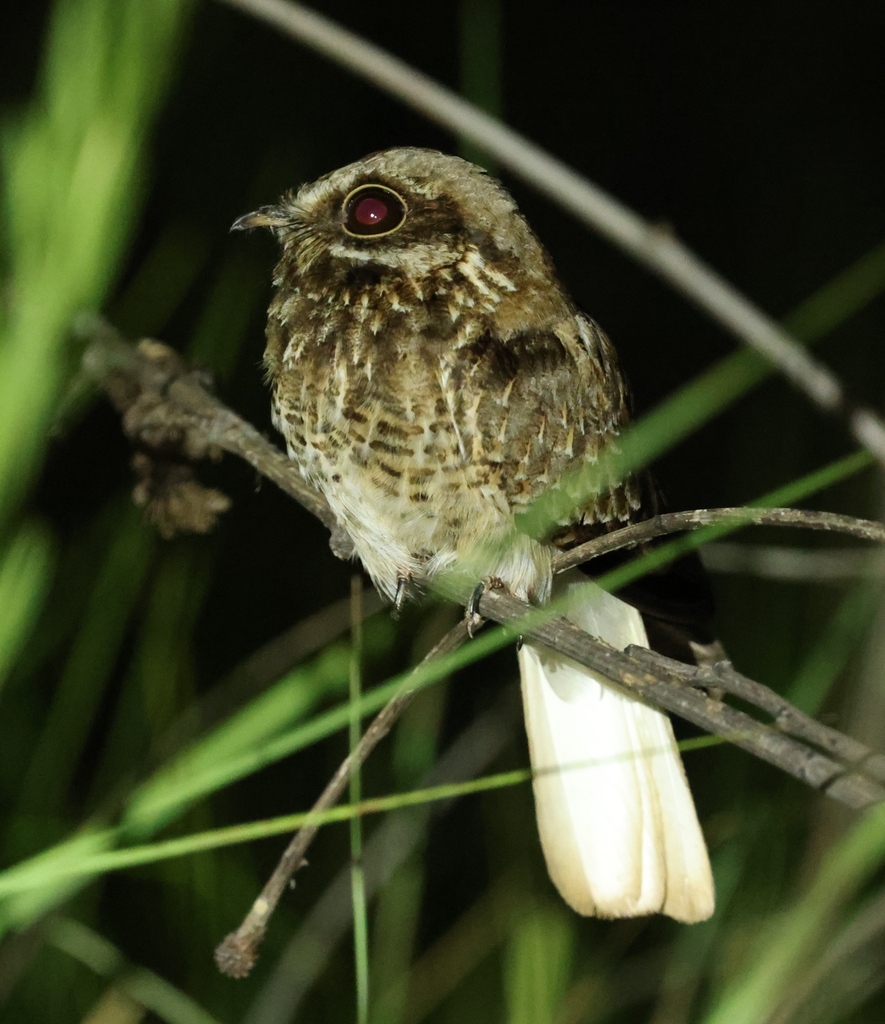
White-winged Nightjar
Photo © Abby Darrah
Photo © Abby Darrah — CC BY 4.0 — Source: iNaturalist photo #471621405Identification
The white-winged nightjar is a small nightjar, measuring 19 to 23 cm in length. Adult males are distinctive, with pale grayish-brown upperparts boldly spotted and streaked with black and brown, particularly on the crown. A striking white supercilium and "moustache" mark the face, while the breast is grayish-brown with a chestnut tinge. The defining feature—particularly obvious in flight—is the whitish wings and mostly white tail, which males display prominently. The rest of the underparts are white. Adult females are notably different, with buffy underparts and no white plumage, making them considerably more subtle in appearance. Juveniles are browner overall than adults. Both sexes weigh between 46 and 55 grams.
Range & Habitat
This species is found in widely separated sites across three South American countries: northern Bolivia, south-central Brazil, and eastern Paraguay, with historical reports also from southern Brazil. The white-winged nightjar inhabits open grasslands with scattered trees and bushes, particularly savanna and cerrado habitats. It occurs from sea level up to 210 metres elevation, making it accessible in relatively low-lying terrain across its range.
Behaviour & Diet
The white-winged nightjar is primarily a ground-nesting species, with clutches of two eggs laid directly on the ground. Females alone incubate the eggs, while males perform spectacular display flights showcasing the distinctive white wings and tail—behaviour that serves both territorial and mate-attraction functions. These displays are accompanied by mechanical wing noises. Males produce a soft territorial call described as "tshere-she-shew" during chases, and an abrupt "eek" as an alarm call.
For feeding, this species forages in continuous, characteristically slow low flight interspersed with glides, though it occasionally sallies from low perches. Its diet consists primarily of insects, including beetles and moths. The species may be migratory in at least parts of its range, though migration patterns remain incompletely understood.
Best Time & Places to See It
In Paraguay, egg-laying occurs from mid-September to mid-November, suggesting this may be a productive season for observing breeding behaviour and displays. However, given the species' very small population and restriction to only a few scattered sites across its range, finding white-winged nightjars requires patience and local knowledge. Visits to protected grassland and cerrado habitats in Bolivia, Brazil, or Paraguay offer the best chances, though advance consultation with local guides familiar with current sighting locations is essential.
Photography Tips
Males in display flight offer the most photographic reward, with the white wings and tail providing striking contrast against darker backgrounds. Approaching during breeding season in Paraguay (September to November) may increase opportunities to photograph territorial displays and the distinctive wing and tail patterns. The species' preference for low, slow flight and low perches makes it more accessible than many nightjars, though low-light conditions at dawn and dusk—when nightjars are most active—will require appropriate camera settings and possibly supplementary lighting.
No community photos yet. Log in to add the first one.
No community observations of this species yet.