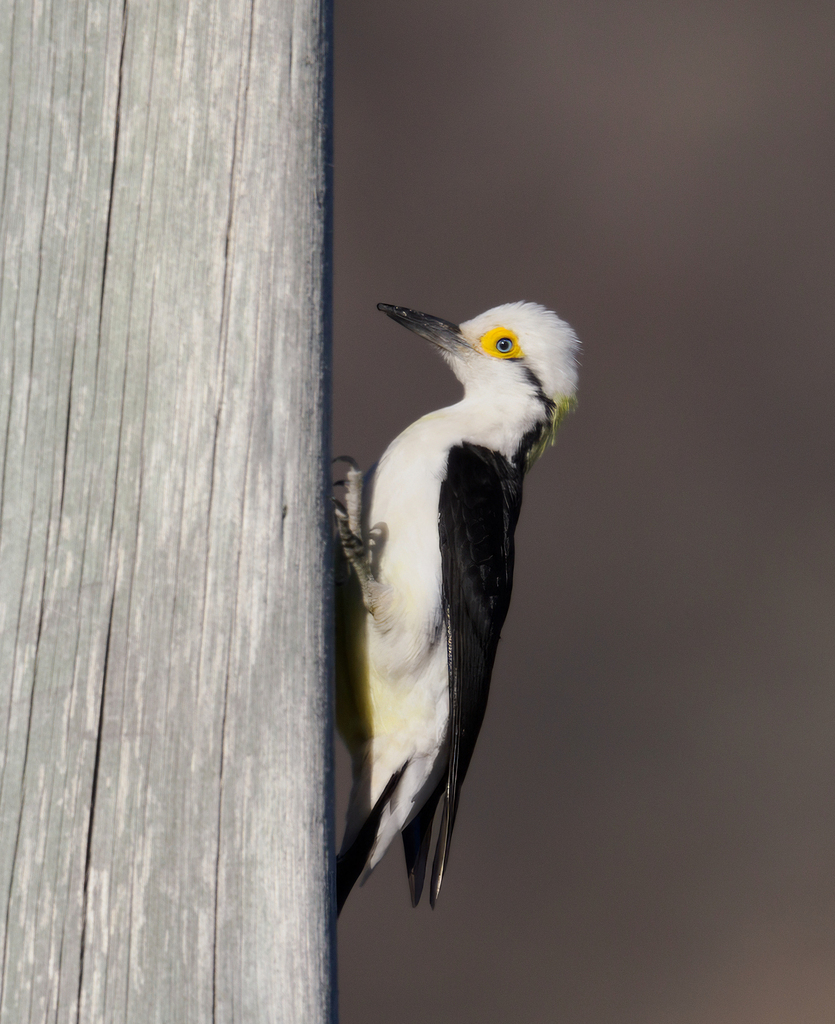
White Woodpecker
Photo © Gabriel Brachetti
Photo © Gabriel Brachetti — CC BY 4.0 — Source: iNaturalist #294895172Identification
The white woodpecker is a striking and unmistakable bird, measuring 24 to 29 cm in length and weighing around 108 g. Its plumage is boldly contrasting: the crown, face, rump and underparts are pure white, while the mantle, back, wings and tail are black. A defining feature is the bare ring of bright yellow skin encircling the eye, which has a yellowish iris. Males display some yellow on the breast and nape, along with yellow on the belly, while females lack the breast and nape colouration. Both sexes share the yellow belly patches. A narrow black stripe runs from behind the eye to the nape. The beak is long and grey, paler at the base, and the legs are grey. Juveniles are duller, with buff-coloured pale areas instead of pure white, and a grey rather than yellow orbital ring.
Range & Habitat
This South American woodpecker has a large distribution east of the Andes, ranging from Suriname and French Guiana through much of Brazil to southeastern Peru, Bolivia, Paraguay, Uruguay and northern Argentina. It inhabits altitudes up to about 2,000 metres and is non-migratory, though it makes short-distance movements opportunistically. The species is highly adaptable, occupying forest edges, open dry woodland, wooded savannah, scrubland with scattered trees, plantations, orchards and parkland. It has even colonised mangroves and city suburbs, expanding its range into areas of felled timber.
Behaviour & Diet
White woodpeckers are social birds, sometimes seen in groups of up to ten flying with distinctive floppy wing-beats in procession. They forage noisily in family groups, maintaining an active and conspicuous presence in their habitat. Their diet is remarkably varied, encompassing fruits, berries and seeds—making them significant seed dispersers for various plant species. They are also opportunistic hunters, raiding wild bee and wasp nests to feed on adult insects, larvae and honey. Breeding occurs between September and November, and while they may sometimes nest communally, much remains unknown about their breeding habits.
Best Time & Places to See It
The white woodpecker's extremely large range, estimated at over 10 million square kilometres, offers numerous opportunities for sightings across South America. Although generally uncommon with a somewhat patchy distribution, the species is expanding its range at the southern end of its distribution and shows increasing population numbers. Your best chances come during the breeding season from September to November. The bird's adaptability means it may be encountered in various habitats, from natural woodlands to suburban gardens and orchards, making it accessible to travellers throughout much of Brazil, Bolivia, Paraguay, Uruguay and Argentina.
Photography Tips
The white woodpecker's bold black-and-white plumage and striking yellow eye patch make it a rewarding photographic subject with excellent contrast in natural light. Look for birds in open woodlands and scrubland where there is unobstructed sightlines. Since they forage in noisy family groups, audio cues can help locate them. The bird's floppy wing-beat flight pattern in procession offers dynamic shooting opportunities. Early morning provides the best light and activity levels. Exercise patience when photographing in suburban settings and plantations, where they are increasingly found—the adaptable nature of this species means that even modified habitats can yield excellent sightings and images.
Emas National Park
Brazil
+333 birds+23 mammals
Across the high plateaux of central Brazil, where the cerrado grasslands roll toward distant horizons under an immense sky, Emas National Park anchors one of South…
VIEW NATIONAL PARKSerra do Cipó National Park
Brazil
+379 birds+5 mammals
Where granite escarpments rise above the Atlantic Forest transition zone in southeastern Brazil, Serra do Cipó National Park unfolds across a landscape of dramatic ridges, cascading…
VIEW NATIONAL PARKItatiaia National Park
Brazil
+519 birds+12 mammals
Where granite peaks pierce the Atlantic rainforest canopy in southeastern Brazil, Itatiaia National Park rises as one of the country's oldest and most ecologically vital protected…
VIEW NATIONAL PARKPeixe National Park Lagoon
Brazil
+293 birds+4 mammals
Where the coastal plains of Rio Grande do Sul meet the Atlantic, Peixe National Park Lagoon sprawls across nearly 2,200 square kilometres of shallow waters, reed…
VIEW NATIONAL PARKSuperagui National Park
Brazil
+246 birds+2 mammals
Where the Atlantic rainforest meets the subtropical coast of Paraná, Superagui National Park sprawls across more than 1,000 square kilometres of one of Brazil's most biodiverse…
VIEW NATIONAL PARKSerra da Bocaina National Park
Brazil
+441 birds+5 mammals
Where the escarpment of the Serra da Bocaina rises sharply from the Atlantic coastal plain, tropical rainforest cloaks steep mountainsides that climb toward peaks exceeding 2,000…
VIEW NATIONAL PARKIguaçu National Park
Brazil
+387 birds+17 mammals
Where the Paraná Plateau plunges toward the Atlantic watershed, six thousand square kilometers of subtropical rainforest cling to steep gorges and river valleys in this corner…
VIEW NATIONAL PARKIlha Grande National Park
Brazil
+233 birds
Across the subtropical plateaus and Atlantic forest remnants of southern Brazil, a vast protected landscape spanning nearly 4,600 square kilometers safeguards one of the continent's most…
VIEW NATIONAL PARKSerra dos Órgãos National Park
Brazil
+446 birds+13 mammals
Granite peaks thrust skyward through the Atlantic Forest canopy in the mountains immediately north of Rio de Janeiro, their bare rock faces rising above a landscape…
VIEW NATIONAL PARKChapada dos Guimarães National Park
Brazil
+450 birds+1 mammals
Where weathered sandstone plateaus rise above the cerrado grasslands of central Brazil, Chapada dos Guimarães National Park protects 624 square kilometres of ecological transition zone that…
VIEW NATIONAL PARKChapada dos Veadeiros National Park
Brazil
+324 birds+6 mammals
Where granite plateaus rise above the cerrado savanna in central Brazil, Chapada dos Veadeiros National Park unfolds across 6,665 square kilometres of some of the world's…
VIEW NATIONAL PARKPantanal Matogrossense National Park
Brazil
+322 birds+17 mammals
Where the flooded forests of central Brazil meet vast seasonally inundated grasslands, Pantanal Matogrossense National Park sprawls across nearly 2,900 square kilometers of one of the…
VIEW NATIONAL PARKSerra do Gandarela National Park
Brazil
+333 birds+3 mammals
Where granite massifs rise through Atlantic Forest in southeastern Brazil's highlands, Serra do Gandarela National Park protects nearly 1,000 square kilometres of montane terrain that few…
VIEW NATIONAL PARKBrasília National Park
Plano Piloto, Brazil
+338 birds+15 mammals
Cerrado grassland and scattered woodland sweep across the central Brazilian plateau where this national park sprawls across more than a thousand square kilometres of the Federal…
VIEW NATIONAL PARKAraucárias National Park
Brazil
+231 birds+3 mammals
Where the southern Brazilian highlands rise into cool temperate forest, Araucárias National Park protects one of the Atlantic Forest's most distinctive ecosystems across 506 square kilometres…
VIEW NATIONAL PARKCampos Gerais National Park
Brazil
+143 birds
Where rolling plateaus rise above the Atlantic forest escarpment in Paraná's interior, Campos Gerais National Park unfolds across 539 square kilometers of highland grassland and forest…
VIEW NATIONAL PARKBahuaja Sonene National Park
San Pedro de Putina Punco, Peru
+602 birds+8 mammals
Where the Madre de Dios and Heath rivers converge in southeastern Peru rises one of South America's most biodiverse wilderness regions: a vast protected realm of…
VIEW NATIONAL PARKEl Palmar National Park
Distrito Sexto, Argentina
+244 birds+14 mammals
Across the Paraná River floodplain in northeastern Argentina, palms rise from wetland and grassland in a landscape shaped by water and time. El Palmar National Park…
VIEW NATIONAL PARKRío Pilcomayo National Park
Argentina
+271 birds+13 mammals
Where the Río Pilcomayo cuts through northeastern Argentina's subtropical lowlands, a sprawling mosaic of wetlands, grasslands, and seasonally flooded forests creates one of South America's most…
VIEW NATIONAL PARKIguazú National Park
Puerto Iguazú, Argentina
+346 birds+15 mammals
Where the Paraná Plateau plunges toward the Atlantic watershed, nearly 800 square kilometers of subtropical rainforest drape across Misiones Province in a landscape carved by millennia…
VIEW NATIONAL PARKParque Provincial Pampa del Indio
Laguna Limpia, Argentina
+231 birds+4 mammals
Across the flat horizons of Chaco Province, where the Paraná River system spills into vast wetlands and grasslands, Parque Provincial Pampa del Indio protects one of…
VIEW NATURE RESERVEChaco National Park
Municipio de Presidencia de la Plaza, Argentina
+258 birds+7 mammals
Across the humid subtropical lowlands of northeastern Argentina, where the Paraná River basin feeds vast seasonal wetlands and gallery forests, Chaco National Park protects one of…
VIEW NATIONAL PARKNo community photos yet. Log in to add the first one.
No community observations of this species yet.