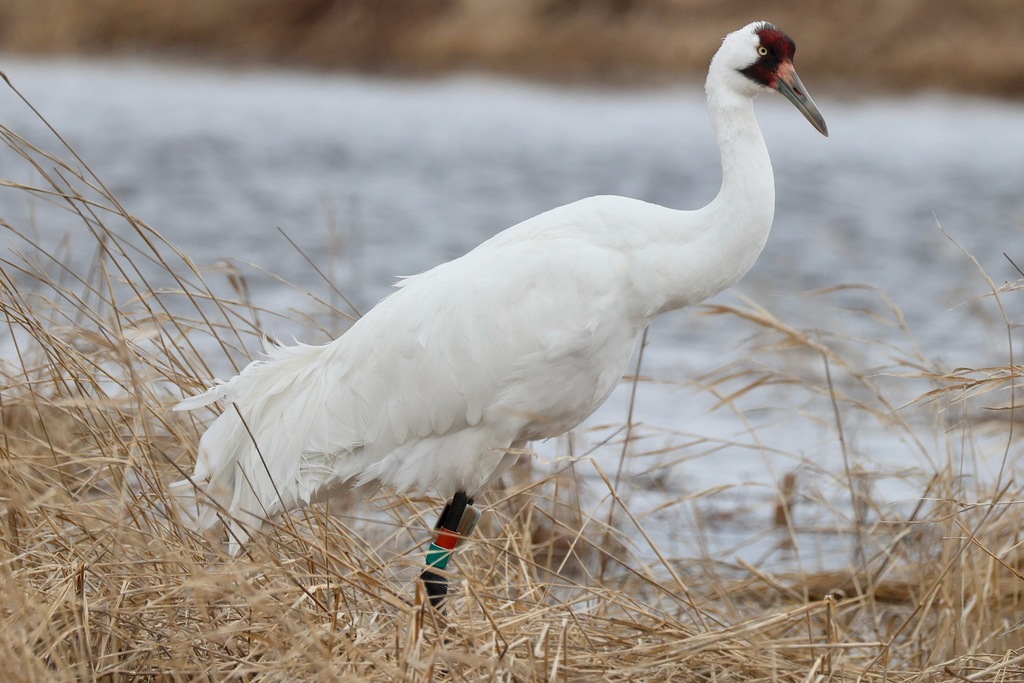
Whooping Crane
Photo © Cole Wolf
Photo © Cole Wolf — CC BY 4.0 — Source: iNaturalist photo #634496730The whooping crane (Grus americana) is an endangered crane species, native to North America, named for its "whooping" calls. Along with the sandhill crane (Antigone canadensis), it is one of only two crane species native to North America, and it is also the tallest North American bird species, with an estimated 22–30+ year life expectancy in the wild. After being pushed to the brink of extinction by unregulated hunting and loss of habitat that left just 21 wild (and two captive) cranes by 1941, the whooping crane made a partial recovery through conservation efforts. The total number of cranes in the surviving migratory population, plus three reintroduced flocks and in-captivity, is just over 830 birds as of 2025. This includes about 560 individuals in the remnant population that migrates between coastal Texas, USA, and the Northwest Territories, Canada, which is termed the "Aransas-Wood Buffalo Population" after the protected areas that anchor the population's wintering and breeding ranges, respectively. Additionally, there are about 140 individuals in two reintroduced populations breeding in Wisconsin and Louisiana, USA, and an additional 130 individuals in captivity. == Taxonomy == The whooping crane was formally described in 1758 by the Swedish naturalist Carl Linnaeus in the…
Wood Buffalo National Park
Improvement District No. 24, Canada
+187 birds+10 mammals
Across nearly 75,000 square kilometres of boreal forest, wetland and grassland in northern Alberta, the landscape unfolds in a mosaic of spruce and pine woodland interspersed…
VIEW NATIONAL PARKWheeler National Wildlife Refuge
Triana, United States
+268 birds+10 mammals
Shallow impoundments and meandering channels spread across northern Alabama's humid subtropical landscape, where Wheeler National Wildlife Sanctuary anchors a critical junction of wetland and woodland habitat.…
VIEW WILDLIFE SANCTUARYSt. Marks National Wildlife Refuge
Saint Marks, United States
+324 birds+16 mammals
Where the Apalachee Bay begins to define the Florida coastline, salt marshes and freshwater impoundments merge into one of the southeastern United States' most productive wildlife…
VIEW WILDLIFE SANCTUARYChassahowitzka National Wildlife Refuge
Homosassa, United States
+299 birds+14 mammals
Where the Gulf of Mexico's coastal marshes dissolve into brackish tidal flats and mangrove thickets, the Chassahowitzka National Wildlife Sanctuary near Homosassa represents one of Florida's…
VIEW WILDLIFE SANCTUARYNo community photos yet. Log in to add the first one.
No community observations of this species yet.