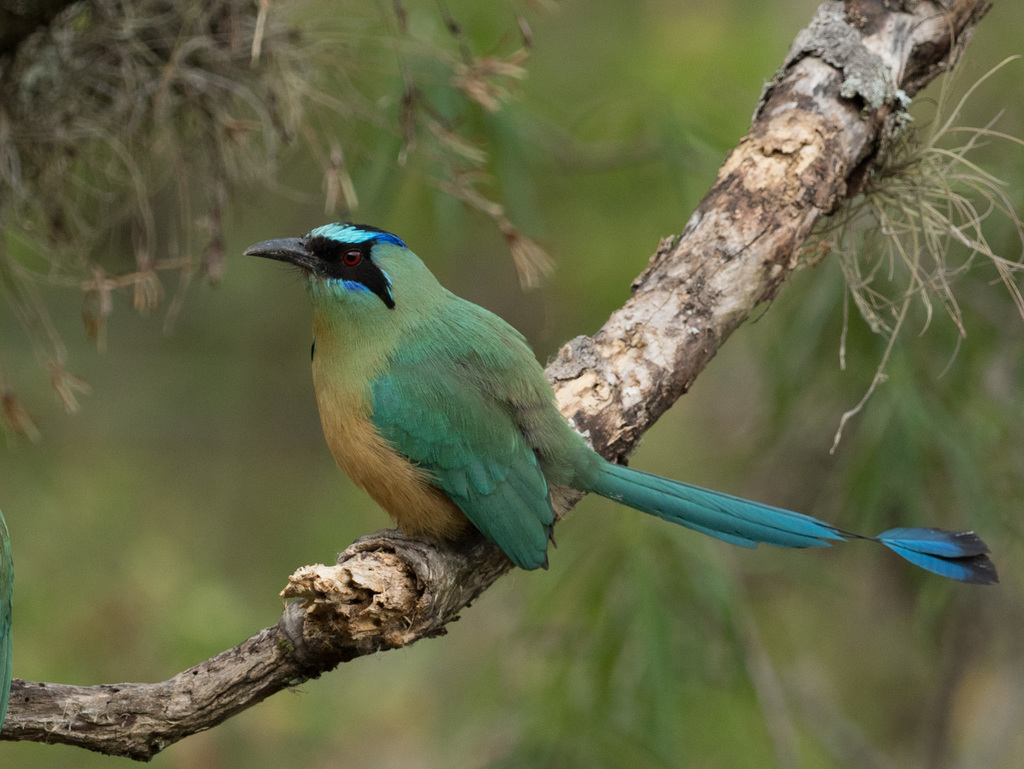
Whooping Motmot
Photo © William Stephens
Photo © William Stephens — CC BY 4.0 — Source: iNaturalist photo #64218098Identification
The whooping motmot is a strikingly colorful bird with distinctive plumage that makes it recognizable in its forest habitat. Its back and wings are olive-green, contrasting with dull brown underparts. The crown is black and surrounded by a bright blue band, while a black eyemask bordered in turquoise gives it a masked appearance. The most eye-catching feature is its long tail, which ranges from green to blue with extended feathers that terminate in dramatic racquet-shaped tips, tipped with blue and black. This small to medium-sized bird weighs between 75 and 124 grams.
Range & Habitat
The whooping motmot is found across northwestern South America, with populations in Colombia, Ecuador, Panama, Peru, and Venezuela. The species has four recognized subspecies with somewhat disjunct ranges: the nominate form occurs from eastern Panama through northern and western Colombia; another subspecies inhabits the Guajira Peninsula in northern Colombia; a third ranges from eastern Colombia into northwestern Venezuela; and the fourth is found in western Ecuador and northwestern Peru. These birds favor several types of forest environments, including lowland evergreen and deciduous primary forests, forest edges, and secondary growth forests.
Behaviour & Diet
Like other motmots in the order Coraciiformes, the whooping motmot nests in long tunnels excavated into earth banks, a characteristic shared across the family. The species' diet remains relatively poorly documented, though it is believed to feed primarily on large arthropods. Additionally, it has been recorded eating berries and small lizards, suggesting a varied diet adapted to available forest resources.
Best Time & Places to See It
To find whooping motmots, focus on suitable forest habitats throughout their range in northwestern South America, particularly in primary and secondary forests and forest edge zones. The bird's presence in multiple countries and habitat types offers several opportunities for observation, though specific seasonal patterns are not well documented. Your best approach is to search appropriate forest habitats methodically, listening for the bird's distinctive vocalizations.
Photography Tips
The whooping motmot's vibrant plumage and long tail make it an attractive photographic subject. The striking blue crown band, turquoise-bordered eyemask, and ornate tail feathers with racquet tips provide excellent compositional elements. The bird's relatively small size means you'll benefit from a telephoto lens. Since it inhabits forest environments, be prepared for challenging lighting conditions typical of forest interiors, and patience will be essential when searching through the canopy and mid-story vegetation.
Cerros de Amotape National Park
District of San Jacinto, Ecuador
+246 birds+1 mammals
Arid mountains rise abruptly from Peru's northwestern frontier, their slopes clothed in xerophytic scrubland and seasonal deciduous forest that transforms these Andean foothills into one of…
VIEW NATIONAL PARKNatural Utría National Park
Alto Baudó (Pie de Pató), Colombia
+372 birds+11 mammals
Where the Chocó's coastal mountains plunge toward the Pacific, Utría National Park preserves one of Colombia's most biodiverse and least-visited wilderness expanses. Sprawling across 1,287 square…
VIEW NATIONAL PARKMorrocoy National Park
Municipio Silva
+290 birds
Where the Caribbean coast of northwestern Venezuela meets protected coastal waters, a mosaic of mangrove forests, sandy beaches, and coral reef systems defines Morrocoy National Park.…
VIEW NATIONAL PARKSoberanía National Park
Cristóbal, Panama
+495 birds+34 mammals
Rainforest and riverine woodland blanket the rolling terrain of this 714-square-kilometre national park in Colón Province, where the Caribbean watershed feeds a maze of streams and…
VIEW NATIONAL PARKChagres National Park
Caimitillo, Panama
+486 birds+19 mammals
Where the Chagres River carves through the humid tropics of central Panama, a vast montane and lowland forest sprawls across more than 2,300 square kilometers, anchoring…
VIEW NATIONAL PARKDarién National Park
Tucutí, Panama
+534 birds+13 mammals
Where the spine of Central America crumbles into wetland and rainforest, Darién National Park sprawls across more than 20,000 square kilometres of some of the tropics'…
VIEW NATIONAL PARKPortobelo National Park
Portobelo, Panama
+366 birds+9 mammals
Where the Caribbean's turquoise waters meet the Darién's verdant shore, Portobelo National Park sprawls across 570 square kilometers of coastal forest, mangrove wetland, and coral-fringed islands…
VIEW NATIONAL PARKNo community photos yet. Log in to add the first one.
No community observations of this species yet.