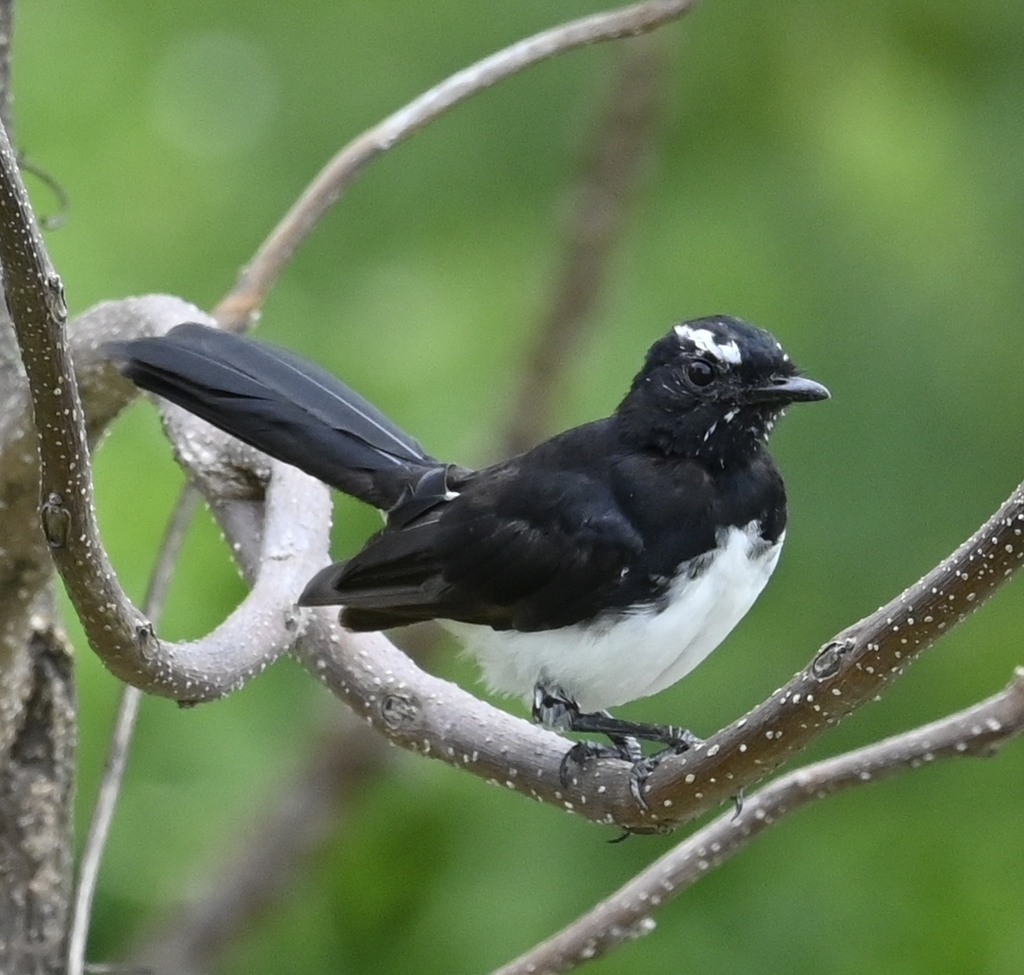
Willie Wagtail
Photo © Micha Baum
Photo © Micha Baum — CC BY-SA 4.0 — Source: iNaturalist photo #435194577Identification
The willie wagtail is a striking small passerine measuring 19–21.5 cm in length, instantly recognizable by its bold black-and-white plumage. The head, throat, upper breast, wings, and tail are jet black, contrasting sharply with pure white underparts. Both males and females share identical plumage, making sex identification impossible by appearance alone. The species possesses longer legs than other fantails—an adaptation to its ground-foraging lifestyle—and a short, slender bill with a characteristic downward hook. Three subspecies are recognized: the nominate form across central and southern Australia, the smaller R. l. picata from the north, and the notably larger R. l. melaleuca from New Guinea and nearby islands.
Range & Habitat
The willie wagtail is native to Australia, New Guinea, the Solomon Islands, the Bismarck Archipelago, and Eastern Indonesia, where it is common and familiar throughout most of its range. This adaptable species thrives in open and semi-open habitats, avoiding only thick forest. It has responded remarkably well to human landscape modification and is now a ubiquitous sight in urban lawns, parks, and gardens across its range, making it one of the region's most frequently encountered birds.
Behaviour & Diet
The willie wagtail is insectivorous, spending considerable time actively chasing prey in open environments. Its common name derives from its distinctive habit of wagging its tail horizontally while foraging on the ground. Despite its small size, this species is notably aggressive and territorial, regularly harassing much larger birds such as laughing kookaburras and wedge-tailed eagles. It features prominently in Aboriginal folklore throughout Australia and New Guinea, where it appears in diverse roles—from a teller of lies and stealer of secrets to a harbinger of successful crops.
Best Time & Places to See It
The willie wagtail's adaptability to human-modified landscapes makes it readily observable in parks, gardens, and urban areas throughout its range. Look for it in open habitats where it actively forages on the ground, pursuing insects with characteristic tail-wagging behavior. Its familiarity with human presence and preference for accessible open spaces makes it one of the most reliable fantails to encounter, particularly in settled areas across Australia and nearby regions.
Photography Tips
The bold black-and-white contrast of the willie wagtail makes it highly photogenic in good light. Position yourself in open areas where the bird forages on ground or low vegetation, allowing you to capture its characteristic horizontal tail-wagging behavior. The species' aggressive territoriality means it may approach closely, offering excellent opportunities for detailed shots. Early morning light best highlights the crisp plumage contrast, while action photography of ground foraging or interactions with larger birds can produce dynamic images.
Aketajawe Lolobata National Park
Annan River (Yuku Baja-Muliku) National Park
Bald Rock National Park
Barrington Tops National Park
Belair National Park
Ben Boyd National Park
Blue Mountains National Park
Boodjamulla National Park
Bouddi National Park
Nothing matches these filters.
No community photos yet. Log in to add the first one.
No community observations of this species yet.