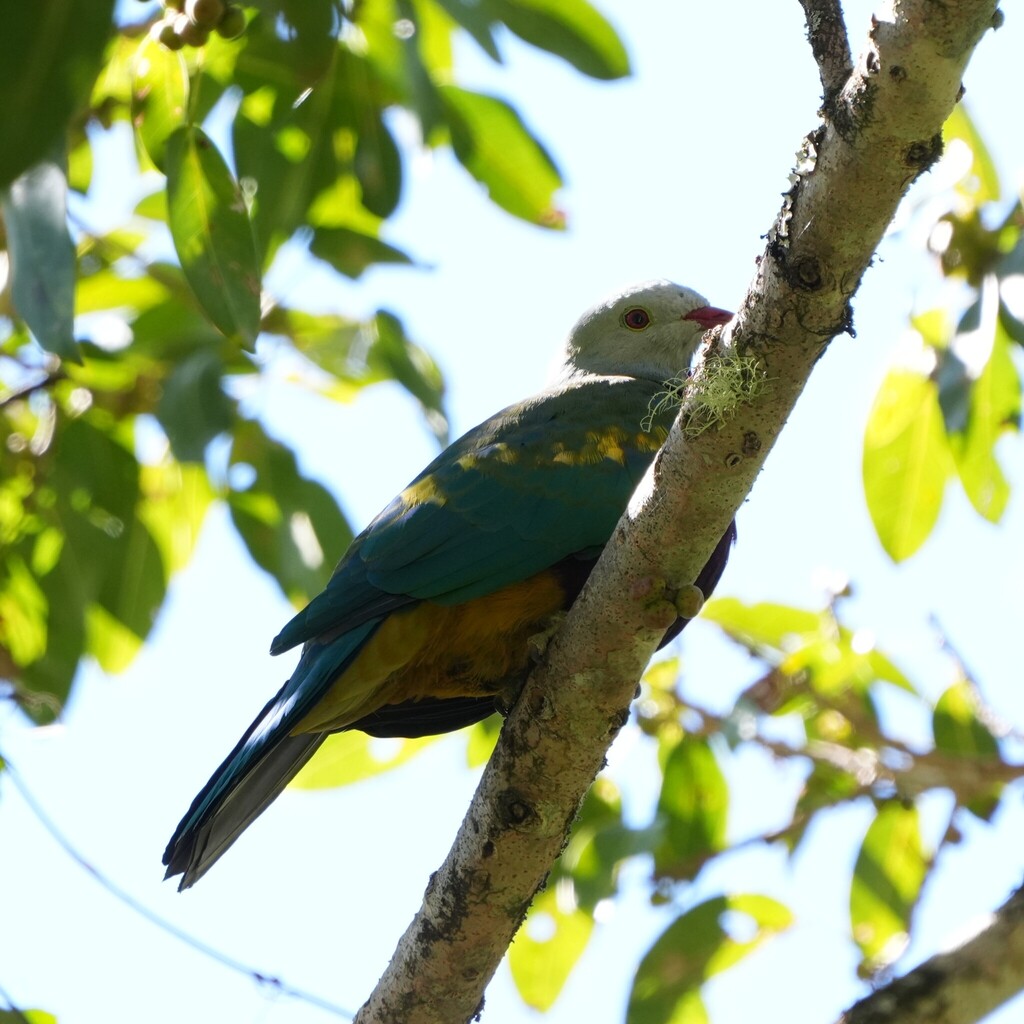
Wompoo Fruit Dove
Photo © themaskedlapwing
Photo © themaskedlapwing — CC0 1.0 — Source: iNaturalist #308109563Identification
The wompoo fruit dove is one of the larger fruit doves native to New Guinea and eastern Australia, measuring up to 45 cm in overall length, though birds in northern regions are generally smaller. The species is unmistakable in its plumage: striking purple colouration adorns the neck, chest, and upper belly, while the lower belly is bright yellow with green underparts. The sexes are similar in appearance, though juveniles display duller, greener plumage than adults. Despite their vibrant colouration, these doves are surprisingly inconspicuous, remaining hard to spot amongst the forest canopy thanks to their quiet and unobtrusive habits. Their distinctive call—a loud "wollack-wa-hoo"—often sounds remarkably human and is frequently the first indication of the bird's presence.
Range & Habitat
Five subspecies of wompoo fruit dove are recognised across a wide distribution. In New Guinea, they occur from the Raja Ampat Islands and Bird's Head Peninsula in the northwest, throughout central, northeast, and southeast regions, including nearby islands such as Yapen, Manam, Bagabag, and Karkar. The species also inhabits eastern Australia, where populations range from the far northeast of Cape York Peninsula south through Queensland to central New South Wales. The wompoo fruit dove inhabits rainforests where fruit-bearing trees are abundant, remaining sedentary and preferring to stay within their local area rather than undertaking long journeys.
Behaviour & Diet
These fruit doves are highly specialised frugivores, feeding on a diverse range of rainforest fruits depending on seasonal availability. Their diet includes figs (particularly Ficus species), cinnamon, palm fruits, and annonaceae, among many others. Remarkably, despite their modest size, they can swallow whole fruits up to 2 cm in diameter and demonstrate acrobatic skill in collecting fruit from trees and vines. They can occasionally supplement their diet with insects. Wompoo fruit doves congregate in large flocks where food is abundant, exploiting whatever fruits are in season locally.
Breeding timing varies according to weather conditions. Both sexes construct a sturdy nest from forked twigs positioned not far from the ground. A single white egg is laid, with both parents sharing incubation and chick-rearing duties. If the chick dies, the pair may attempt a second breeding in the same season.
Best Time & Places to See It
The wompoo fruit dove is widespread and common throughout its large range, making it a reliable sighting in suitable rainforest habitats. Locating these birds often depends on finding fruiting trees; listen for their distinctive human-like calls, particularly in areas where figs or other preferred foods are abundant. Seasonal fruit availability (October–March for many fig species, August–October for palms) may influence local concentrations, offering better viewing opportunities during peak fruiting periods.
Photography Tips
The wompoo fruit dove's vibrant purple and yellow plumage is highly photogenic, but patience is essential given their quiet, canopy-dwelling nature. Position yourself near fruiting trees in rainforests and listen carefully for their calls to locate individuals. Early morning hours often provide the best light and activity levels. A telephoto lens is necessary to capture distant canopy birds, and expect challenging lighting conditions beneath the rainforest canopy—fast film speed or high ISO may be required. The contrast between their purple and yellow plumage can be striking when well-lit, rewarding patient photographers with spectacular images.
Nerang National Park
Gold Coast, Australia
+126 birds+13 mammals
Steep subtropical rainforest clads the hinterland ridges of southeast Queensland's Gold Coast, where Nerang National Park sprawls across 34 square kilometres of protected bushland between the…
VIEW NATIONAL PARKHerberton Range National Park
Australia
+115 birds+10 mammals
Rainforest-clad ridges and rocky outcrops define this 324-square-kilometre reserve in far north Queensland, where the mountainous terrain of the Herberton Range rises through layered eucalypt woodland…
VIEW NATIONAL PARKDaintree National Park
Dedin, Australia
+362 birds+37 mammals
Daintree National Park is one of the world’s oldest and most biologically diverse tropical rainforests, protecting an extraordinary landscape where ancient forests meet the Great Barrier…
VIEW NATIONAL PARKLamington National Park
Australia
+227 birds+24 mammals
Where subtropical rainforest rises steeply from the Queensland coast, Lamington National Park spreads across 541 square kilometres of one of Australia's most biodiverse mountain landscapes. The…
VIEW NATIONAL PARKEndeavour River National Park
Philadelphia, Australia
+203 birds+1 mammals
Where the Endeavour River winds through northeastern Queensland's tropical lowlands, a compact mosaic of rainforest, open woodland, and riverine corridor creates one of Australia's most ecologically…
VIEW NATIONAL PARKGlass House Mountains National Park
Australia
+151 birds+8 mammals
Conical peaks of volcanic origin rise dramatically from the coastal lowlands of southeastern Queensland, their weathered slopes cloaked in eucalyptus woodland and open sclerophyll forest that…
VIEW NATIONAL PARKBribie Island National Park
Brisbane, Australia
+284 birds+20 mammals
Across tidal flats and shallow waterways north of Brisbane, Bribie Island National Park spreads across nearly four hundred square kilometres of subtropical coastal wilderness—a patchwork of…
VIEW NATIONAL PARKNo community photos yet. Log in to add the first one.
No community observations of this species yet.